Month: May 2024

Skills or Degrees? You may need both to thrive

By Nusaiba Ibrahim

For over a year, I have been working alongside other creatives in my department after I assumed my role as a content writer and website manager with a higher education institution. The department in which we work is formally referred to as the Media and Communication Department, but somehow, maybe before I joined, it became known as the Creative Department.

Whenever we attend a meeting, we are termed the creatives. Only along my journey did I realise that two or three of the team members had undergone degrees in disciplines that had little or no bearing on the creative industry. The team—a social media manager, a content writer or website manager, a graphic designer, a motion designer, and a creative support staff member—has one thing in common: we possess skill sets that are within the creative industry. Yet, we all have degrees.

During our usual chitchats, I realised that the social media person I had met was a history graduate with a second degree in the same field. He’s doing wonderfully well today in Lagos because of his exquisite skills as a brand marketer and manager. The new staff member who assumed the role is a biology graduate; the motion designer studied industrial design; the graphic designer and I studied mass communication; and the creative support staff studied quantity survey and obtained a postgraduate diploma in the same field.

From the faculty to operational staff to even students, the creative department comprises geniuses skilled in producing exceptional creative pieces that would be admired by the university’s community and beyond. Hence, the department is admired by many. Simple casual discussions with students and staff, whether in or out of the office, never ended without passionate statements like “I will stop by to learn one or two things” or “I’ll come to learn a few things.”

When I was putting this piece together, a faculty member, a friend of the creative department, had come in to drop a request. While going out of our office, he was tempted to read the title of the article. He read it carefully and said, “I think I disagree with you. I am of the opinion that skills are better than degrees.” I turned and tried to explain that the topic didn’t mean degrees were superior to skills or vice versa. They could be used to complement each other when necessary.

This particular faculty member only left me with more thoughts about the debate. He’s a faculty member with a B.Sc. and Master’s degree in International Relations and is very much appreciated by the institution due to his expertise in teaching. He is yearning for a skill set. I understand he must not have realised he could do well as a public speaker, as that is what he’s most notable for. Hence, he didn’t value his proficiency in public speaking, which is now widely applauded. Later that day, he came into our office to further explain his passion for learning graphic design or motion design.

With these current debates, which have awakened people’s desire to invest more in skill sets, I think we are on the path to building the future we’d envisioned to be far. We are getting closer to a better Nigeria. Nonetheless, you might still need a solid foundation from degrees that will familiarise you with values and etiquette that will propel your career.

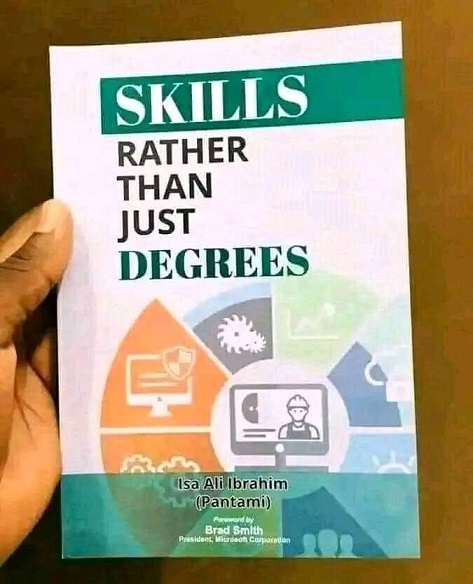
I’d say this regarding the book title by Prof. Pantami, ‘Skills rather than Just Degrees’, that stirred the Arewa atmosphere a week ago (which I haven’t read). I’m only saying this based on the evident experiences of the revered scholar and the book title. Sheikh Pantami possesses three degrees: a B.Sc., an M.Sc., a Ph.D., and other academic qualifications. He is also a distinguished Islamic scholar who has been lauded adequately due to his skills in teaching Islamic education through his exceptional preaching.

To showcase the relevance of having both, the Sheikh used his wealth of technology experience to serve as a minister and accepted a professorial award (which has generated so much back-and-forth). In the process of serving as one of the ministers under former President Buhari, he definitely acquired more administrative and political skills, making his career stronger.

So you see, the title wouldn’t have become a bone of contention if people had realised the Sheikh was writing to explain the benefits of obtaining both, but just a little bit of emphasising skills. But works of art unleashed on the world are open to criticism. This is something authors and artists cannot control; hence, the Sheikh faced reactions due to his publications.

One of the things I’ve learned amid other creatives is skills and academic upgrades. I tell you, we’ve learned so much from each other. We often see ideas from similar perspectives when it comes to designs, motion graphics or writing. Three out of four yeses is always a pass for any content. We have become part of one another’s journey and a great team. Despite our skill-based engagements, we’d encourage one another to further our degrees.

Whether you have skills or degrees or both, use what you have to get what you want in life. With degrees, you can pursue a particular area of interest and gain something extraordinary. Likewise, with skills, you can also realise your potential. So, the big idea is to use any of the two to gain something beneficial for yourself.

Nusaiba Ibrahim Na’Abba wrote from Kano. She can be contacted via nusaibaibrahim66@gmail.com.

Controversy erupts in Kano as emirate councils law repealed, Sunusi reinstated

By Uzair Adam Imam

The Kano State House of Assembly has repealed the Kano State Emirate Councils Law, which had established five new emirates in Kano, Gaya, Karaye, Rano, and Bichi during the administration of former Governor Abdullahi Umar Ganduje.

The law’s repeal, following its third reading on Thursday, has elicited mixed reactions among Kano residents.

The abrogated law will require district heads who were elevated or appointed under it to revert to their previous positions.

When the law was initially established in 2019, there were fears that it might politicize the traditional emirate system.

Kano residents expressed their opinions on social media, with some viewing the repeal as a politically motivated move, while others saw it as a step towards restoring the integrity of the emirate council.

Critics of Ganduje’s administration argue that the creation of new emirates undermined the traditional system.

Every new government to bring with it new emir

Dr. Ibrahim Siraj, a political analyst and lecturer at Bayero University, Kano, criticized the development, warning that it could lead to every new government appointing a new emir, thereby politicizing the emirate system.

“An interesting precedent has been set here in Kano: every change of government will bring with it a new emir and an entirely different emirate system,” he said.

He lamented that this could lead to numerous living but non-serving emirs, breaking the tradition of lifelong service.

Abdulyassar Abdulhamid expressed a broader concern, stating, “My concern is not about the emir’s removal or the installation of a new one. But a theory I have been nourishing for some time is giving way to reality.

“The struggle, the loudmouth(ness), the so talked-about intellectualism is about an excessive desire to be on a throne. Nothing more,” he added.

Ado Garba noted that those who supported the previous government’s decision to create new emirates were now seeing the repercussions.

“But because the majority of us are not sincere, they refused to see reasons. Now, here we are. Ganduje will never be forgiven by the good people of Kano,” he said.

Atiku Mu’amun Bello highlighted the anomaly of having one person potentially serving as both the 14th and 16th Emir of Kano.

“So we will just call him ‘former emir’ when he eventually leaves or is dethroned,” he added.

History repeats itselfUman Garba, reflecting on the historical context, stated, “There is nothing new on earth. Just history repeats itself. Let us simply accept the fate and move on.”

Abdulmalik Shu’aibu emphasized the importance of the emirate councils and questioned the motives behind the repeal by Governor Yusuf and Rabi’u Musa Kwankwaso.

“If truly Governor Abba and Kwankwaso love Kano, they shouldn’t have underestimated the tremendous contribution by the emirate councils in the state,” he asserted.

Yusuf Umar Yaro described the repeal as political retaliation, arguing that it was not aimed at the development of the state or its people.

The repeal of the Kano State Emirate Councils Law has sparked significant debate, reflecting deep divisions over the role and politicization of traditional institutions in Kano.

Court halts reinstatement of Sanusi as emir of Kano

By Uzair Adam Imam

A Federal High Court in Kano has issued an order halting the reinstatement of Muhammadu Sanusi II as the Emir of Kano.

The court’s decision came in response to a lawsuit filed by Alhaji Aminu Bappa Dan Agundi, also known as Sarkin Dawaki Babba, on Thursday.

Justice A.M Liman, the presiding judge, granted an interim injunction suspending the implementation of the repealed Kano Emirate law, which aimed to reinstate Sanusi II as the Emir.

The court ordered that the operation of the Kano State Emirate Council (Repeal) Law, 2024, be suspended, affecting all offices and institutions created under the provision of the Kano State Emirate Council Law, 2019.

The court also restrained the 5th to 8th respondents (not specified in the report) from enforcing, executing, or implementing the repealed law.

Additionally, the court ordered the maintenance and preservation of the status quo by all parties involved, pending the hearing and determination of the plaintiff’s originating motion.

The court also granted an order for an accelerated hearing on the matter.

This development means that Sanusi II’s reinstatement as Emir of Kano has been put on hold pending the court’s further decision.

Return of Sunusi: The dilemma ahead

Mohammad Qaddam Sidq Isa (Daddy)                     

The return of Muhammadu Sunusi ll as Sarkin Kano is yet another manifestation of the influence of politics on the traditional Masarauta establishment, which, after all, has always been used and abused by politicians.

Since the British conquest of the Usman Dan Fodio Islamic sultanate in what subsequently became part of today’s northern Nigeria, the enthronement and dethronement of emirs (Sarakuna) have always been motivated by underlying political interests. 

Throughout the colonial era, the British would only enthrone aspiring princes deemed the most loyal to the British colonial establishment as leaders of their respective emirates. This practice enabled them to maintain their colonial grip through those proxy-Sarakuna. And since then, successive generations of military and civilian administrators have followed suit, enthroning and dethroning Sarakuna literally at will. 

The only shift in this regard is that, in the past, the influence of political leaders would mostly come to play only when a throne became vacant mainly due to the death of the Sarki, when the incumbent governor would influence the emergence of his successor, as it happened in 2014 in Kano that led to the enthronement of Sunusi. However, now that the trend is becoming systematic, it will indeed, if left unchecked, render the reins of Sarauta effectively tenured, subject to the tenure of the governor behind it. 

After all, just like his enthronement in 2014 by then-Governor Rabiu Musa Kwankwaso and his subsequent dethronement in 2020 by then-Governor Abdullahi Umar Ganduje, Sarki Sunusi’s return to the Kano throne remains politically motivated within the context of the power struggle in Kano politics between Kwankwaso and Ganduje, two provincial vindictive enemies hell-bent on finishing off each other.  

By the way, as a subservient Kwankwaso ‘boy’, Governor Abba Kabir Yusuf himself is a mere fighting tool in the hands of his godfather in the struggle. 

Interestingly, Kwankwaso has tactically put his vengeful mission against Sunusi on hold for now, pending finishing off Ganduje and his legacy. 

Sunusi incurred then-Governor Kwankwaso’s wrath as a then-Lagos-based bank executive when he kept dishing out disparaging criticisms against Kwankwaso and his government. For instance, in an article he titled “The Kwankwaso Phenomenon”, Sunusi described then Governor Kwankwaso as a “rural aristocrat” who “surrounds himself with provincials and places key posts in the hands of rural elite”. He also compared Kwankwaso’s government to “the classic comedy of the Village Headmaster in a village council”. 

Kwankwaso got mad at Sunusi and demanded his sacking by his then-employer, United Bank for Africa (UBA). He threatened to stop his government’s dealings with the bank in case of non-compliance. 

Anyway, now that Sunusi is back, it remains to be seen how it plays out between him and Governor Abba, considering Sunusi’s penchant for publicity stunts involving controversial utterances against government policies and wrongdoings. 

As much as Sunusi is excited about his return to the Kano throne, the development represents a tricky dilemma for him that also tests his supposed commitment to outspokenness against government wrongdoings. 

On the one hand, Governor Abba won’t tolerate his stunts in the name of outspokenness; no governor will, either. And unless he (Sunusi) has, this time around, decided to desist from his stunts to keep his throne, Governor Abba, under Kwankwaso’s influence, won’t hesitate to go to any extent, including dethronement, to deal with him. 

On the other hand, his distance from his stunts would undoubtedly mean the end of the reputation he has somehow earned as an outspoken critic of government wrongdoings.  

Mohammad wrote from Dubai and can be reached via mohammadsidq@gmail.com.

Sanusi Lamido reinstated as Emir of Kano, dothroned emirs ordered to vacate palaces

By Uzair Adam Imam

Governor Abba Kabir Yusuf of Kano State has reappointed Malam Muhammadu Sanusi II as the Emir of Kano, a position he was removed from in 2020.

The governor announced the appointment on Thursday at the Government House, shortly after signing the Kano Emirate Law as amended.

The signing ceremony was attended by the Deputy Governor, Speaker of the State Assembly, and other principal officers of the government.

With this development, Sanusi II has been officially reinstated as the Emir of Kano.

In a related development, Governor Yusuf has directed the five former emirs of Kano, Bichi, Rano, Gaya, and Karaye to vacate their palaces within 48 hours, starting from 5:00 pm on the day of the announcement.

They have also been ordered to hand over all properties in their possession to the Commissioner for Local Government/Deputy Governor.

This move is seen as a reversal of the decision made by former Governor Abdullahi Ganduje, who had dethroned Sanusi II in 2020 following a personal rift.

More details to follow…

House of reps passes bill to bring back old national anthem

By Uzair Adam Imam  

The House of Representatives has passed a bill to revert to the old national anthem, “Nigeria, We Hail Thee”, in a swift move that saw the bill pass through first, second, and third reading within minutes. 

House Leader, Professor Julius Ihonvbere, led the debate, arguing that the old anthem is a national symbol and sign of authority that acknowledges the country’s realities.  

He stated the need for Nigerians to embrace the anthem as a unifying force. 

However, Minority Leader, Kingsley Chinda, opposed the bill, citing the colonial origins of the old anthem, which was authored and composed by Britons.  

He questioned the timing of the bill, given the more pressing challenges facing the country. 

Despite Chinda’s objections, the bill received expedited passage and was subsequently passed by the lawmakers.  

The move marks a significant change, as the old anthem was replaced with the current one, “Arise, O Compatriots”, in 1978.

No invasion of Kano Emir’s palace, DSS clarifies

By Uzair Adam Imam 

On Thursday, the Department of State Service (DSS) denied media reports that it invaded the Emir of Kano’s Palace, saying they were untrue. 

The state Director of DSS, Mr Muhammad Alhassan, said this when he spoke with reporters in Kano.

Alhassan said that the DSS only deployed its personnel to the palace as part of a security arrangement for the First Lady, Mrs Oluremi Tinubu’s visit to the Emir. 

He said, however, that the personnel were withdrawn following the postponement of the visit due to the Emir’s absence from town.

He said there was no truth in the report alleging that DSS operatives stormed the Emir’s Palace in connection with the recent development at the State House of Assembly. 

He urged Nigerians to disregard the false and malicious report, which he said was intended to cause unnecessary tension and misinformation.

On Thursday, the State House of Assembly repealed the Kano Emirates Council Law 2019, thereby dissolving the Emirates of Bichi, Gaya, Karaye, and Rano.

The return of Sanusi

By Aliyu Nuhu

I have read the amended Kano Emirates law, which was brief, concise and straight to the point, to achieve certain ends. It is a promise fulfilled by the new NNPP government. Engr. Rabiu Musa Kwankwaso had said time without number that if elected, the government would repeal the Dr Abdullahi Umar Ganduje-led Emirates laws.

If Governor Abba Kabir Yusuf signs the amendment into law (which is a certainty), it will remove the present emirs from their offices and return all the Ganduje creation of first-class emirs back to district heads (hakimai). The affected emirs are those of Gaya, Rano, Karaye and Bichi.

The new law gives the governor the power to either re-appoint them hakimai or remove them and search for new ones.

Until the coming of this new law, I thought that Muhammadu Sanusi II’s return was impossible, as it had no precedence in the history of the Kano emirate. But after talking to officials and people who know the workings of the government, it appears certain that Sanusi will return to his throne, in fact, soon enough to preside over the coming Eid-Kabir prayer. 

Nothing is certain yet, but nothing is impossible, thanks to political intrigues and the need for the new government to reverse Ganduje’s legacies. There is no love lost between Kwankwaso, Abba, and Ganduje.

For my own views, I support the amendment of the Emirates laws and the return of a strong Kano emirate, but I don’t support Sanusi’s return as emir of Kano. The current Emir of Kano, Aminu Ado Bayero, is doing well and is loved by the people. 

I don’t support Sanusi’s return. I know he has not learned a lesson and will still come back and meddle with Kano politics, attack Abba and his government, and continue shooting his mouth as if he is an ordinary person. People who sit on the Kano throne don’t talk too much. He must also not try, like his grandfather did to Sardauna, to outshine the Kano state governor.

In history, there was an incident where the then-Emir Muhammadu Sanusi shamed Sardauna in the Kano race course parade ground by attracting a standing ovation with the Sardauna seated. The premier of Northern Nigeria considered it an affront to himself as the Emir stole the spotlight by arriving in full splendour and pageantry, and the whole assemblage had to stand up for the Emir in traditional homage and honour. It was a percussion to the dethronement of Emir Sanusi of Kano.

The grandson Sanusi Lamido Sanusi has inherited those tendencies from his grandfather, and I daresay when it comes to attacking and criticizing the government, Kwankwaso/Abba don’t have the patience, and if you like to call it table manners of Ganduje. They will throw out Sanusi in a blink of an eye.

They said a leopard never changes its colours. But time will tell.

Until then.

JUST IN: Kano assembly repeals emirates council law

By Uzair Adam Imam  

The Kano state house of assembly has passed the Kano Emirates Council Law (Repeal Bill) 2024 after scaling its third reading.  

The law has abrogated the establishment of five new Emirates in the state. All offices established under the repealed law have been set aside by the new bill. 

Also, all district heads elevated or appointed under the repealed law are to revert to their previous positions. 

The Kano State Emirates Council (Amendment number 2) Law, 2024, was sponsored by the Majority Leader and member representing the Dala Constituency, Lawan Hussaini Chediyar Yan Gurasa.  

The law, which created five new emirates, was first assented to by ex-Governor Abdullahi Umar Ganduje on December 5, 2019. 

A principal officer of the assembly, who did not want his name mentioned, said, “No Jupiter can stop the assembly from amending the law.”

Police officer shot dead by colleague in Jos

By Uzair Adam Imam  

A police officer attached to the enforcement team of the Jos Metropolitan Development Board (JMDB) was reportedly shot dead at Terminus Market, Jos, the capital of Plateau State.  

Security operatives, including policemen and soldiers, have been mobilised by the state government to carry out enforcement against street trading in the area.  

The security operatives were stationed around Terminus Market to ensure total compliance with the law. 

Ibrahim Musa told our correspondent that the police officer was hit by a stray bullet fired by one of the security men patrolling the area.  

He said, “Around 12 o’clock on Wednesday, the security personnel were pursuing traders when suddenly, an officer mistakenly shot the policeman in the neck, and he died instantly. Moments later, officials of the Road Safety Corps evacuated the corpse to a hospital.” 

An official of the market, who wished to remain anonymous, also confirmed the development, saying the officer was mistakenly killed by his colleague.  

The situation caused tension in the area, resulting in the firing of teargas canisters to disperse the crowd. 

When contacted, the spokesperson for the state police command, DSP Alabo Alfred, said the police were investigating the matter.