
By Abubakar Idris Misau
At first glance, the words “Deserting” and “Desertification” sound almost identical and, taken together, seem to make no sense; ironically, however, especially as intended here, they are the antagonists who jointly tell us what we must do to save life on Earth. Sorry, let me explain.
It was my elementary school Maths teacher who first taught me that multiplying two negative numbers yields a positive result. I had to concede later that this isn’t a conspiracy. If it were, it would never have been corroborated by our English teacher. The two core-subjects’ teachers were staunch enemies [I mean, non-friends]; yet the latter said there’s a similar rule in linguistics and semantics about what is called the “double negatives”.
Since deserting literally means abandoning something, it seems negative. By contrast, desertification, the process by which fertile, productive land becomes arid and desolate, is so dangerous that it no doubt qualifies as another negative. Following the arithmetic-linguistic logic of double negatives, therefore, “deserting”, as used in this piece, becomes an honourable cause. Simply put, deserting desertification does not mean running away from what one needs to care for, but rather abandoning our harmful habits that are turning our green, fertile lands into dry, lifeless deserts. In other words, desertification is a call to action to change how we treat the surface of our dear mother Earth.
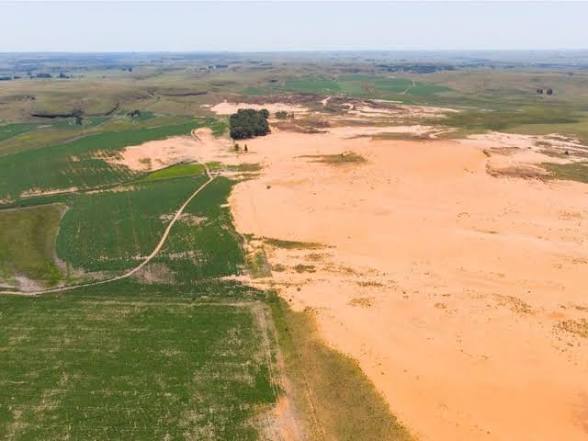
Come to think of it, Mother Earth is the only mother whose children are hell-bent on turning her barren, out of greed. We do this by double-dealing, on the one hand with the mother and on the other with her enemies. It seems to me as though we love coming to her in the morning, saying “Oh, Mama, give us today our daily bread”, and then going behind her back and setting the bakery on fire at night! I mean, it’s no different when the so-called most intelligent species, numbering up to 8 billion, dedicates its intellect to deforestation, overgrazing, poor agronomic practices, open-pit mining, and other unsustainable land-use practices that strip land of vegetation, exhaust soil nutrients, and disrupt the water cycle; all while expecting the mother to keep providing us with every ecosystem service as if nothing happened. But it is simply an “inevitable consequence of nature” [to borrow from Prof. Brian Cox] that when we stretch dryland ecosystems to their breaking points, they turn into arid wastelands – read: deserts – or, more appropriately, “sandlands”.
As a matter of fact, whichever way one sees the bad guy, the truth is that Mr Desertification hardly ever acts alone. In the Sahelian ecological region of Northern Nigeria and other regions globally, he almost always works with Madam Earth’s children to damage her reproductive organs. Now, that’s a bad revelation. Meanwhile, the good news is that not all her children are the same. Some good Samaritans have even been working to extinguish the fire, in which case they deserve some support; some conspire against her out of ignorance, in which case they can do with some education; and so on – hence this call to action.
Here, forgive me for introducing the Greek philosopher Aristotle. It was his idea that writers, in fulfilling their duty, should try to structure arguments around the three fundamental pillars [modes] of persuasion, the rhetorical triangle: Ethos, Pathos, and Logos. Ethos concerns the communicator’s credibility; Pathos, the audience’s emotions; and Logos, the logical reasoning contained in the presentation.
Long story short, since this writer is not an authority on the subject in question, he ought not to suggest any social behavioural change straight out of his moro-moro head. He is simply to convey the message of the world’s most credible Who’s Who on the issue: namely, the United Nations Convention to Combat Desertification (UNCCD).
According to the UNCCD, humanity destroys about 10, 20, 30, 40, 50 …100 million hectares of productive land every year. The first time I read this, I was shocked. I knew that we cleared up to 10 million hectares of forest land annually, but I didn’t know that we were destroying the rangelands, grasslands, and so on at that rate. For perspective, damaging 100 million hectares of land annually is equivalent to losing the whole of Egypt. Or, better still, destroying the equivalent of four football fields every second. Most probably, this message would make more sense to us if the changes were happening right before our eyes. Imagine two countries playing a game in the ongoing World Cup, only for the stadium to turn into a total desert in a second. The World Cup would likely be asked to give way for an emergency UNCCD Summit.
In fact, there is no doubting it, the more land we allow to desert encroachment, the more likely we are to go to war with each other. That is why, in 2020, during a UN Security Council meeting to discuss ‘Maintenance of international peace and security: the humanitarian impact of environmental degradation and peace and security’, Ibrahim Thiaw, Executive Secretary of UNCCD, said: “In arid lands, such as in Africa’s Sahel region, violence often erupts over competition for access to depleted land and scarce water resources.” He then went on to outline three factors that are adding fuel to the fire: over-dependence on natural resources by rural dwellers; shrinking resources due to land degradation, drought, and climate change; and high population density.
All of these are self-evident. In Northern Nigeria, the conflict between farmers and herders over scarce natural resources is a vivid case of that. It’s also common knowledge that Lake Chad has lost up to [a staggering] 90% of its surface area since the 1960s, shrinking from 26,000 km2 in 1963 to as low as <1,500 km2 in 2018 when the United Nations Environment Programme (UNEP) published the story “Tale of a disappearing lake”. These affect millions of people.
There is no question whatsoever: drylands are the closest bus stops to deserts and are therefore the major victims of desertification. Now, let’s go back to Bonn to collect some statistics from the UNCCD again. Covering up to 41% of the earth’s land surface, mainly in developing countries of Africa and Asia, drylands are home to more than 2 billion people. And because more than 70% and 20% of them are rangelands and grasslands, respectively, half of the world’s livestock and up to 44% of crops are produced from drylands. How essential are they?
Meanwhile, right now, as scientists say, up to 40% of the world’s land is already degraded, directly affecting over 3.2 billion people. Also, land degradation and droughts cost the global community an estimated eye-watering $878 billion every single year. Isn’t that a lot of money to squander on making the earth look like the surface of Mars, huh?! For me, turning the green planet into another red planet is a cold, dry, bitter joke.
As the Roman Philosopher-Emperor Marcus Aurelius put it 18 centuries ago, “You can commit injustice by doing nothing”. Indeed, this is an issue on which neutrality is complicity. It now makes more sense to me what one of my mentors once told me, for which I must quote him verbatim: “Mr Idris”, he said, “you see, doing nothing is such an expensive hobby…” Suffice it to say that if we continue to ignore this crisis, the financial and physical hangover will be brutal. Well, it actually already is.
I don’t want to go into a discussion of the need for governments and big corporations to invest $1 billion a day until 2030 to meet global land restoration targets, which, in fact, is precisely required. I know it might sound like a hefty price tag, but it is actually the ultimate buy-one-get-one-free deal. We know for a fact that for every $1 invested in healthy land, the economic return ranges from $7 to $30. It turns out that, under this realistic assumption, saving the planet is highly profitable.
While not everything can be detailed in an article this short, addressing desertification isn’t rocket science. We know how to do it well enough. The solution simply requires a massive shift. We first need to address deforestation and work toward restoring already degraded lands. Farmers need to switch to smart agricultural methods that protect the soil. If we can save rainwater and give the soil periodic holidays to “fallow”, we definitely can stop the deserts from winning. I tell you all these because I have a modest understanding of the basics. After all, I am a development practitioner who envisioned a climate-resilient, food-secure sub-Saharan Africa and whose work and current focus span sustainable land-use practices, assisted natural regeneration, and agroforestry and livelihood systems in Nigeria.
In 1994, the UN General Assembly established the UNCCD and declared June 17 as the World Day to Combat Desertification and Drought. Since then, June 17 has been commemorated to raise awareness of solutions to land degradation, drought, and desertification. The theme for this year, 2026, is “Rangeland: Recognise. Respect. Restore.” As this writer presumes we all know what rangelands are, it’s fair to allow relevant MDAs, such as the Ministries of Agriculture, Environment, and Livestock, and initiatives such as the African-led Great Green Wall Initiative, to deliver their mandates in peace. At the same time, we equally do our parts as individuals and as groups.
Therefore, the choice before us is simple, yet likely embarrassing depending on how we manage it. We can either continue on our current path, in which case we will watch our favourite green spaces turn to dust, or we can take a stand today to save life on land. Because if we don’t desert our destructive habits right now, the desert is going to move in and claim our dessert (dessert, not desert). My ancestors would say, “Dabara ta rage wa mai shiga rijiya.”
There I lie.
Abubakar Idris Misau, a Forestry and Wildlife graduate from the University of Maiduguri, writes from Akure, Southwest, Nigeria. He is reachable via email abubakar.consult@gmail.com.