
By Ibraheem A. Waziri
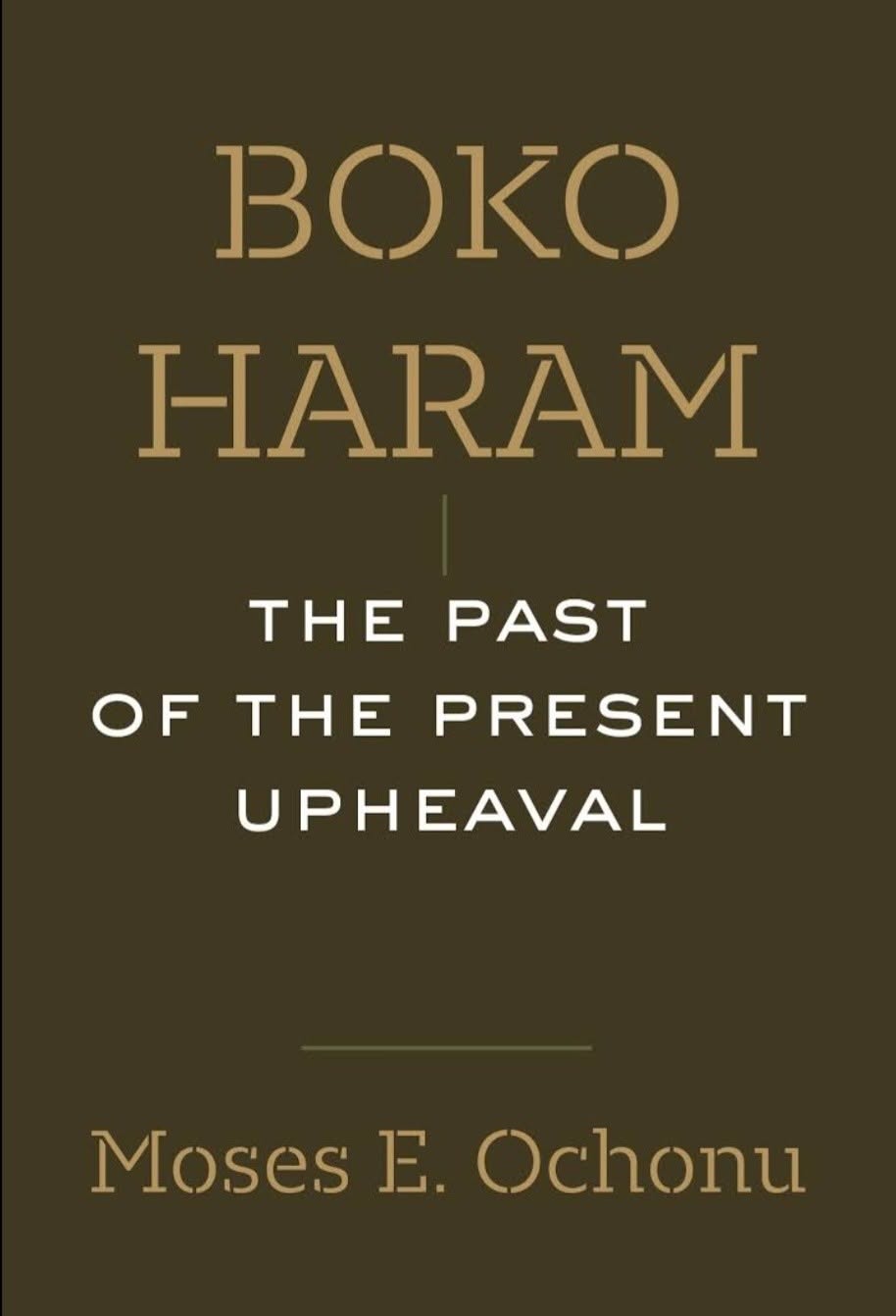
Moses E. Ochonu, Boko Haram: The Past of the Present Upheaval, University of California Press, Oakland, 2026.
There are books that inform, books that provoke, and, rarer still, books that compel you to interrogate not merely their subject but the assumptions through which it has long been misread. Moses E. Ochonu’s Boko Haram: The Past of the Present Upheaval belongs, in large measure, to this last category. It is a serious, learned, and often illuminating work. It is also, at a foundational level, a work that mistakes genealogy for inheritance. In a region where the stakes of historical narrative are measured in mass graves rather than academic citations, that error deserves honest reckoning.
Let me be clear from the outset: Ochonu is no lightweight, and no serious reviewer should pretend otherwise. His central argument, that Boko Haram did not emerge in a historical vacuum but must be situated within a long tradition of Islamic reform, dissidence, and theological contestation in Northern Nigeria, is not only defensible but necessary. His four-phase map of postcolonial Muslim dissidence, from Sheikh Abubakar Gumi’s pragmatic shiga a gyara (enter to reform) politics, through the revolutionary “Islam Only” radicalism of the 1980s, to the Salafi fence-sitting of the 1990s, to the full-blown jihadism of Muhammad Yusuf, is genuinely useful. His insistence that Boko Haram be studied as a rational, calculating actor rather than dismissed as inexplicable barbarism reflects an intellectual courage sorely needed in the debate. All of this deserves acknowledgement.
But respect for a scholar’s craft does not require silence about where it occasionally leads him astray. After sustained engagement with this book, I find that Ochonu’s historical genealogy – meticulous and intellectually compelling as it is – ultimately commits the cardinal error of confusing proximity with equivalence. That the Fodiawa jihad and Boko Haram invoke similar texts, deploy similar vocabulary, and emerge from overlapping cultural landscapes does not make them participants in the same civilisational project. Resemblance is not identity. And a genealogy is emphatically not a pedigree.
The fact that Boko Haram claims Dan Fodio does not mean Dan Fodio claims Boko Haram. Throughout history, movements of radically different character have invoked the same ancestors. Revolutionary France invoked Rome. Such invocation tells us about the claimant; it tells us nothing reliable about the legacy claimed.
The Missing Dimension: What the Genealogy Leaves Out
Ochonu’s framework operates almost entirely along the axis of theological and political dissidence, the reformist impulse, the grievance against corrupt rulers, and the appeal to textual authority. What it leaves almost entirely out of view is the civilisational dimension of Northern Nigerian history: the long, patient, and extraordinarily durable process by which the Hausa-speaking world built not only political orders but also moral architectures, shared systems of meaning, obligation, hierarchy, and dignity that survived dynasties, empires, conquest, and colonial transformation alike.
That moral architecture did not originate with Dan Fodio. It was already ancient when the Fodiawa arrived. The old Hausa city-states and the Kanem-Bornu, which Ochonu himself acknowledges as a sophisticated Islamic civilisation predating Sokoto by centuries, had already created the conditions for a complex society organised around recognisable concepts of hierarchy, obligation, and social responsibility. The Fodiawa did not create this order. They found it, deepened it, gave it sharper Islamic articulation, and codified it in law and administrative structures. This is the real achievement of the nineteenth-century jihad, not that it overthrew the existing order, but that it built upon and consolidated what was already there. The Caliphate succeeded because it was, in the deepest sense, continuous with the civilisation it reformed.
At the centre of that civilisation lies a concept absent from every reformist movement Ochonu analyses, whether in the Fodiawa corpus, the MSSN anthems, or a single Boko Haram sermon. It is the concept that the late Anthony H. M. Kirk-Greene famously described in his landmark essay, “Mutumin Kirki: The Concept of Good Person in Hausa.” Mutumin Kirki, The Good Person, is the civilisational ideal at the heart of Hausa moral order.
The Mutumin Kirki ideal captures something no purely theological analysis can adequately convey: that social legitimacy in Hausa society derives not from ideological purity or reformist credentials, but from kirki, the cluster of virtues encompassing mutunci (dignity), kunya (shame as a moral conscience), responsibility, restraint, and recognition of one’s obligations within the social order. The framework placed duties on Sarakuna and Malamai alike, gave meaning to the roles of Attajirai and ordinary farmers, and even extended its logic to those society defined as marginal. Everyone knew where they stood. Everyone knew what was expected. Dignity required discipline. Power required restraint. And knowledge without wisdom was understood to be incomplete, even dangerous.
Colonialism, for all its violence and extractive logic, largely preserved the structure within which this framework operated. Indirect rule in Northern Nigeria worked precisely because the existing institutions already possessed legitimacy. The Emirates, the Alkali courts, and the hierarchies of office were incorporated into, and in some respects reinforced within, the colonial administrative framework. The resulting order was imperfect, as every historical product is. But it remained broadly legible to the moral universe the Kirki framework had constructed over centuries. In this sense, each successive political order, from Kanem-Bornu to the Sokoto Caliphate to colonial administration, can be understood as a successive tenant of the same civilisational operating system, adapting it, straining it, but ultimately operating within its logic.
The Verdict: Why Boko Haram Is Different, Categorically
Against this backdrop, the comparison between Boko Haram and the Dan Fodio jihad does not merely strain; it collapses. The Fodiawa jihad, whatever its human costs, was oriented towards institution-building. It produced a legal system, an administrative hierarchy, an educational network, a scholarly tradition, a literary culture, and a deepened moral framework that placed obligations on rulers and ruled alike. It expanded the universe of the Mutumin Kirki ideal; it did not attack it.
Boko Haram has done the exact opposite, systematically. It has attacked schools, murdered scholars, destroyed markets, abducted children, and reduced entire communities to rubble. It has not built a single institution that a future generation will inherit with gratitude. It has not produced a single scholar whose work will outlast the insurgency. It has not deepened the social hierarchies in which dignity and obligation are mutually reinforcing; it has weaponised those on the margins of society and enslaved those it was supposed to protect. Whatever else this represents, it is a direct assault on the civilisational operating system that both Kanem-Bornu and the Sokoto Caliphate spent centuries constructing.
Ochonu acknowledges this divergence; he explicitly notes that Boko Haram’s positions “directly contradict major aspects of the Fodiawa reformist creed and statecraft.” Yet within his framework, these divergences occupy a subordinate position. Structurally and rhetorically, the main assertion is the connection. And it is that connection, Boko Haram as participant in Northern Nigeria’s reformist DNA, that lingers in the mind and provides precisely the legitimacy Boko Haram’s ideologues have always craved. This is not a small risk. It is the central vulnerability of an otherwise admirable intellectual project.
Those of us who have observed Northern Nigerian politics, society, and intellectual life across decades, including pundits and commentators who know this civilisation not only from the archive but from the inside, find this framing, however sophisticated its execution, essentially uninitiated. It reads like the work of someone who has mastered the grammar of Northern Nigerian Islamic history with enormous care but has not quite absorbed its spirit: the civilisational confidence, the deep institutional memory, and the quiet but unmistakable recognition shared by virtually every segment of Northern Nigerian society not affiliated with Boko Haram that this movement does not belong to the tradition it claims. It is not reform. It is rupture, a specifically anti-civilisational rupture that the region’s history has not witnessed in any comparable form.
A movement may quote the same texts as its predecessors and still negate them. The Dan Fodio movement built what endured. Boko Haram destroys what was built. That distinction is not a footnote to the history of Northern Nigeria. It is the history of Northern Nigeria.
Final Reckoning: The Question History Is Actually Asking
Ochonu’s book asks: Where did Boko Haram come from? It is a vital question, and the book answers it with real skill. But the deeper question, the one the civilisational history of this region most insistently raises, is: What does Boko Haram’s existence reveal about the resilience of the moral architecture it attacks?
The long view of Northern Nigerian history suggests this: the Kirki operating system has survived before. It survived the disorder preceding the Fodiawa jihad. It survived the internal rebellions of the post-jihadi Caliphate period. It survived British conquest and the dismantling of the Sokoto political order. It survived the postcolonial state’s repeated failures to honour the obligations the Caliphate tradition placed on rulers. It did so because it is not merely a political arrangement or a theological position. It is a civilisational inheritance, embedded in culture, language, social practice, and moral imagination, that no single insurgency, however violent, has yet to erase.
Moses Ochonu has given us an important, serious, and deeply researched book. He has expanded our understanding of the landscape in which Boko Haram emerged, and he has done so with intellectual integrity. But genealogy, to repeat, is not pedigree. The real story of Northern Nigeria is not the story of rebellion. It is the story of civilisation, the long, patient construction of a moral society anchored in dignity, responsibility, learning, and character. Measured against that standard, Boko Haram appears not as the culmination of Northern Nigerian history but as its most violent recent attempt at self-erasure.
And on that measure, the verdict of civilisation itself remains, as it has always been, clear: this is not our inheritance. This is our wound.