
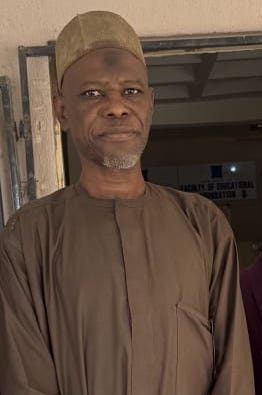
By Aisha Musa Auyo
Innalillahi wa inna ilaihi raji’un. I am still struggling to absorb the shock of Baba Ahmad’s passing. Saying goodbye to a father, mentor, and teacher whose impact on my life cannot be overstated is one of the hardest things I have ever had to do.
I owe my Doctorate in Educational Psychology entirely to him. Among all the paths I could have taken in life, he was the one who steered me toward this field.
I was sixteen, in my first year, when I walked into Educational Psychology 001 and met Prof. Ahmad for the first time. Back then, I resented studying education when all I had ever wanted was medicine. But his intellectual energy, his rigour, and his sheer passion changed something in me. I remember thinking, so there’s a medical side to education, a psychology that isn’t strictly clinical. This is it. This is what I should specialise in. The workings of the human mind had always fascinated me, and the learning theories he introduced us to were captivating, made simple by his rare gift for turning abstract ideas into something anyone could grasp.
That evening, I told my father about this brilliant professor. He smiled. “We went to secondary school together, in Hadejia,” he said. “Prof. Abubakar, too, from educational psychology, also from Hadejia. They’re your fathers as well. You should go and greet them sometime.”
When I finally did, before I could even say a word, he looked at me and said my name. “You’re Aisha Auyo. Your resemblance to your father is striking.” We wouldn’t cross paths again until I returned for my master’s.
He was nothing short of supportive through it all. During my defence, he could be stern, but it was the kind of sternness that steadied rather than shook you. “Aisha, kinga, dukanmu nan mu iyayenki ne. Ki kwantar da hankalinki.” Aisha, look, all of us here are your parents. If there’s anything you don’t understand, we will always be here to help and guide you.”
Whenever Prof. Ahmad spoke about psychology and research, you understood immediately that you were in the presence of someone who had mastered his craft. There was no corner of educational psychology, no angle, including its Islamic dimensions, that he hadn’t explored. He designed curricula, taught, researched, supervised, and mentored thousands. How he managed to keep expanding his knowledge alongside everything else he carried never ceased to amaze me. Dedication, commitment, grit, passion….. that rare combination made him a force wherever he stood.
His mind absorbed and retained information in a way few others could. Many of us in educational psychology drew our energy from him. He pushed people to study even on the days they had no will left to. His influence stretched across Northern Nigeria and beyond.
Students called him the “Dodo” of every defence session because if you tried to cut corners or talk your way around a gap in your work, he would catch it from a single glance. He could smell unpreparedness from a mile away, and he had no patience for laziness or carelessness, which led some to assume he lacked warmth. He didn’t. He was simply a principled man who valued hard work and honesty. Behind that exacting exterior was a humble, selfless, generous soul who helped more people than most of us will ever know.
I remember a conference in Gombe, when he learned I was staying with family friends instead of with him. He was furious and immediately tried to change the arrangement. “Aisha ba ki da inda ya fi cancanta ki zauna fiye da gidana a garin Gombe”. Aisha, there is nowhere more fitting for you to stay in Gombe than my house. He was on sabbatical at the time. When my hosts came to collect me, he kept insisting, “Diyata ce fa. Babanta yana nan” …She is my daughter. Her father is right here. Eventually, we compromised: two days with my hosts, two days with him. He opened his home to so many students, and those days were full of warmth and laughter.
When I finished my master’s defence, relieved and overjoyed that I was finally done, he called my father to congratulate him and urged him to push me back for a PhD. My father called and said, “Babanki Dr Kaugama ya ce ki dawo PhD”. Your father, Kaugama, says you should return for your PhD. I told him I would, just not yet, in sha Allah, someday soon.
My father never let it go. Every time we spoke, while I was in Ogun, he reminded me about the PhD. Your father, Ahmad, says you will have all the support you need. That was how I found myself buying the form and sitting the aptitude test. When he saw me in the exam hall, he lit up. “Aisha, I know you’ll ace this,” he said. “Kina da ƙoƙari da himma” Those words carried me through. I told myself I would not let down everyone who believed in me. Alhamdulillah, I passed and was given admission number 00001 that year.
During my PhD coursework exams, he once noticed my hands trembling and asked what was wrong. “I’m hungry, sir, I haven’t eaten,” I admitted. I had been reading and lost track of time. He told me, plainly, that as an educational psychologist, I ought to know better that the brain runs on food. He said, You need it to read, to understand, to recall, to organise your thoughts. He asked what I wanted to eat and went out himself to arrange it. I couldn’t write a word until I had eaten. Once I was full, he said, “Now continue your paper. I won’t add a single second for you. Time off is time off, for everyone.” I wrote as fast as I could and managed to answer every question. I never made that mistake again.
After my PhD viva, I asked to take a photo with him. “Aisha, ba ni da lokaci,” he teased. “Baba, you forced me to come back for this program,” I reminded him. “Remember how you called my father?” He laughed. “Yes, I remember everything.” “Then I’m forcing you to take this picture with me,” I said. “You’re part of my academic journey. You’re the reason I fell in love with educational psychology.” We took a few photos together and said our goodbyes.
Baba Ahmad was a father to many. His home was always full of orphans and relatives from Kaugama. He was a comrade, a tireless community man, a teacher in the truest sense. His death is an immense loss to his immediate family, to the NISEP family, and to every endeavour he poured himself into. May his contributions to academia continue to benefit him in this life and the next.
When I heard the news, my first thought was: Will he meet my father there? Allah ya yi musu rahama da gafara duka. Allah ya kula da bayansa. Allah ya hada mu duka a Aljanna.
May Allah grant them mercy and forgiveness, watch over those they left behind, and reunite us all in Paradise.
Aisha Musa Auyo, PhD, is an Educational Psychologist, author, and media professional passionate about translating research into practical, everyday impact. She writes on parenting, family dynamics, and education, drawing from both professional expertise and personal experience. Aisha is also a parenting and relationship coach and the founder of Eesher Auyo’s Empire. She is based in Abuja, Nigeria.