By Sabiu Abdullahi
Nigerians residing in South Africa have urged the Federal Government to take firm measures to safeguard their lives and businesses amid rising xenophobic tensions in the country.
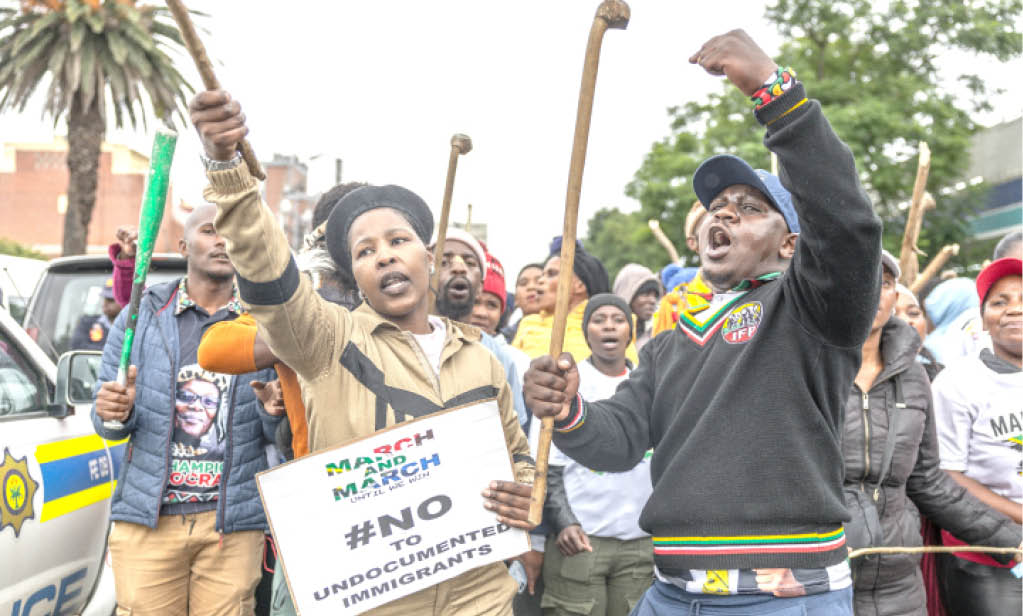
The call was made by the President of the Nigerian Citizens Association in South Africa (NICASA), Rev. Frank Onyekwelu, in a statement issued on Sunday. His appeal comes as anti-foreigner protests intensify across several South African cities, with demonstrators reportedly targeting businesses owned by foreign nationals and demanding their expulsion.
The Nigerians in Diaspora Commission (NiDCOM) had earlier advised citizens in South Africa to temporarily shut down their businesses and remain indoors for safety. The commission’s spokesperson, Abdur-Rahman Balogun, said the directive followed a notice from the Nigerian Consulate-General in Johannesburg.
NiDCOM disclosed that protests in areas such as East London, Cape Town, Durban, and KwaZulu-Natal have turned violent. Incidents of looting, property damage, and injuries have been reported. The commission also warned of planned demonstrations in Gauteng province between April 27 and 29. It noted that foreign-owned businesses are often the main targets during such unrest. Nigerians were therefore advised to close their shops on April 27, which marks South Africa’s Freedom Day, and possibly remain closed until April 29.
According to Daily Trust, despite the advisory, many Nigerians have criticised the Federal Government on social media. They argued that asking citizens to stay indoors does not address the root of the problem or guarantee their safety.
Meanwhile, Ghana has taken diplomatic steps over a related incident involving one of its citizens. Authorities in Accra summoned South Africa’s acting High Commissioner, Thando Dalamba, after a viral video showed a Ghanaian being harassed. Ghana’s Ministry of Foreign Affairs confirmed that the victim was a legal resident and condemned the act. The country’s Foreign Affairs Minister, Samuel Ablakwa, also announced plans to relocate the victim, Emmanuel Asamoa, at government expense. The move followed direct engagement with South African authorities, which led to official apologies and diplomatic discussions.
In its statement, NICASA expressed strong concern over what it described as a growing pattern of hostility against Nigerians and other African nationals in South Africa.
Onyekwelu said, “We are alarmed by the increasing normalisation of hostility, manifested through inflammatory rhetoric by certain political actors, unlawful intimidation, and discriminatory enforcement practices by some law enforcement personnel.
“These actions not only undermine human dignity but also threaten the long-standing bonds of African solidarity.”
The association called for immediate high-level diplomatic engagement between Nigeria and South Africa. It also demanded a clear system for reporting and addressing cases of harassment, abuse, and xenophobic attacks. NICASA further requested accountability for security personnel found guilty of misconduct and urged the Nigerian government to reassure its citizens of their protection abroad.
The group warned that xenophobia contradicts the vision of African unity and called for a coordinated response through the African Union and regional bodies.
Reacting to the situation, the spokesperson for Nigeria’s Ministry of Foreign Affairs, Kimiebi Imomotimi Ebienfa, said the government is awaiting updates from its missions in Pretoria and Johannesburg. He stated, “[We are] waiting for updates from our Missions in Pretoria and Johannesburg”.
Diplomatic experts have also weighed in on the development. A former President of the United Nations Human Rights Council, Ambassador Martin Ihoeghian Uhomoibhi, condemned the attacks and urged Nigeria to respond decisively.
He said, “The Federal Government should take strict action.
“You cannot go to sleep when you are being publicly attacked. Nigeria should act and act very simply and promptly.”
Uhomoibhi dismissed suggestions that Nigerians should leave South Africa, adding, “That is not the solution. You [Nigeria] should take diplomatic action.”
“The game of diplomacy is reciprocity. You slap me, I slap you back. In diplomacy. If you keep quiet, you portray yourself as a sleepy dog or something or a nobody.”
On his part, former Nigerian ambassador to Sudan, Côte d’Ivoire, and Angola, Suleiman Dahiru, said Nigeria’s options are largely limited to diplomatic engagement.
He explained that while the attacks are “totally misplaced,” addressing them remains the responsibility of South African authorities.
“Nigeria has engaged South Africa on so many occasions. This is a diplomatic issue, and it is being handled diplomatically,” he said.
Dahiru also rejected claims that Nigerians are responsible for job losses in South Africa, describing such arguments as baseless.
“They are not working for any state government in South Africa. They are not working for any local government. So, to blame them for taking away jobs that should normally go to them is totally wrong,” he said.
He added that most African migrants operate private businesses and should not be blamed unfairly. “Nobody has stopped South African blacks from doing what other Africans are doing. Let them set up their own businesses and get their own people to patronise them,” he said.
However, Dahiru advised migrants to be mindful of how they are perceived. He noted that displays of unexplained wealth could create suspicion among locals.
Xenophobia: Nigerians Seek Urgent FG Intervention Amidst Persecution of African Nationals in South Africa

ByAdmin
27 April 2026