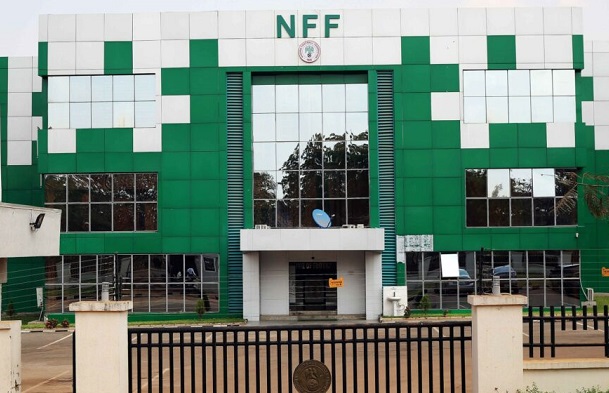
The Economic and Financial Crimes Commission and the Independent Corrupt Practices and Other Related Offences Commission have opened investigations into the management of a N12bn intervention fund released by the Federal Government to the Nigeria Football Federation.
The fund was approved by President Bola Tinubu in 2024 to settle outstanding wages, allowances and bonuses owed to members of Nigeria’s national teams.
A source familiar with the investigation told journalists on Thursday that some officials connected to the matter had been invited by the anti-corruption agencies and had made statements.
“They have been under our radar before now. We invited some officials over to our offices, and they gave their statements. Presently, they are on administrative bail. We have not ended our investigation,” the source said.
The development came to light through a response issued by the NFF to a request for access to financial records and utilisation documents linked to the fund.
The response was contained in a letter signed by Onoja Joshua, Esq., on behalf of the NFF General Secretary. The letter was dated August 18, 2026, and addressed to the Principal Partner of Cromwell & Okeke.
The law firm had earlier written to the federation on August 7, 2026, with the correspondence received by the NFF on August 11.
The request, made under the Freedom of Information Act, sought financial records and other documents relating to the N12bn intervention fund reportedly released for the payment of players’ wages and bonuses.
The federation, however, declined to provide the documents, citing the ongoing investigations by the EFCC and ICPC.
“I am directed to refer to the above subject matter and your correspondence dated 7th August, 2026 but received on 11th August, 2026,” the letter stated.
“It is my instruction to inform you that the subject matter of the request under the Freedom of Information Act is subject of investigations by the Economic and Financial Crimes Commission and the Independent Corrupt Practices and Other Related Offences Commission.
“Therefore, all documents relating to the request are before the Economic and Financial Crimes Commission and the Independent Corrupt Practices and Other Related Offences Commission.”
The Federal Government had announced the release of the N12bn in January 2024, shortly before the Super Eagles began their campaign at the Africa Cup of Nations in Côte d’Ivoire.
A statement from President Tinubu’s Media Centre said the intervention covered outstanding salaries owed to coaches of the senior national team, as well as allowances and other payments due to several national teams.
“President @officialABAT has approved the payment of N12bn outstanding backlog for Nigeria’s National teams of various sports, which includes Super Eagles and others,” the statement read.
“The payment entails the clearing of the senior national team coaches’ salaries running up to 15 months, payments of allowances and promises due to the senior national teams, women’s teams, and U-20 national team.”
Despite the intervention, complaints over unpaid allowances and bonuses have persisted within Nigerian football.
In November 2025, the Super Eagles reportedly refused to train in Rabat, Morocco, before a crucial 2026 World Cup play-off against Gabon. The players cited unpaid allowances dating back to 2019, including payments linked to achievements such as qualification for the 2025 Africa Cup of Nations and the World Cup play-offs.
In April 2026, reports also emerged that members of Nigeria’s 2023 and 2025 Flying Eagles teams were demanding about N1.5bn from the NFF.
The amount reportedly covered qualification bonuses for six major tournaments as well as pre-tournament camping allowances accumulated over about 65 days.
The latest investigation comes amid wider concerns over the management of Nigerian football. The Super Falcons recently failed to qualify for the 2027 FIFA Women’s World Cup, while the Super Eagles also missed the 2026 World Cup in the United States, Canada and Mexico.
NFF President Ibrahim Gusau, who assumed office after his election at the federation’s congress in Benin City in September 2022, is seeking another term at the proposed September 27 elective congress.
His administration has faced increasing criticism, although the NFF board has denied claims that the National Sports Commission is seeking to halt the election and establish a normalisation committee to oversee Nigerian football.
Efforts to obtain comments from the EFCC and ICPC spokespersons, Dele Oyewale and John Odey, were unsuccessful as of the time of filing the report.