By Uzair Adam
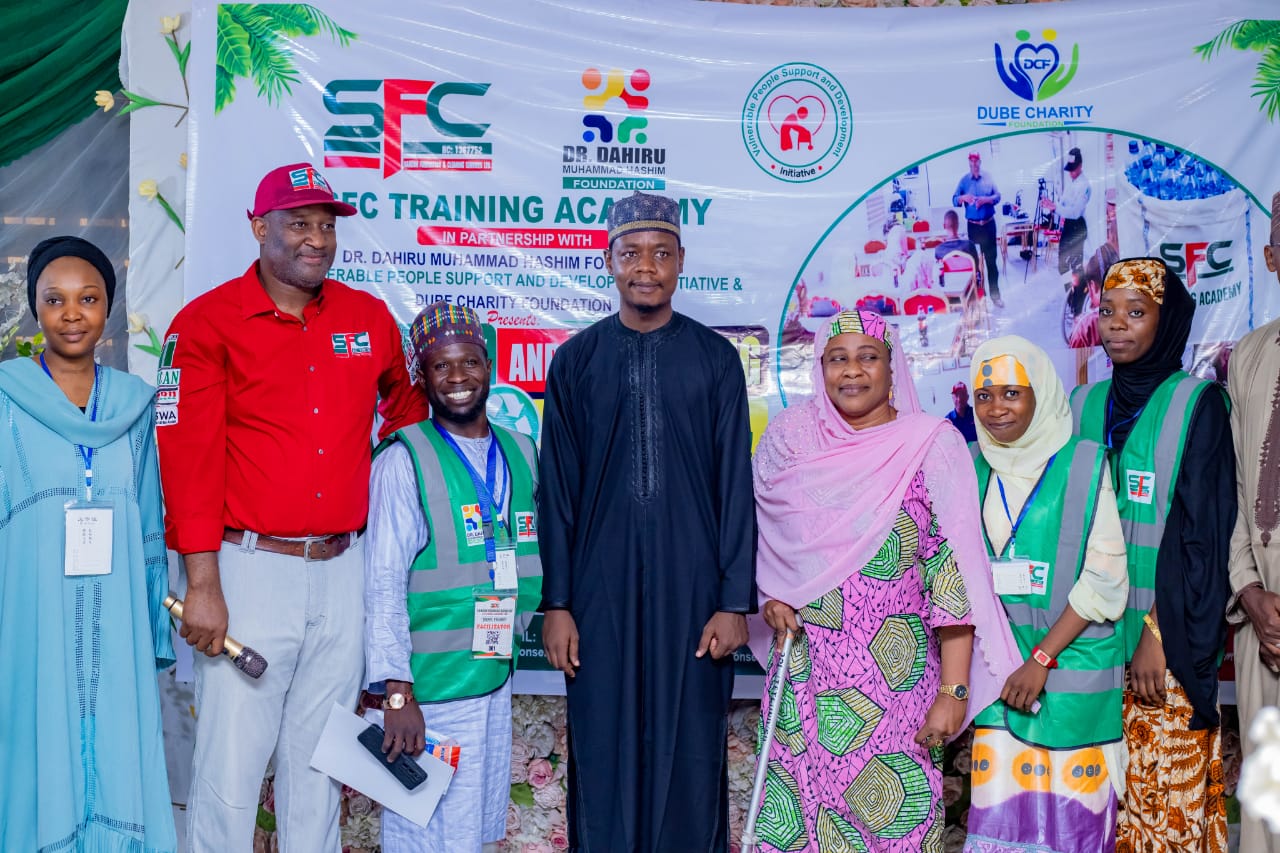
Women and persons with disabilities (PWDs) in Kano were on Wednesday trained on plastic waste recycling and empowered with tools and cash support as part of efforts to promote environmental sustainability and improve livelihoods among vulnerable groups.
The training, organised by SFC Training Academy in partnership with the Dr. Dahiru Muhammad Hashim Foundation, Vulnerable People Support and Development Initiative, and Dube Charity Foundation, focused on turning plastic waste into economic opportunities for women, widows and persons living with disabilities.
Speaking during the event, the Coordinator of SFC Training Academy, Dr. Sani Hussaini, said the initiative was designed to integrate persons with disabilities into the circular economy through practical recycling skills.
According to him, many people living with disabilities are often excluded from empowerment programmes despite their potential to contribute meaningfully to society.
“We are here today to train participants on waste-to-wealth initiatives. These participants are largely drawn from persons with disabilities because they have often been left behind in many programmes,” he said.
Dr. Hussaini explained that the organisers secured support from partners and sponsors, including the Commissioner for Environment and Climate Change, Dr. Dahiru Muhammad Hashim, who sponsored participants with working tools and financial support.
“He provided weighing scales, hand gloves, face masks, reflective vests and also donated N20,000 cash support to each participant. This gesture is highly commendable and the participants are very happy,” he added.
He noted that although the organisers initially planned for about 70 beneficiaries, over 135 people turned up for the training, describing the response as encouraging.
The coordinator further revealed that the academy plans to establish a database of participants and support the best-performing beneficiaries by enrolling their children back in school.
He added that the organisers also intend to connect participants with companies such as Coca-Cola to enable them combine recycling with small-scale beverage businesses for sustainable income generation.
Dr. Hussaini said the initiative was also aimed at addressing economic hardship by providing vulnerable persons with alternative means of livelihood.
“If someone can sell just a few packs of water daily and retain the plastic bottles for recycling, they can earn a sustainable income monthly. This can significantly improve their standard of living,” he said.
He added that the academy was established to equip youths and vulnerable persons with practical skills in cleaning, recycling, pest control and waste management.
“We want to take youths off the streets by providing this kind of training. We are calling on meaningful individuals and organisations to partner with us so that we can scale up these interventions,” he said.
Speaking on behalf of the founder of the Dr. Dahiru Muhammad Hashim Foundation, the Commissioner for Environment and Climate Change, Muhammad Nazir Zakari described the initiative as timely and impactful.
He said the training was particularly important because it targeted persons with special needs drawn from different communities and equipped them with skills and empowerment support to start small businesses and sustain themselves.
“The training and empowerment will help them to start businesses and become self-reliant. This is not the first time the foundation has supported initiatives like this,” he said.
Zakari expressed excitement over the turnout of participants, noting that the gathering reflected growing awareness among persons with disabilities about opportunities for self-development and economic empowerment.
He commended Dr. Dahiru Muhammad Hashim for his commitment to environmental sustainability, social inclusion and improving the lives of vulnerable people through consistent support for empowerment programmes.
Also speaking, the Director of Persons with Special Needs at the Kano State Ministry of Women Affairs, Children and Persons with Disabilities, Dr. Binta Bala, described the programme as a laudable initiative capable of reducing hardship and promoting inclusion.
“To be sincere, this is a very good initiative. If properly utilised, it will reduce hardship, create jobs and strengthen inclusion of persons with disabilities in society,” she said.
Dr. Bala stated that economic empowerment helps reduce discrimination against persons with disabilities by enabling them to participate actively in community life.
“When your economy is balanced, you can freely mingle with anyone. Nobody will stigmatise or discriminate against you,” she added.
She noted that the Kano State Government had introduced several laws and policies to support the welfare and inclusion of persons with disabilities, including empowerment and advocacy programmes.
The director recalled that the ministry recently collaborated with a development partner to train 169 women on recycling and waste-to-wealth initiatives, including 26 women with disabilities who were supported with starter packs and financial inclusion services.
In his remarks, Mustapha Usman, a coordinator with the Vulnerable People Support and Development Initiative and member of the National Association of Persons with Physical Disabilities, expressed appreciation to the organisers.
“This is something very tangible that we have rarely seen in our community. It is an empowerment that can make people with special needs self-reliant and successful,” he said.
He prayed for continued support for organisations and individuals working to uplift vulnerable persons in society.
SFC Academy Empowers Vulnerable Women, PWDs through Waste-to-wealth Initiative in Kano

ByAdmin
21 May 2026