
By Sadiq Ilyas
In 2017, Governor Abdullahi Ganduje reportedly disagreed with Sarki Muhammadu Sanusi II’s critical comments about the government’s handling of the state’s finances. Sanusi accused the government of mismanagement and corruption, particularly about the state’s debts.
The disagreement between the two escalated in 2019 when the Kano State government created four other emirates, reducing the powers of the Emir of Kano, who was Sanusi then.
Sanusi challenged the creation of the emirates in court, arguing that it was politically motivated and designed to weaken his position as emir. However, in March 2020, a Kano State High Court ruled that creating the emirates was legal.
In March 2020, Sanusi was removed from his position as Emir of Kano by the Kano State government, citing insubordination and disrespect to the governor and other officials. Sanusi denied the allegations and challenged his removal in court, but his efforts were unsuccessful.
Since the removal of Sanusi as the 14th Emir of Kano, many people have reacted differently, and that generated sympathy around the Emir, who was seen as a victim, while the Governor is seen as the villain.
The Kano Governorship election result is believed to be won majorly as protest votes against Ganduje’s policies, including creating new emirates and his perceived allegation of corruption. On the other hand, the New Nigeria People’s Party, NNPP, gave a margin of 128,000 votes to the ruling All Progressives Congress, APC. Although the APC plans to challenge the victory in court, the likelihood of overturning the election is slim.
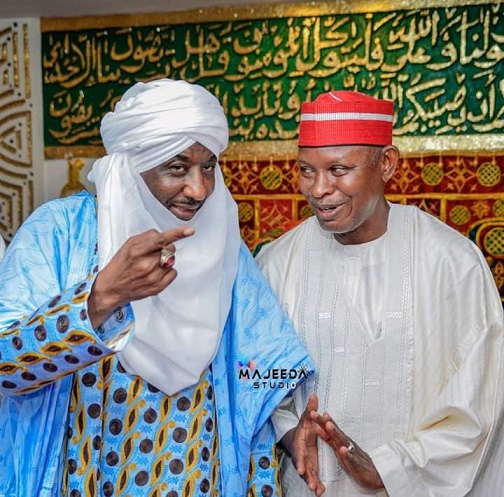
The 14th Emir of Kano is believed to have supported the NNPP with many antics. First was his appearance in a white and red outfit, the Kwankwasiyya insignia, just before the election when he visited his mother. People also rumour that he financed the campaign of the NNPP of the Governor-elect Abba Kabir Yusuf. Though the 14th Emir was out of the country during the election period, he was believed to be in Makkah praying for the victory of the Governor-elect.
Since the announcement of the Governorship results in Kano, social media space was filled with slogans such as “Sabon Gwamna, Sabon Sarki”, meaning “new Governor, new Emir”. The atmosphere in the Emir’s palace becomes tense, and the Emir’s outfit choice for the Hawan Daushe Durbar says it all. He wore golden armour, which some analysts say is a sign of confrontation in times of war. But now that the battle with swords is over, the question is who is playing with the lion’s tail.
Kwankwaso VS Ganduje
In a recent interview with reporters, Senator Rabiu Musa Kwankwaso, the leader of the NNPP and presidential candidate of the party in the 2023 election, has stated that the incoming government of Abba Yusuf, the Governor-elect of Kano State, will review the dethronement of the 14th Emir of Kano, Muhammadu Sanusi II.
“We tried not to intervene in the issue of bringing or removing any Emir. But now, an opportunity has come. Those given this opportunity will sit down and see the issues. Then, they will look at what they are expected to do. Besides the Emir, even the emirate has been divided into five places. All these need to be studied,” Kwankwaso stated.
He also said that, as elders, they would continue to advise the incoming government to do the right thing.
Meanwhile, Kano State Governor, Dr Abdullahi Umar Ganduje, has reiterated that the four new emirates created by his administration are here to stay.
“The four new emirates are a symbol of unity, progress, and the well-being of the people. They were created to honour the people of these regions and recover the reputation of the traditional institutions,” Ganduje said during the Workers’ Day celebrations held at Sani Abacha Stadium in Kano.
He added that the emirates were created to upgrade and promote their tradition, and they have brought development to these places. “I assure you that these emirates are permanent. They have come to stay. Even if we are not in government, these emirates are untouchable. I promise you this by the grace of God, they have come to stay,” he added.
It remains to be seen how the situation will unfold in Kano State regarding the dethronement of Sanusi II and the creation of new emirates.
History may repeat itself
During the administration of Governor Abubakar Rimi in the late 1970s and early 1980s, there was an attempt to create five emirates in Kano state by splitting the Kano Emirate into five.
This move was met with opposition by some members of the royal family and other traditional rulers, who saw it as an attempt to weaken the influence of the Kano Emirate.
However, Governor Rimi went ahead with the plan and created the new emirates of Gaya, Karaye, Bichi, Rano, and Kano.
The Kano Emirate was reduced in size and given a more ceremonial role, while the new emirates were granted more administrative and political powers.
When Governor Sabo Bakin Zuwo took over in 1983, he reversed the decision and restored the Kano Emirate to its original size and status, with the other emirates abolished.
His decision was seen as an attempt to restore the traditional balance of power and to address the concerns of those who opposed the creation of the new emirates.
In 2019, Governor Abdullahi Ganduje created four new emirates in Kano State, including Gaya, Karaye, Bichi, and Rano, in addition to the Kano Emirate. The move was met with controversy and legal challenges, with some arguing that it was politically motivated and aimed at reducing the influence of the Kano Emirate. This followed the dethronement of the 14th Emir Muhammadu Sanusi II. And from all indications, history may repeat itself, with the NNPP becoming a new government.
Experts opinion
Following the recent dethronement of Sanusi as Emir of Kano and the creation of new emirates by the Ganduje administration, Nadir Nasidi, a historian at the Ahmadu Bello University Zaria, has spoken out against the move, stating that it is unnecessary and unpalatable.
In an interview, Nasidi stated, “Kano is the only emirate in the whole country with one unifying emir, but the creation of unnecessary emirs isn’t a palatable one. Many people, including myself, told the Ganduje administration that what he was doing wasn’t a good one.”
While acknowledging that Sanusi’s dethronement was final and he could not be brought back, Nasidi suggested that the other emirates be reduced to local chiefs under the overall Emir of Kano, who would be chosen from among the existing kings.
He said, “Nobody will bring back Sanusi. He’s gone already. But the other emirates must be reduced to local chiefs under the overall emir of Kano. They can choose amongst all the kings one person to be the overall king.”
Nasidi’s suggestion comes amid ongoing debates about the wisdom and legality of creating new emirates in Kano State. The creation of four new emirates in the state was met with widespread criticism, with some people accusing the government of trying to weaken the influence of the Emir of Kano.
Critics argue that the move is politically motivated and aimed at reducing the Emir’s power and influence. On the other hand, supporters of the new emirates say that it will promote development and bring the government closer to the people.
As the debate continues, it remains to be seen whether the incoming administration will consider Nasidi’s suggestion or continue with its plans to bring back Sanusi Lamido as the Emir and reverse the creation of the emirates in Kano State.
Sadiq Ilyas wrote via silyas1989@gmail.com.
Sanusi never challenged his dethronement in any court; he only challenged his forceful exile to Awe and banishment from entering Kano. However, if there is any proof we will like the writer to bring forth.
Although I enjoyed reading the piece, the writer can do better if he avoids being repetitive; “the move is politically motivated….” kept on appearing unnecessarily in different paragraphs.