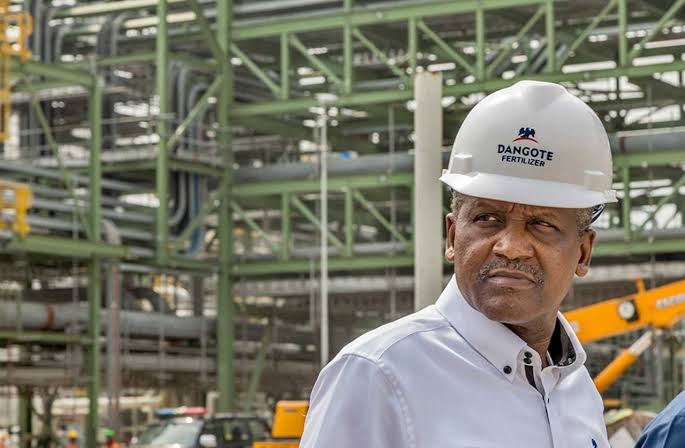
By Sabiu Abdullahi
President of Dangote Industries Limited, Aliko Dangote, has linked part of the high cost of petrol in Nigeria to the continued smuggling of the commodity into neighbouring countries.
Dangote said petrol sells for between 30 and 50 per cent more in some neighbouring countries than in Nigeria, a price difference he said encourages traders to move the product across the borders for higher returns.
He made the remarks during an interview aired on Arise TV on Tuesday, where he discussed petrol prices, domestic supply and the possible impact of the ongoing crisis in the Middle East.
Addressing concerns over the cost of petrol in Nigeria, Dangote said the price should be considered alongside what consumers pay in neighbouring countries.
“You know, expensive is relative. In the sense that today, maybe, you know, a lot of them, there’s ignorance also. What they need to do is ask, what is the neighbour’s price?”
The businessman said the price gap had continued to encourage the movement of locally produced petrol out of Nigeria.
“I don’t know if you know that there’s still a lot of smuggling of the same petrol we are producing to our neighbouring countries.”
Dangote explained that petrol prices in neighbouring countries were significantly higher than those in Nigeria, making cross-border sales attractive to traders.
“Because those neighbouring countries are about 30 to 50 per cent more expensive than Nigeria. So, it’s not actually like for like.”
He cited Niger as an example, saying petrol sold at N1,350 in Nigeria could fetch between 20 and 25 per cent more across the border.
“And people can now go and ask, okay, fine, what is the price of, even now at N1,350? Okay, the price in Niger is 20 to 25 per cent more than Nigeria,” he said.
Dangote questioned what other legitimate business could offer such an immediate return.
“So, what business are you going to do that will make you have an instant 25 per cent return?” he asked.
He also described how petrol intended for the Nigerian market could be diverted towards border communities for resale.
“So, it means that, yes, you take the [petrol], you go and take it across the border. You pretend you are taking it to Sokoto, you go and just take it to Ilela, and you sell.
“Actually, they don’t have.”
According to Dangote, the cross-border movement reduces the amount of petrol available within Nigeria because traders can obtain higher returns outside the country.
Beyond the issue of price, Dangote warned that the ongoing crisis in the Middle East could create a different challenge for Nigeria’s petroleum market.
He said the major concern could shift from the cost of petrol to the availability of the product.
“And the problem now, going forward, I must also warn that this crisis in the Middle East is not even about price; it’s about availability,” Dangote said.
He, however, assured Nigerians that his refinery would continue to supply the domestic market despite possible disruptions in the international energy market.
“We will deliver to Nigeria. Nigerians don’t need to worry. There will not be any shortage from our own part.
“There won’t be any shortage. There will not be any queues. We will make sure that we keep satisfying the market, despite all odds,” Dangote added.
His comments came shortly after the Dangote Petroleum Refinery and Petrochemicals opened its N2.15tn initial public offering (IPO) on the Nigerian Exchange.
The IPO comprises 4.1 billion ordinary shares priced at N525 each, with a minimum subscription of 10 shares worth N5,250. The offer is open to retail, institutional and eligible African investors and is scheduled to close on October 13, 2026.