By Sabiu Abdullahi
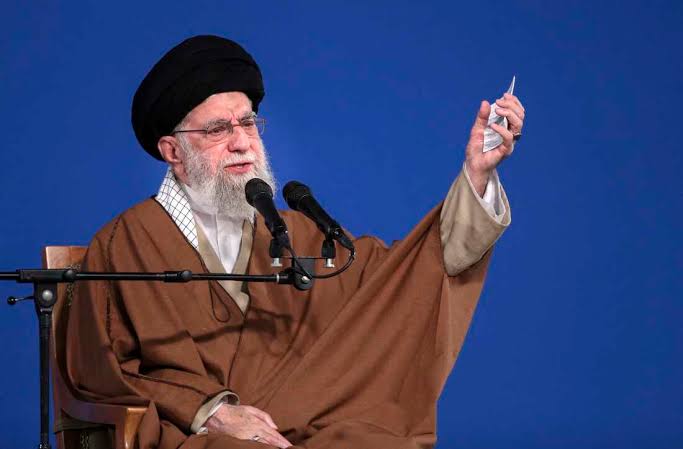
Iran’s Supreme Leader, Ayatollah Ali Khamenei, has warned that any military attack by the United States would lead to a “regional war” in the Middle East, as tensions continue to rise between Tehran and Washington.
Khamenei issued the warning on Sunday amid the presence of the US aircraft carrier USS Abraham Lincoln and other American warships in the Arabian Sea. The deployment followed President Donald Trump’s decision to send the vessels after Iran’s violent crackdown on nationwide protests.
Iranian state television reported Khamenei’s remarks online before broadcasting any video of his speech.
“The Americans should know that if they start a war, this time it will be a regional war,” Khamenei was quoted as saying.
He also insisted that Iran had no intention of attacking other countries but would respond forcefully to any provocation. “We are not the instigators and we do not seek to attack any country. But the Iranian nation will deliver a firm blow to anyone who attacks or harasses it,” he said.
Khamenei further described the ongoing protests across Iran as an attempted coup, adopting a tougher stance after earlier acknowledging that economic hardship had contributed to public anger. The protests began on December 28 after the collapse of Iran’s currency and later turned into a direct challenge to his leadership.
“The recent sedition was similar to a coup. Of course, the coup was suppressed,” he said. “Their goal was to destroy sensitive and effective centers involved in running the country, and for this reason they attacked the police, government centers, (Revolutionary Guard) facilities, banks and mosques — and burned copies of the Quran. They targeted centers that run the country.”
Reports indicate that tens of thousands of people have been detained since the demonstrations began. In Iran, charges related to sedition can carry the death penalty, a development that has drawn concern from the United States. Trump has previously described the killing of peaceful protesters or mass executions as red lines for possible military action.
Meanwhile, Iran also scheduled live-fire military drills for Sunday and Monday in the Strait of Hormuz, a key oil shipping route through which about one-fifth of the world’s traded oil passes. The US military’s Central Command warned against any threat to American forces or disruption of commercial shipping during the exercise.
In a related development, the Speaker of Iran’s Parliament, Mohammad Bagher Qalibaf, announced that Tehran now considers all European Union militaries to be terrorist groups. The statement followed the EU’s decision to designate Iran’s Revolutionary Guard as a terrorist organization over its role in the crackdown on protests.
Qalibaf, a former Revolutionary Guard commander, made the declaration as lawmakers appeared in Guard uniforms in parliament.
“By seeking to strike at the (Guard), which itself has been the greatest barrier to the spread of terrorism to Europe, Europeans have in fact shot themselves in the foot and, once again, through blind obedience to the Americans, decided against the interests of their own people,” Qalibaf said.
Lawmakers later chanted “Death to America!” and “Death to Israel!” during the session.
Trump, for his part, has said Iran is engaged in talks with the United States, even as he declined to confirm whether he had decided on military action.
“I don’t know that they will. But they are talking to us. Seriously talking to us,” Trump said, while stressing the need for a “satisfactory” deal to prevent Iran from acquiring nuclear weapons.
However, Iran’s Supreme Leader has repeatedly ruled out direct negotiations with Washington. Despite that, Ali Larijani, a senior Iranian security official, wrote on social media that “structural arrangements for negotiations are progressing,” although no public evidence of direct talks has emerged.
Iran’s Supreme Leader Ayatollah Khamenei issues stern warning to US amid tension

ByAdmin
1 February 2026