By Sabiu Abdullahi
The Nigerian Air Force (NAF) has recorded more than 2,900 sorties and over 6,100 flying hours, consuming nearly 10 million litres of aviation fuel during national security operations between November 2025 and September 2026.
The figures were disclosed in a statement issued on Sunday by the Director of Public Relations and Information of the NAF, Air Commodore Ehimen Ejodame, ahead of the first anniversary of the Chief of the Air Staff, Air Marshal Sunday Aneke, on October 30.
Ejodame said the operations involved precision air strikes, armed reconnaissance, surveillance and close air support aimed at weakening hostile groups, disrupting their activities and improving the effectiveness of ground forces.
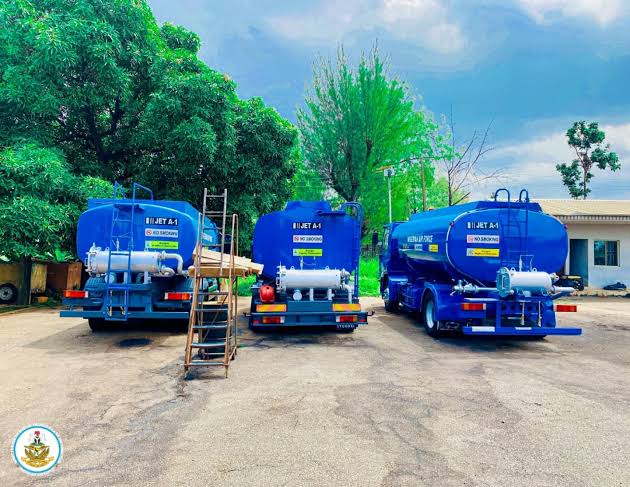
“Between November 2025 and September 2026, the NAF recorded over 6,100 flying hours and more than 2,900 sorties, consuming close to 10 million litres of Jet A-1 fuel in support of national security operations.
“These missions encompassed precision air strikes, armed reconnaissance, surveillance, close air support and other tasks designed to degrade hostile elements, disrupt their freedom of action and enhance the effectiveness of surface forces.
“Central to this effort has been intelligence-led mission planning, with operations guided by actionable intelligence, defined objectives and assessments of mission outcomes,” the statement said.
According to the spokesperson, the Service has focused on ensuring that each mission serves a clear operational purpose and contributes to national security.
He said the operational activities formed part of Aneke’s transformation agenda, which prioritises operational effectiveness, personnel welfare, technological advancement and institutional accountability.
NAF announces personnel welfare, promotions
On personnel welfare, Ejodame said the Air Chief had adopted the principle of “Welfare for Enhanced Warfare”, which recognises the importance of adequately supporting and motivating personnel to sustain operational effectiveness.
He said the Service had pursued improvements in personnel allowances, medical support, accommodation and other infrastructure. It had also reactivated welfare airlift services for personnel deployed to frontline operational theatres.
Ejodame disclosed that 57 senior officers were promoted to the ranks of Air Vice Marshal and Air Commodore. He added that 1,534 senior non-commissioned officers and 1,936 non-commissioned officers also advanced to higher ranks.
According to him, more than 550 personnel participated in international training and professional engagements, while over 6,000 received training within Nigeria to improve their technical expertise, specialised skills and leadership capacity.
Five helicopters added to fleet
On fleet modernisation, the NAF spokesperson said the Service received five additional helicopters in September, comprising three AW-109 Trekker Type B helicopters and two H125 helicopters.
He added that the Air Force was pursuing the acquisition of 12 AH-1Z attack helicopters, alongside other aircraft and unmanned aerial systems, to strengthen its combat, airlift, training, intelligence, surveillance and reconnaissance capabilities.
Ejodame also disclosed that six L-39ZA aircraft were undergoing reactivation and upgrades in Slovakia and Nigeria, while periodic depot maintenance of a C-130 aircraft was ongoing in Portugal.
On infrastructure, he said the NAF had approved 284 projects, with 145 completed and 139 still ongoing.
The projects cover residential accommodation, academic and medical facilities, administrative and operational buildings, roads, electricity, water supply and recreational facilities.
Air Force strengthens safety, accountability
Ejodame said the Service had taken steps to improve aviation safety and accountability through the establishment of an Operational and Safety Audit Committee and improvements to its Safety Management System.
He added that the NAF was developing structures to prevent and respond to civilian harm, including standardised training and improved assessment and investigation capabilities.
The Service was also working towards establishing an Open-Source Intelligence Centre to strengthen situational awareness and operational planning through publicly available information and emerging technologies.
On local production, the spokesperson said the NAF had pursued initiatives involving the production of Aircraft Release Device 863 impulse release cartridges, a 250-kilogramme bomb-loading trolley and the development and ground testing of locally produced 57-millimetre rockets.
He further said community-focused healthcare, educational and other special projects had continued to support civil-military relations and public confidence.
Ejodame said the Air Force remained committed to translating investments in personnel, aircraft, training, technology and infrastructure into improved operational outcomes.
“Through stronger joint operations, strategic partnerships, improved maintenance, professional development and responsible employment of airpower, the Service continues to pursue greater readiness and effectiveness in addressing Nigeria’s security challenges,” the statement said.
Nigerian Air Force Records 2,900 Sorties, Burns Nearly 10 Million Litres of Fuel in Security Operations

ByAdmin
26 October 2026