
By Hamisu Adamu Dandajeh
Electric vehicles (EVs) are often called “inevitable”. The only question, we’re told, is timing. Nevertheless, the data says otherwise. Even the world’s most electrified economies remain overwhelmingly combustion-powered on the road. Nigeria’s constraints run deeper still. They are not only rooted in physics, minerals and money, but also on political willpower.
Start with Norway. It is the closest thing the world has to a completed EV transition. Battery-electric vehicles made up 96–97% of new car sales in 2025. Decades of tax breaks, toll discounts and bus-lane access built that number. But look at the cars actually on Norwegian roads, not the ones sold this year. Only a third of the total fleet is electric. That is the highest share in the world. And it still leaves two-thirds of Norway’s cars running on combustion. Sales dominance and fleet electrification are not the same thing. That gap is the central fact of this entire debate.
Other countries make the point harder. China crossed 50% EV sales penetration in 2025. Its road fleet is still only about 13% electric. Germany’s EV sales share collapsed from 29% to 19% when subsidies were cut, then recovered to 28% once they returned. Adoption moves with subsidy, not momentum. The US sits at roughly 10% of new car sales, stalled since federal tax credits expired. Japan’s EV sales share fell from 3% to 2% in 2025.
Globally, the EV fleet reached about 116 million units in 2026. The world’s total car fleet exceeds one billion vehicles. China alone holds 61% of all EVs on earth. A 30% sales share this year still means a fleet penetration of five to seven per cent. Cars last fifteen to twenty years. Old stock does not disappear because new sales shift. This is steady progress. It is not imminent replacement.
Nigeria’s problem is a different category of constraint. The national grid serves over 220 million people. It generates between 4,000 and 4,800 megawatts on a good day. That is about 20 watts per person. Pakistan manages 180. Indonesia manages 250. The United States manages 3,530; 176 times Nigeria’s figure. You cannot charge an EV fleet on a grid that cannot keep the lights on. Nigeria’s grid still collapses outright. Generation crashed to 20 megawatts nationwide in January 2026.
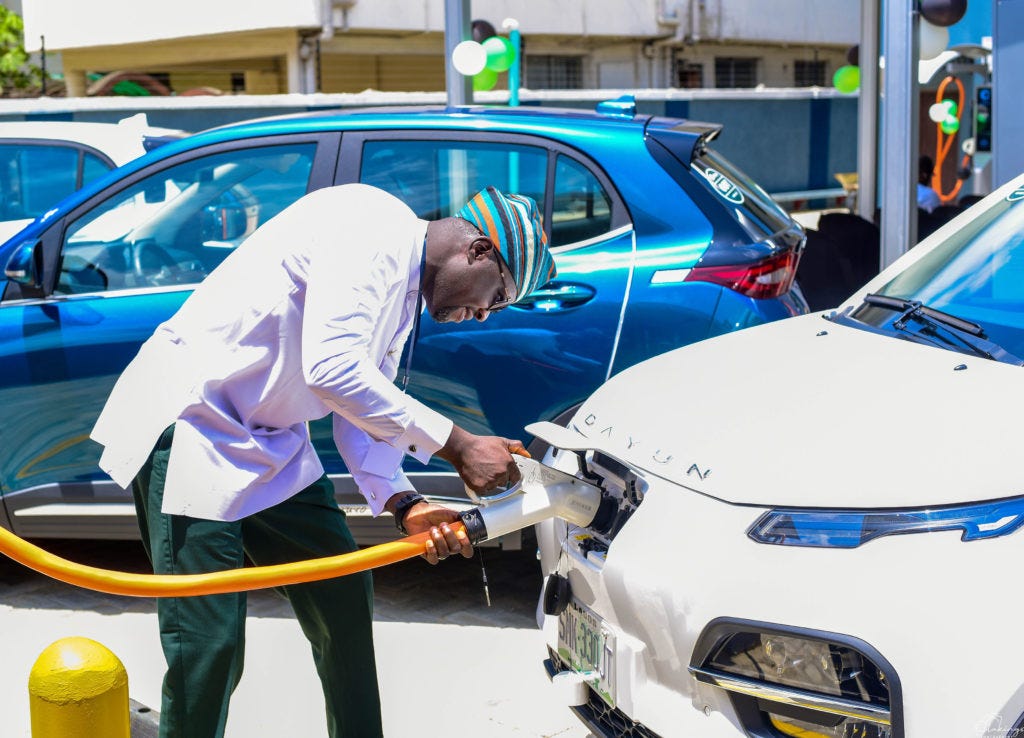
Nigeria’s Energy Transition Plan targets 60% EV fleet share by 2050. Today, EVs are under 1% of the country’s vehicles. That is a few tens of thousands of cars; by industry estimate, no official figure exists. Import duty waivers pushed nearly 4,000 more EVs into the country in the first half of 2026. They are landing in a market where the grid runs at 30% of installed capacity. Barely half the population has a grid connection at all. Public charging stations number around a dozen nationwide.
Here is the telling part. Nigerian charging operators now run diesel and petrol generators to keep their own chargers working when the grid fails. The EV system depends on the fuels it is meant to replace. A car charged from a diesel generator is not a clean-energy solution. It is a combustion engine with an expensive extension cord.
Electric two- and three-wheelers are the exception. They are gaining real ground, often paired with solar charging. They already beat petrol bikes on lifetime cost. But a solar-charged motorcycle and a grid-dependent passenger car are different problems. Confusing the two is where much of the optimism about Nigeria’s EV transition breaks down.
Four structural constraints hold the combustion engine in place even in wealthy, grid-secure economies. Minerals come first. The cobalt supply gap is projected to widen from 15% to over 25% by 2040. Lithium demand is set to more than triple. The real bottleneck is refining, not mining. China controls most of that capacity, regardless of where the ore comes from. Battery supply chains are nearly as exposed as the oil trade they aim to replace.
Grid capacity is the second constraint, and it is not just a developing-world problem. The US grid faces simultaneous demand growth from data centres, reshored industry, building electrification and EV charging. Data centre demand alone is forecast to more than double by 2035. Ninety per cent of US charging operators cite grid limits, not construction cost, as their biggest obstacle. Lagos and Chicago differ in degree, not in kind.
Fleet turnover is the third. Cars stay on the road for over a decade. Fleet electrification always lags sales electrification. Norway proves it: a third of its fleet is electric, compared with 97% of its sales. Even a Nigeria that hit 100% EV sales tomorrow would run a majority-combustion fleet well into the 2040s.
Heavy-duty transport is the fourth. Electric truck sales more than doubled in 2025. They still make up barely one in ten trucks sold worldwide, and mostly in China. Long-haul freight, shipping, aviation and heavy equipment remain unsolved. Battery energy density per kilogram still trails diesel and jet fuel by a wide margin. These are the vehicles moving most of the world’s freight.
None of this argues against electric vehicles. Norway’s numbers are real. China’s manufacturing scale is real. The direction of travel is toward more electrification. But “more” is not “complete replacement,” and only the first claim survives contact with the data.
Nigeria’s real constraint is a 4,000-megawatt grid serving a quarter-billion people. That leaves meaningful EV penetration limited, for now, to solar-charged two- and three-wheelers and isolated pilot fleets. The industrialised world faces a different but equally real constraint: a mineral supply chain that cannot yet support the scale being promised, a grid under pressure from EVs and data centres at once, and a vehicle stock so large that even a fully electrified sales market takes a decade or more to become a fully electrified road.
The honest forecast is not replacement. It is long, uneven coexistence. EVs will take a growing share of new sales where grids and supply chains allow it. Combustion engines will keep doing the heavy lifting for the existing fleet, and for the jobs battery technology still cannot do. Anyone promising a firm end date for the petrol or diesel engine is selling a story the numbers do not support.
Hamisu Adamu Dandajeh is an Associate Professor of Sustainable Fuels, Energy and Climate Change, Department of Mechanical Engineering, Ahmadu Bello University, Zaria, Nigeria. Email: hadandajeh@gmail.com