
By Abubakar Idris Misau
Altitude: 120 m AGL; Latitude: 9.0538° N; and Longitude: 7.4913° E. Through an aerial assessment, we see clearly Mr Engineer working in a high-tech lab [read: field] and dealing with the precision of machines and equations, and Oga Forester standing in a quiet woodland handling the unpredictable messiness of nature. The picture shows two different professionals occupying completely distinct worlds. On the ground, however, a meticulous survey presents two applied scientists, each drawing on established knowledge from the basic sciences and working to solve real-world problems. The Engineer collects data from Physicists, Chemists, and Mathematicians; the Forester receives inputs from Biologists, Agronomists, and Ecologists — all for the very same reason: improving life on land. In other words, they do not study the laws of nature merely out of curiosity [though curiosity is one reason], but as applied scientists who take foundational science and use it to create practical solutions for humanity.
Historically, however, their professional training has led them to view the same landscape through different lenses. For example, when an engineer looks at a rural community, they see a need for roads, bridges, transmission lines, and power grids. A forester, by contrast, sees ecosystem dynamics, deforestation, desertification, and climate change. Meanwhile, if these scientists are to solve Nigeria’s pressing energy challenge, the two views must merge. The engineer must realise that the answers to our modern energy crisis might just be growing right outside their laboratory windows, and the forester must accept that “climate activism” has to go beyond anti-deforestation policies and tree planting campaigns. Tangible solutions must produce clean, affordable energy alternatives for people. This piece argues that the engineer-forester marriage can give birth to the figurative “ɗan mai ido”.
It’s unfortunate that, on the basis of the current arrangement, when modern engineers think about renewable energy, their minds instantly drift toward fields of sleek solar photovoltaic panels or towering wind turbines. These technologies are undeniably the vanguards of the global energy transition. However, as any engineer in the field will admit, solar and wind power have certain vulnerabilities. Solar panels, for example, lose efficiency as ambient temperatures increase, and wind turbines face structural strain from turbulent, unpredictable wind currents. Here, engineers can reliably work with foresters to strategically design and deploy agroforestry shelterbelts and windbreaks around large-scale solar farms and wind corridors. Foresters know exactly which deep-rooted tree species can thrive in specific zones to act as localised, natural cooling mechanisms through transpiration. By lowering the ambient temperature of the surrounding microclimate, a well-managed forest perimeter helps solar panels operate closer to their optimal temperature, boosting overall performance.
Nigerian media houses have had enough of national grid collapse news. While solar and wind energy alternatives are decentralised and, as such, cannot cause national grid collapse, anyone using these technologies knows they have their own version of intermittency. This is due to the limited storage capacity of their batteries. This means that, beyond structural protection for solar and wind, the forestry-engineering alliance has to solve the notorious puzzle of grid intermittency without relying exclusively on expensive, environmentally unfriendly chemical battery storage. Simply put, it must produce its own clean, affordable energy!
Here, the energy security crisis in Nigeria cannot be divorced from the broader threat of climate change. In fact, they exist in a destructive feedback loop. Isn’t it true, for example, that severe droughts drastically reduce the water levels of our major hydroelectric dams (like Kainji and Shiroro), cutting off baseline electricity generation? Well, how about extreme heatwaves adding pressure to transmission grids? Documented evidence points to desertification in the north forcing human displacement and completely altering local energy demands. Most importantly, fossil fuels are not considered clean for obvious reasons. All of that. What do we do?
In my view, to break this cycle henceforth, engineers must design systems that operate in harmony with natural carbon cycles. Applied forestry science could be essential here. Since forests sequester greenhouse gases directly from the atmosphere and store them as biomass, foresters can work to improve efficiency in the production process while engineers tackle the energy-conversion part of the equation… You gerrit?! After all, as a forester, I know that forestry is the active protection, scientific management, and wise usage of trees for the benefit of the present generation while considering future generations. It doesn’t say we shouldn’t use them.
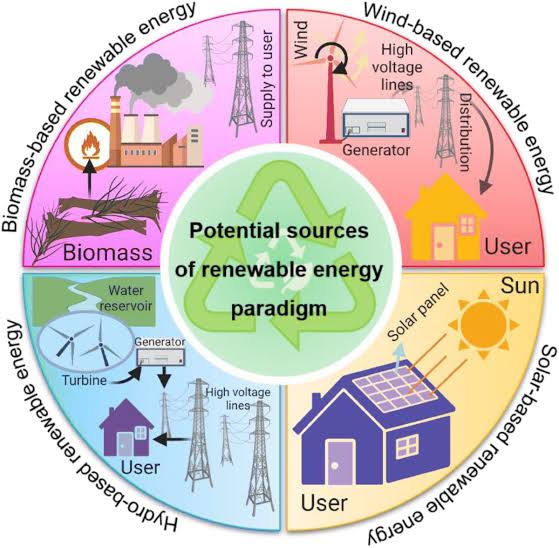
As I see it, therefore, the future of energy security, especially in rural communities, lies in hybrid bio-solar and bio-wind microgrids. In these systems, solar or wind power serves as the primary energy source during peak daytime or windy conditions. When these sources drop, a localised, automated biomass gasification system fueled by a continuous, scientifically managed pipeline of forestry and sawmill residues kicks in seamlessly to provide baseline power. Biogas is here to serve us. It should be utilised. Since forests produce biomass, we can maintain them as a living component of solar and wind grid infrastructure. In this unified, resilient ecosystem the forester manages the inputs, and the engineer optimizes the outputs.
Following this line of thinking, therefore, working with foresters is a sure path for engineers to efficiently transition from carbon-emitting energy to carbon-neutral or carbon-negative energy systems. Consider establishing “energy plantations” on degraded lands. Foresters choose species that restore lands and ensure high biomass production, while engineers build localised conversion plants. Because the carbon released during biomass energy generation is exactly equal to the carbon the trees absorbed while growing, the entire cycle remains net-zero. For a country like Nigeria, heavily bedevilled by oil pollution in the Niger Delta and desert encroachment in the North, this approach lets us restore ecosystems while securing a sustainable fuel source that displaces petroleum dependency. This is beyond win-win.
Whenever issues like this are discussed and similar solutions proposed, people dismiss them as unrealistic, inefficient, expensive, and so forth. But those are not academic submissions. History offers examples of even more dismissive assumptions that innovations and engineering solutions later proved wrong. Perhaps the clearest example was the global perspective on coal in the 19th century. No sensible person thought oil would take the place of coal, and it happened. In his 1865 book The Coal Question, to show the supremacy of coal over all other alternative energy sources, the English Economist William Stanley Javons even praised the black substance as “the sole necessary basis of our material power”. And, “the naturally best source of power as air and water and gold and iron are, each for its own purpose, the most useful substances and such that would never be superseded.” Javons published his work when oil wasn’t even discovered in commercial quality. But alternatives always exist.
Back to the solution. The engineering-forestry partnership is very relevant to the Global Agenda 2030, famously known as the United Nations’ Sustainable Development Goals (SDGs). When we fuel decentralised bioenergy grids with managed forest products, we directly support SDG 7 (Affordable and Clean Energy) by providing power to communities using local resources. And because this energy cycle displaces fossil fuels and prevents open-air waste burning, it directly contributes to the almighty SDG 13 (Climate Action). Meanwhile, as foresters oversee resource generation, this energy security is achieved without destroying ecosystems. Isn’t that aligning with SDG 15 (Life on Land)?
The marriage of engineers and foresters also breathes life into the African Union’s Agenda 2063, which envisions “The Africa We Want”. Its goals include climate-resilient economies and sustainable natural resource management. Genuinely, I don’t think achieving Agenda 2063 is feasible if we import foreign technological solutions wholesale and ignore local geographical realities. Instead, I see the place of capitalising on our ecological endowments (forestry) with structural innovation (engineering) to pioneer a uniquely African model of green industrialisation.
Notably, I believe this collaboration is the missing key to the Nigeria Energy Transition Plan (ETP). Nigeria’s bold roadmap to achieve carbon neutrality by 2060 includes an aggressive milestone: phasing out 72% of decentralised diesel generators by 2030. For decades, Nigerian industries and homes have run on an expensive, polluting “shadow grid” of petrol and diesel generators. To eliminate them, the ETP explicitly calls for a dramatic ramp-up in solar PV, hydro, and biomass integration. However, the ETP’s ambitious targets are mathematically impossible if treated as purely mechanical problems. We cannot replace millions of diesel generators with intermittent solar power alone. As argued in this piece, we need a steady, dispatchable baseline power source. Sustainable biomass, managed by professional foresters and processed by engineers, provides that exact baseline. Without the forester to secure a sustainable, non-deforesting supply of wood residue, sawdust, and other forms of biomass waste, the engineer’s transition turbines will simply run out of fuel.
There’s no doubt at all: the complex riddle of Nigeria’s energy security will not be solved by a single breakthrough in a software lab, nor will it be answered by digging deeper into old oil wells. The challenges of our time demand that we outgrow the rigid intellectual silos built into our university curricula and professional institutes. As long as engineers look only at cables and solar panels, and foresters look only at climate change impacts on biodiversity and nature conservation, we will remain trapped in a landscape of fragmented, half-baked solutions.
Go to Brazil, and so forth; the story is different. It says we are behind. It says it’s doable.
It’s therefore high time we rethink what “technology” actually means. In my view, a forest gives us fertile ground to invent and test technologies. A tree is a highly sophisticated solar-powered machine that captures carbon, cools the environment, and manufactures organic energy. When we learn to treat the forest as a vital partner in our infrastructure plans, we unlock an entirely new toolkit for national development.
As a forester, I invite engineers to a talk on and in the forest. I am confident that together, through the shared practical language of the applied sciences, we can build a highly resilient, decentralised, and truly self-sustaining Nigeria. The answers, I opine, to our nation’s energy security are growing right outside our windows, waiting for us to start talking.
It’s July. We are in the second half of 2026. Those farmers who, during the first half of the year, prepared their lands in what the agronomists call [pre-planting] “cultural practices”, are today already smiling. Others are probably green with envy. A famous proverb attributed to ancient Chinese wisdom captures my call for a proactive mindset. “The best time to plant a tree was 20 years ago. The second best time is now.” I believe this proverb perfectly mirrors my visionary argument. A long-term proposal that says we haven’t done what we should have, but still, we should.
Abubakar Idris, a graduate in Forestry and Wildlife from the University of Maiduguri, writes from Benin City, Nigeria. He can be reached at abubakaridrismisau@gmail.com.