By Hamza Muhammad Tasiu 

Let’s imagine this: 

You are a young mother. You leave Kaduna a few days earlier for a task in Abuja. After finishing the task, you call your husband and tell him that you will be coming back and that he should buy your best food from your best restaurant for you. You tell him how badly you miss him. You tell him that you’ve bought his favourite perfume for him. You even tell him that he should tell your little daughter that you have bought her a special present from Abuja.

And given that this is the first time you go to Abuja, you tell him that you have a lot of stories from the nation’s capital. So you stop and buy your mother apples and pineapples on your way to the train station. You also buy a new shirt for the Almajiri that runs errands for you.

You leave Idu station at 6 pm and are scheduled to arrive at Kaduna’s Rigasa train station by 8 pm. On the train, you say salaam to the other occupants and shake their hands. You smile at a little girl, and she smiles back. Her cute smile injects you with a dose of happiness you’ve not felt in a long time. The woman sitting next to you is an elderly woman in her late 60s. She looks like your mother. She starts a conversation, and, before long, you feel at home with her. You talk about a lot of things with her. You talk about the month of Ramadan and how you plan to spend it. You even tell her your readiness to fast throughout Ramadan as your ulcer seems to become dormant lately. She complains that she cannot fast as she is on medication. She says she will fast after finishing her drugs. 

Not more than 30 minutes into your journey, that woman now seems like someone you have known for many years. Amidst the exciting conversation you are having, she suddenly falls asleep. You want to continue the conversation but feel it uncourteous to wake her up from sleep. You allow her to continue sleeping. Before long, you also get overpowered by sleep due to the exhaustion from your work in Abuja. Suddenly, you wake up to the sounds of explosions and gunshots. In what seems like the twinkle of an eye, all the unlucky passengers are rounded up by the terrorists. They rain all sorts of abuse on you and force you to walk for tens of kilometres on foot in the bush.

Days have now become months, and you are still under the pharaonic care of these terrorists. You look at that older woman, and you feel sorry for her. Her health is deteriorating as she does not have the drugs that she takes three times a day. She often tells you in the night: “Zan mutu ‘ya ta. Ga ruwa, ga sauro, ga yunwa, ga duka, ga jinya. Ba zan iya ba. Karfi na ya kare!” But you give her words of encouragement and ask her to keep on, promising her that God will bring help.

Your comments seem to boost her spirit. She says to you: “Allah Ya miki albarka ‘ya ta. Da ba dan ke ba, da bansan inda zan sa kaina ba.” As soon as she closes her mouth, one of the terrorists says to her: “Idan ba kiyi shiru ba hajiya, zan zane ki wallahi! Kar kiga shekarun ki, yanzu zakiyi kuka wallahi! Kin manta dukan da aka muku da safe koh?” 

The elderly woman then says, somehow inaudibly: “Ya Allah ka saka mana. Ka mana hisabi da wadanda suka daurawa kansu nauyin kare mu amma suka banzantar da nauyin da suka daurawa kan su, amin.” As if someone has put her on a speaker, all the kidnapped victims say, “amin” in a resounding voice. The terrorists then descend on them, beating them mercilessly, saying: “Mu zaku hada da Allah? Wallahi zamu kashe ku gaba daya! Matsiyata kawai! Tsinannu! Idan ba a bamu kudi ba, wallahi sai mun kashe ku duka! Wahalallun banza! Dangin matsiyata!” You become angry because of the abuses they rain on you because you are someone your people highly respect, but then you remember there’s nothing you could do.

Back at home, your little daughter has been waiting for you for more than 100 days! All she can do is to pray to Allah to rescue you. She often tells her father: “Baba ni na hakura da present din, kawai ni mama nake so na gani. Dan Allah ka dawo da ita!” The father goes into his room and cries because there’s nothing he can do. He raises his hands in prayer: “Verily, the most helpless of people are those that are unable to ask for Your help. We ask for Your help regarding these servants. Rescue them, Ya Allah!

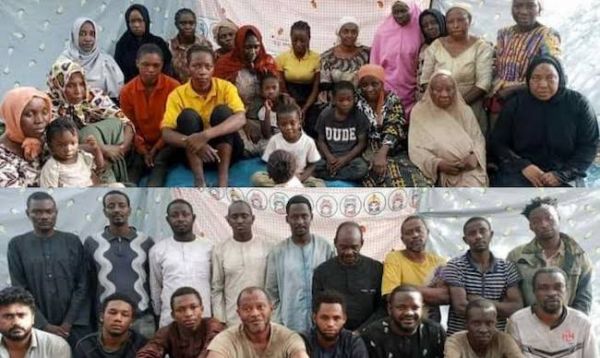
If this story touches you, then wait a minute and reflect on what the kidnapped victims are going through. Think of what their families are going through after watching that video. It’s devastating, to say the least. May God rescue them! The leadership has failed them!

Hamza Muhammad Tasiu 

ByAdmin

Leave a Reply

Your email address will not be published. Required fields are marked *

In Case You Missed It

THE KANO RENAISSANCE: HOW GOVERNOR ABBA KABIR YUSUF IS REWRITING THE STORY OF DEVELOPMENTBy Dr. Saifullahi Shehu ImamAs Kano State marks the third anniversary of Governor Abba Kabir Yusuf’s administration, the evidence of purposeful leadership is visible across every corner of the state from the bustling metropolitan center to the remotest rural communities. Today, the popular expression #ABBAISWORKING is no longer a mere political slogan; it has become a verified reality, supported by over 1,000 major achievements that have fundamentally reshaped the developmental trajectory of Nigeria’s most populous state.Perhaps no sector reflects Governor Yusuf’s vision for human capital development more than education. His administration has fundamentally transformed education in Kano by declaring a State of Emergency and allocating an unprecedented 30–31% of the annual budget, the highest in the nation. This historic fiscal commitment was sustained through the subsequent fiscal cycles, securing education as the primary pillar of governance. Across all 44 Local Government Areas, the administration has directed over ₦1.9 billion through the Community Re-orientation Committee (CRC) to renovate thousands of primary classrooms, plus an additional ₦2.9 billion to build new classroom complexes, decongesting urban schools and constructing modern administrative offices. Over 80,000 sets of three-seater desks have been supplied, rescuing more than 240,000 students from learning on bare floors. The government has hired and integrated over 14,000 permanent, pensionable teachers, including thousands of former BESDA volunteers. Financial barriers have been lowered by providing free textbooks and uniforms for primary students, slashing tertiary registration and tuition fees by 50% at state-owned institutions, and funding examination fees for hundreds of thousands of secondary candidates. The state’s strict targeted funding model has borne immediate fruit, propelling Kano to the top of the national performance chart in the 2025 NECO exams. Furthermore, the revival of the 1,001 Foreign and Domestic Postgraduate Scholarship Scheme has cleared multibillion-naira arrears for stranded medical and engineering scholars in Cyprus and sponsored new cohorts to India and across Nigeria. This holistic investment in infrastructure, teacher welfare, and global scholarships represents the largest commitment to public education in Kano’s recent history, ensuring today’s students become tomorrow’s leaders.In healthcare, the administration has achieved monumental, system-wide progress by matching robust institutional investment with deeply compassionate public policy. This vision is explicitly backed by an aggressive fiscal strategy; for the 2025 fiscal year, over ₦90 billion amounting to an impressive 16.5 percent of the state’s total budget has been earmarked for healthcare development. This substantial investment underscores the administration’s unwavering commitment to making healthcare a cornerstone of its governance, moving far beyond basic audits and surveys into real, well-funded structural transformation. A landmark triumph of this commitment is the recovery, comprehensive modernization, and recommissioning of the Hasiya Bayero Pediatric Hospital, a vital 86-bed facility that had been controversially sold, now restored to provide specialized care for Kano’s children. In tandem, the administration has completely remodeled and equipped the critical accident and emergency section of the Murtala Muhammad Specialist Hospital (MMSH) and extensively renovated the Bamalli Nuhu Maternity Hospital to drastically combat maternal and infant mortality rates. To institutionalize these health safeguards, the Governor signed the pioneering Kano State Centre for Disease Control and Prevention Law alongside a mandatory Premarital Health Screening Law to shield future generations from preventable illnesses. These structural transformations ensure that high-quality healthcare is no longer a luxury reserved for a privileged few, but an accessible, everyday right for all Kano citizens.In the realm of agricultural transformation and food security, the administration has shifted Kano from a reliance on subsistence farming to a powerhouse of agribusiness. Championing a multi-billion naira input initiative, Governor Yusuf flagged off the historic distribution of 79,200 bags (132 trucks) of highly subsidized fertilizers from the Al-Yuma Fertilizer plant in Madobi Local Government, slashing procurement costs by a massive 50% for local farmers across all 44 LGAs. This was bolstered by an additional ₦1 billion worth of free NPK fertilizers distributed via the Kano Agricultural Supply Company (KASCO) specifically targeting smallholder, female, and disabled farmers. To expand year-round farming capacity, the administration has expanded farmlands and successfully rehabilitated major irrigation schemes across 11 Local Governments, bringing over 1,250 hectares under active development. A crown jewel of this infrastructural strategy is the approval of ₦6.8 billion for the massive Dansoshiya Dam and Irrigation Infrastructure Project in Kiru LGA, designed with a projected storage capacity of 3.1 billion liters of water to empower up to 3,000 farmers in its initial phases alone. These deliberate investments have reduced cultivation overheads, multiplied crop yields, and fortified the regional food supply chain.Youth empowerment and self-reliance form another vibrant pillar of the Kano Renaissance. Rejecting the old paradigms of political exploitation, Governor Yusuf launched a comprehensive master plan to empower 50,000 young people. The administration began by systematically reviving eight specialized entrepreneurship and vocational institutes that had been abandoned by the previous administration. Highlighting this return to functional capacity, a single cohort of 2,260 graduates recently completed training across these institutes including the Informatics Institute, the Horticultural Institute, the Driving Institute, and the Poultry Institute. These youths left the Government House not just with certificates, but with critical operational assets ranging from laptops, tablets, and toolkits, to livestock and feed, alongside financial seed capital to seamlessly launch their commercial journeys.On the security front, proactive, intelligence-driven governance has kept Kano State remarkably peaceful and stable despite intense national security challenges. Governor Yusuf has aggressively reinforced the state’s security architecture by assenting to the law establishing the state’s independent Kano State Security Neighborhood Watch, bringing community policing directly to the grassroots. To maximize operational efficiency and response times, the administration recently boosted the Joint Task Force (JTF) operations by distributing dozens of new vehicles and motorcycles across frontline Local Government Areas. This sustained tranquility stands as an absolute testament to a leadership that deeply understands that the first, most non-negotiable duty of government is the absolute security and welfare of its people.As the people of Kano celebrate these remarkable achievements, there is a growing consensus that continuity will be essential to consolidate the gains already recorded. The transformation witnessed across the state has inspired renewed confidence in leadership and strengthened public optimism about the future. It is therefore understandable that many citizens, stakeholders, professionals, traditional institutions, and community leaders increasingly look toward 2027 with the hope that Governor Abba Kabir Yusuf will be granted another mandate to deepen ongoing reforms and complete the noble work he has begun.May Almighty Allah continue to grant His Excellency wisdom, strength, good health, and divine guidance in the service of Kano State. And may the overwhelming achievements of the past three years pave the way for a successful re-election in 2027, ensuring that the Kano Renaissance continues uninterrupted for the benefit of present and future generations.