By Uzair Adam
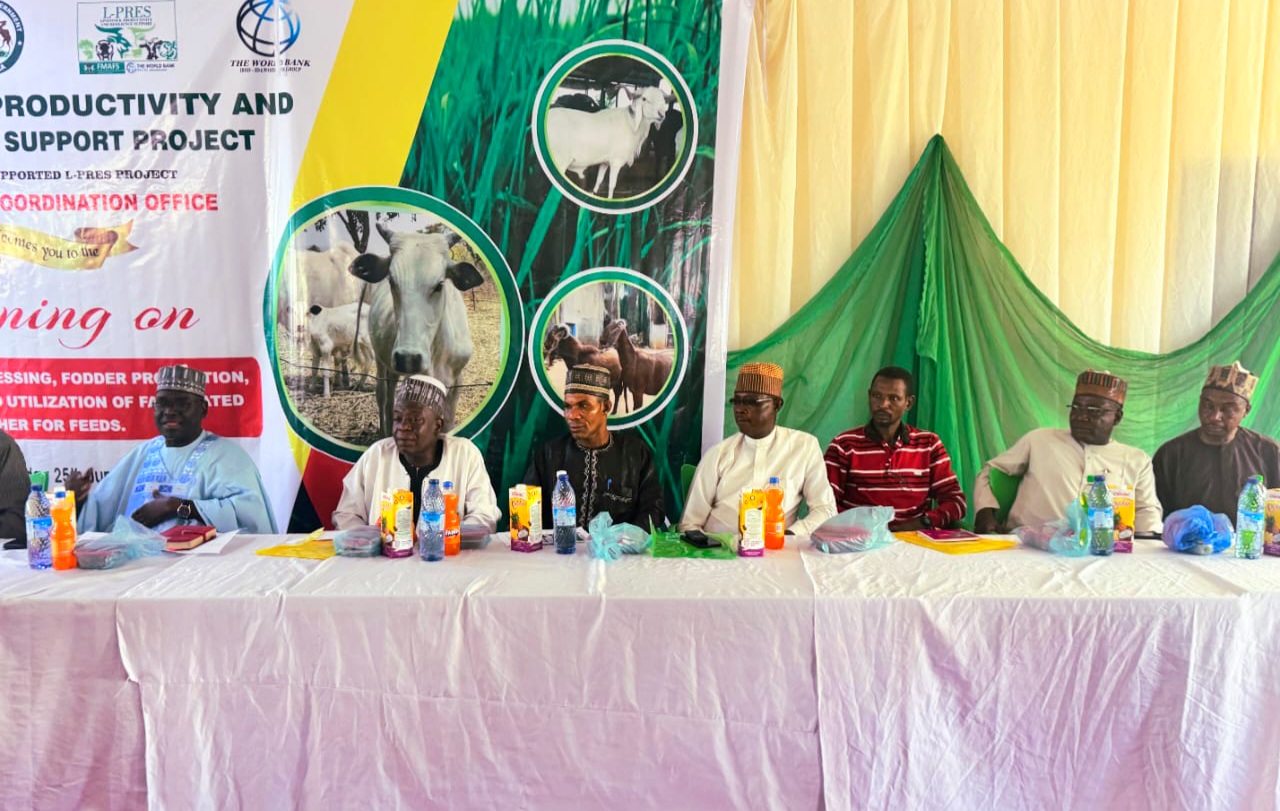
The Livestock Productivity and Resilience Support Project (L-PRES) has commenced a two-day training programme for livestock farmers and other stakeholders in Kano State on crop residue processing, fodder production, silage making and the utilisation of fabricated feed crushers aimed at reducing feeding costs and improving livestock productivity.
The programme, which began on Wednesday, is bringing together more than 200 participants representing over 100 livestock-related groups, including herders, poultry farmers, milk producers, butchers and private sector operators from across the state.
The training focuses on practical methods of converting crop residues and other agricultural waste into affordable and nutritious animal feed while fostering collaboration among stakeholders across the livestock value chain.
The initiative also serves as a platform for participants to exchange ideas, share experiences and explore partnerships that could enhance livestock production and strengthen resilience within the sector.
Explaining the rationale behind the programme on behalf of the Kano State Project Coordinator, Salisu Muhammad Inuwa, Gambo Isah Garko, an Extension Officer with L-PRES in Kano State, said livestock feeding remains one of the biggest challenges confronting producers, particularly during the dry season.
According to him, many livestock producers struggle to access affordable feed, making it necessary to train them on how to convert crop residues into valuable feed resources rather than allowing them to go to waste.
“Feeding has become very difficult. That is why we are giving them this training so they can utilise crop residues and other agricultural waste for livestock feeding,” he said.
Garko explained that participants were being taught how to improve the nutritional value of crop residues through the use of additives and appropriate processing methods.
He said the training would help farmers better understand livestock nutritional requirements and adopt feeding practices that improve animal growth and productivity.
Beyond improving feeding practices, Garko said the programme was designed to strengthen collaboration among stakeholders in the livestock sector.
“We have called major players across the value chain because this gives them an opportunity to interact and establish linkages that will benefit everyone,” he said.
He disclosed that about 200 participants attended the programme, representing 110 groups, including livestock breeders’ associations, poultry farmers, butchers, milk producers and private livestock operators.
Garko further noted that adopting the feed-processing techniques being taught could reduce livestock feeding costs by as much as 40 per cent.
According to him, farmers can significantly cut expenses by processing crop residues such as corn stalks and incorporating them into animal feed instead of depending entirely on commercial feed products.
“Using crop residues together with the crusher machines will drastically reduce production costs while maintaining or even improving the weight gain of animals,” he said.
He further revealed that L-PRES had distributed more than 210 feed crusher machines to livestock groups and farms across Kano State and was planning additional support for poultry feed production.
Garko urged participants to put the knowledge gained into practice and share it with other farmers in their communities.
“The purpose is not just to learn but to practice what has been learned and pass the knowledge to others,” he added.
The emphasis on practical application was echoed by Sule Saleh, Value Chain Officer of Enterprise Project Canada, who explained that the training was intended to ensure beneficiaries effectively utilise and maintain the feed crusher machines distributed under the project.
He said the machines were provided as common-user assets to cooperatives rather than individuals, enabling more farmers within each community to benefit from them.
“The project has distributed these machines across farmer groups, and this training is to show them the best way to operate and maintain them in an environmentally friendly manner,” Saleh said.
He noted that sustainability was a key component of the intervention, with beneficiary groups expected to establish committees responsible for overseeing repairs, maintenance and proper utilisation of the machines.
“We are confident that these arrangements will sustain the equipment and even encourage associations to acquire additional machines in the future,” he said.
Saleh advised participants to make proper use of the knowledge, equipment and other interventions provided under the project.
“Government is not providing these interventions for the sake of it. They are meant to improve your capacity, increase your income and enhance your livelihoods,” he said.
Beyond the technical aspects of feed production, the training also highlighted government efforts aimed at strengthening agriculture and livestock development in the state.
Speaking at the event, Abubakar Muhammad Kabiru, Animal Husbandry Officer with L-PRES, commended the Kano State Government for its continued support to the agricultural and livestock sectors.
He acknowledged the commitment of Governor Abba Kabir Yusuf to programmes aimed at improving agricultural productivity, strengthening livestock production and enhancing food security across the state.
Kabiru encouraged participants to actively engage in the training and apply the skills acquired in their farms and businesses.
“The success of this intervention depends largely on your commitment to applying the lessons learned in your farms, businesses and communities,” he said.
Participants, meanwhile, welcomed the initiative, describing it as a timely intervention for addressing the persistent challenge of livestock feeding.
Among them was Lawan Muhammad Alaramma, Chairman of the Fulani Union of Milk and Fura Sellers, who expressed appreciation to L-PRES for organising the training.
Alaramma said the scarcity of animal feed remained one of the biggest challenges confronting Fulani herders, often forcing them to travel long distances in search of pasture and exposing them to numerous hardships.
He noted that the training, coming after the distribution of feed crusher machines to livestock groups, would help farmers make better use of available resources and improve productivity.
“This is the kind of training we have been looking for over a long period. Feed is our major challenge, and this knowledge will help us overcome many of the difficulties we face,” he said.
Kano L-PRES Equips Farmers with Skills in Crop Residue Processing, Silage Making

ByAdmin
25 June 2026