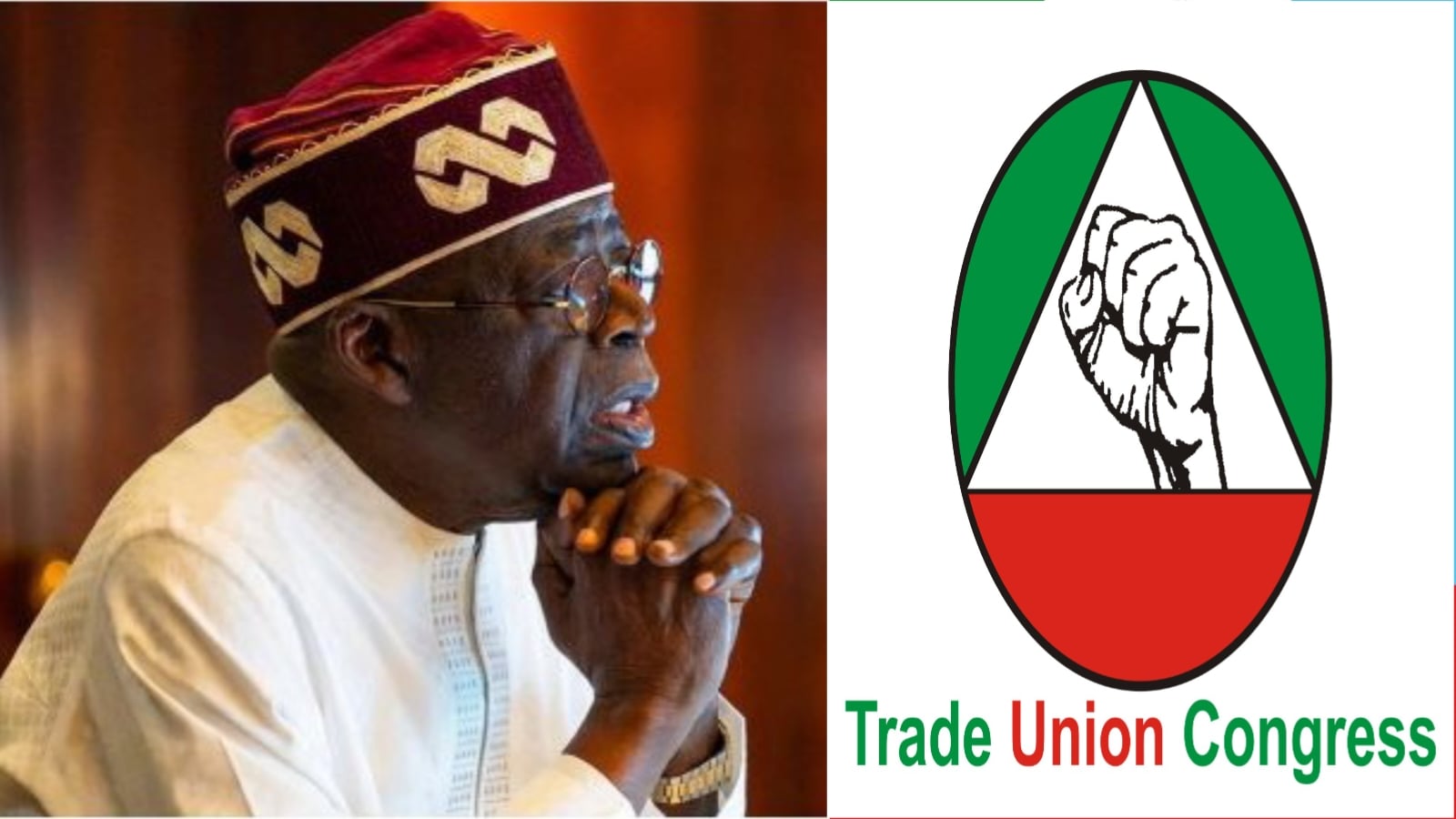
By Sabiu Abdullahi
The Trade Union Congress of Nigeria (TUC) has rejected the Federal Government’s proposed ₦70,000 monthly wage award for federal workers, demanding instead that the minimum salary for the lowest-paid worker be increased to ₦300,000.
The union said workers needed a substantial and sustainable salary increase rather than temporary financial support that might not benefit all eligible employees.
The proposal followed a meeting between the Federal Government and the leadership of the Nigeria Labour Congress (NLC) to discuss workers’ welfare and measures to address the rising cost of living.
In a statement signed by its President-General, Festus Osifo, and Secretary, Nuhu Toro, the TUC also called for the implementation of the agreement reached with the Joint Health Sector Unions (JOHESU).
“Our position is unequivocal: workers are not asking for favours; they are demanding social and economic justice that protects their dignity and livelihoods,” the statement said.
TUC questions implementation of previous wage awards
The union expressed concerns over the implementation of previous wage awards, arguing that the government had yet to fulfil its earlier commitments to workers.
According to the TUC, the wage award introduced in October 2023 was not fully implemented before the parties reached an agreement on a new national minimum wage in 2024.
It claimed that some workers received payments for only one or two months, while others did not receive any payment.
The union also criticised the irregular payment of the previous ₦40,000 wage award, alleging that some workers received payments covering up to four months without a consistent monthly schedule.
It further claimed that more than 80 per cent of state governments and employers in the informal sector did not implement any form of wage award.
The TUC questioned the rationale for introducing another temporary payment while, according to the union, previous commitments remained outstanding.
“How can workers be expected to trust fresh promises when previous obligations remain outstanding?” it asked.
Union seeks sustainable salary increases
The TUC maintained that a permanent salary increase would offer workers more reliable financial support than a temporary wage award, particularly as the prices of essential goods and services continue to rise.
It argued that ongoing negotiations over a new national minimum wage should not prevent the government from granting workers an urgent pay increase.
The union also noted that the economic difficulties extended beyond federal government employees, affecting state and local government workers, pensioners, private-sector employees and those in the informal economy.
It identified rising costs of food, transportation, healthcare and other basic necessities as major pressures on households.
Calls for broader economic measures
Beyond salary increases, the TUC urged governments at all levels to take practical measures to reduce the cost of essential goods and services.
It also called for the timely payment of salaries and pensions, protection of existing jobs and stronger action against exploitative labour practices.
The union further advocated renewed efforts to strengthen the productive sector and create decent employment opportunities.
The disagreement adds another dimension to ongoing discussions between the government and organised labour over workers’ welfare, wage adjustments and the economic pressures facing Nigerians.
The Daily Reality
TUC Rejects FG’s ₦70,000 Wage Award, Demands ₦300,000 Minimum Salary

ByAdmin
29 October 2026