
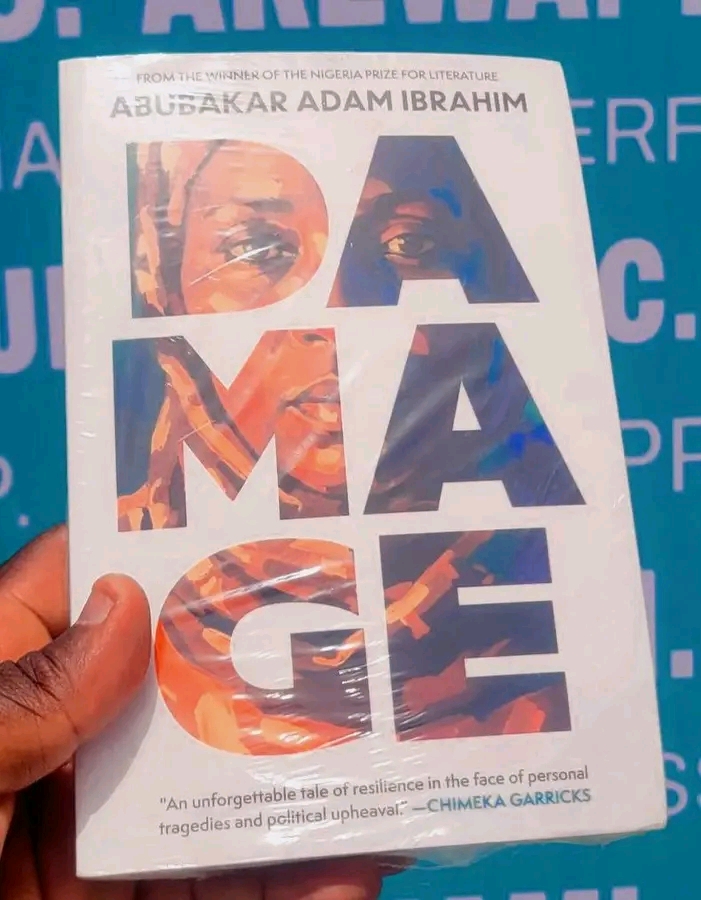
By Aliyu Idris
Damage is Abubakar Adam Ibrahim’s third novel and fifth book. It is a social novel written in twenty-two unequal chapters, set in post-colonial Nigeria during the heated military years spanning the last days of General Ibrahim Badamasi Babangida through the General Sani Abacha years, and back to the present day.
It accounts for the life of Rn. Nasrin Amin, a woman who carried a secret pain through decades of dictatorship and brutality. She was sexually assaulted by an army veteran, General Shehu Jarumai, while searching for her husband’s freedom, trying to secure the release of Aliyu Bello from Abacha’s men. She decides to speak out against Jarumai’s tyranny, which wants his secret buried. And when she does, she drags three generations with her.
For almost three decades, we have been told to move on. To forget military brutality, to forget the khaki years, to forget the frightening knocks on the door and abductions at midnight.
In addition, June 12, 1993 was the day Nasrin cast her first vote. She and her heartthrob, Aliyu Bello, thought that the election would change Nigeria. She was voting for herself. For her heart, for a new dawn, for love, for a future, for a country she believed would finally love her back.
Then one brutal night takes it all. That is the heart of Damage. Not the coup, not the annulment, not the years that followed, but what one night does to a woman and her entire clan, and how that wound keeps bleeding for 30 years.
Similarly, it bleeds into the life of her second husband, Bashar, and her children like Mustapha, the rational dreamer, who thinks logic can save a family that runs on secrets, until he meets a wound that logic cannot touch. Suraj, the second child, the awaiting soldier, who wants to become the very thing that broke his mother. Zubaida, the youngest daughter, who stands with her mother in the turbulence.
They are all haunted by one question: Who is this man (Jarumai) who caused their mother’s pain and is the frontrunner of the brutal occurrences that cost the life of their father, Aliyu Bello?
Moreover, the novel explores how our system, power structures, culture, and orientation aid and abet perpetrators. It asks a devastating question: What does justice look like when silence has already stolen so much?
When Nasrin finally waited decades to speak, the country had already moved on. But the memories kept haunting her, while the perpetrator had entirely forgotten her and the incident.
We are a new generation born after June 12, 1993, who think June 12 is just a public holiday. We don’t know or ask how people like Nasrin get justice after memory itself has been damaged.
No wonder Chika Unigwe calls it “a powerful and unforgettable story of love, loss, inherited trauma, and the relentless pursuit of justice.”
And Helon Habila is right to say you dig deep into characters’ motivations like few can. This is far beyond Season of Crimson Blossoms and When We Were Fireflies. This is his most political and most personal book yet.
As the author opined in his Line of Sight column, “The victims are bold and resolute, but the perpetrators don’t even know they are victims too, victims of the power they serve.”
Damage is not just about what was done to Nasrin on that night, or the arrest and detention of her late husband, Aliyu Bello. It is about the experiences of families with military brutalities, what it means to seek revenge, to love, to lose, to feel guilt and conviction. This is not a book about soldiers in power. It is a book about what soldiers left in us.
If Season of Crimson Blossoms was about forbidden love and When We Were Fireflies was about memory, Damage is where Abubakar fuses both concerns into something enormous.
For me, Damage is the novelist’s best work yet because it refuses to let us do what we do best as Nigerians: move on without processing. It is a story about the cost of memory, the inheritance of pain, and, as the blurb says, the fragile hope that love might endure even after everything else is broken.
To sum it up, it is an easy read with many literary tropes. It is a necessary one to read because it reminds us where we came from as a nation. It is for the generation that was brutalised and learned to be silent. For the generation that inherited the silence without knowing why. And for the generation born under democracy, the one now raising kids, the one that thinks it can romanticise military rule because they never lived it.
And in a move that will unsettle many readers, the perpetrators are also damaged. Not innocently damaged by the system they served, by their own avarice, by a military that victimised Nigeria and, in doing so, victimised itself. Just like General Jarumai and Bankole. This is what elevates it beyond a simple trauma narrative.
Aliyu Idris can be reached via aliyuidris063@gmail.com.