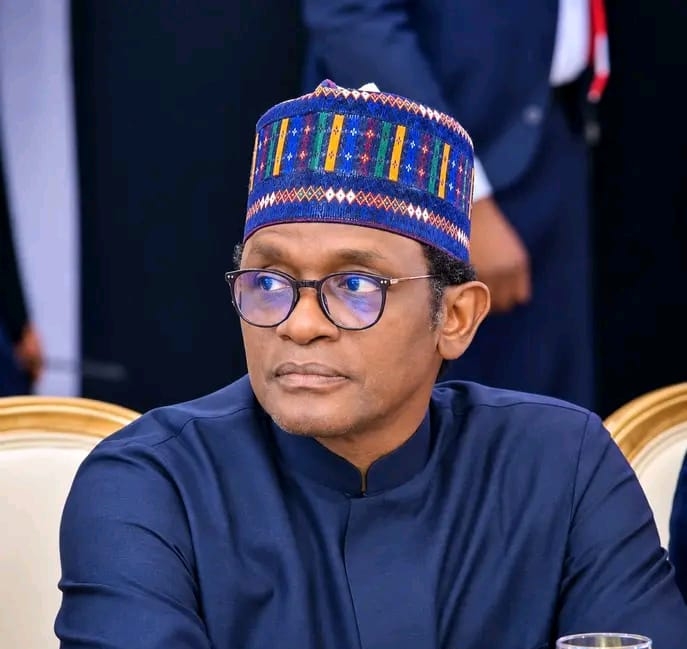
By Maji Bappa Maina
What happens when markets are no longer treated as isolated projects, but as interconnected pieces of an economic system?
That question becomes interesting when we look at the spread of modern and ultra-modern markets being developed across Yobe State under Governor Mai Mala Buni.
From the Yobe City Mall in Damaturu to markets in Yunusari, Potiskum, Nguru, Gashua and Ngalda, and from Geidam, Buni Yadi, Machina and Jajere to Ngelzarma, Sabon Garin Nangere, Yusufari, Jajimaji, Bumsa and Gir Gir, the locations tell a story that goes beyond the construction of individual market buildings.
They suggest a broader attempt to create an economic network across the state.
To understand this, perhaps we need to change the way we look at a market.
A market is not simply a place where people come to buy and sell.
It is where farmers meet traders, where goods move from producers to consumers, where transporters find business, where small enterprises grow, where money circulates and where economic relationships are created.
In development planning, therefore, the location of a market can be just as important as the structure itself.
Consider Geidam.
Its proximity to Nigeria’s border with Niger Republic gives commercial infrastructure there a significance that extends beyond the immediate community.
A functional market in such a location can potentially serve local commerce while also connecting Yobe to wider patterns of regional trade.
Then consider Nguru, Gashua and Machina.
These are important points within Yobe’s commercial geography.
When modern trading facilities are introduced in such locations, they can help distribute economic activity across different parts of the state rather than concentrating everything around the capital.
Then there is Potiskum, with its long-standing reputation as one of the major commercial centres of Yobe.
And in Damaturu, the Yobe City Mall introduces another form of commercial infrastructure, one associated with a more formal and modern retail environment.
But perhaps the more interesting part of the strategy is found outside these major centres.
Ngalda. Buni Yadi. Jajere. Yusufari. Sabon Garin Nangere. Jajimaji. Bumsa. Gir Gir.
Why invest in markets across such a wide geographical spread?
Because development does not become inclusive simply because a state has a few major commercial centres.
Economic opportunity has to be connected to where people actually live and produce.
A farmer in a rural community needs somewhere to sell.
A trader needs somewhere to operate.
A transporter needs somewhere goods can be aggregated.
A small business needs customers.
And consumers need accessible places where goods and services can be exchanged.
This is where Governor Buni’s market strategy becomes interesting from a public-policy perspective.
The question is no longer simply how many markets are being constructed.
The more important question is:
What economic relationships can these markets create when they begin functioning as a network?
Imagine the possibility.
A farmer produces in one community.
The produce moves to a nearby market.
From there, traders aggregate it and transport it to a larger commercial centre.
From a major centre, goods can move toward other parts of Yobe or beyond the state.
At the border, commercial activity can potentially connect with regional markets.
Along the way, transporters, wholesalers, retailers, financial institutions and small businesses participate in the same economic chain.
That is how infrastructure begins to function as an economic ecosystem.
And there is another important dimension.
For a state that has experienced prolonged disruption to economic activities in some communities, rebuilding commercial infrastructure can also contribute to restoring normal economic life.
A market can become a sign that people are returning to ordinary economic activity.
Traders return.
Customers return.
Farmers have somewhere to sell.
Young people can establish small businesses.
Communities begin to reconnect economically.
In that sense, the market becomes part of a wider process of economic recovery and reintegration.
But there is a deeper lesson here for public administration.
Government projects should ultimately be judged not only by what is constructed, but by the systems they help create.
A beautiful market that remains empty is infrastructure without sufficient economic function.
A functioning market, however, can generate activity far beyond its walls.
That is why the next phase becomes just as important as construction itself.
Will traders occupy the shops?
Will farmers gain easier access to markets?
Will storage facilities reduce post-harvest losses?
Will transport networks connect the markets efficiently?
Will financial services follow the commercial activity?
Will the markets create employment?
Will they contribute to sustainable internally generated revenue?
These questions will determine whether the buildings become genuine economic assets.
And this is perhaps the most interesting way to understand the direction Governor Mai Mala Buni appears to be taking with market infrastructure.
The strategy is potentially bigger than building markets.
It is about creating places through which economic activity can move.
From Damaturu to Geidam, from Potiskum to Nguru, from Gashua to Ngalda, and from the larger towns to smaller communities, these projects can be understood as nodes within a wider economic geography.
The Yobe City Mall represents one end of that commercial spectrum.
The border communities represent another.
The modern markets scattered across the state provide the connecting points in between.
And when those points begin functioning together, something more important than individual buildings can emerge: a more connected local economy.
Perhaps, therefore, the real measure of this strategy will not be the number of markets opened.
It will be the number of economic opportunities that begin moving through them.
Because in development, infrastructure matters most when people can use it to move goods, services, ideas, income and opportunity.
That is where a market stops being merely a building.
It becomes part of the development system.
Maji Bappa Maina is a Political Writer | Voice of Development, Leadership & Public Insight
Where Governor Buni’s Market Strategy Becomes a Public-Policy Question

ByAdmin
17 September 2026