By Sabiu Abdullahi
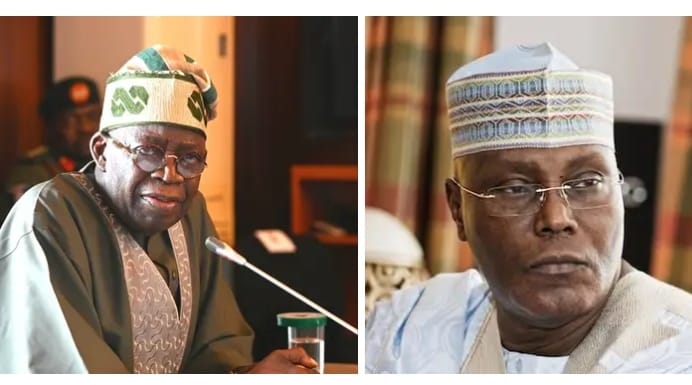
Former Vice President Atiku Abubakar has criticised the Tinubu administration’s defence of its economic policies, insisting that government statements cannot hide the hardship many Nigerians continue to face.
Atiku, the presidential candidate of the African Democratic Congress (ADC), made the remarks in a statement issued on Monday by his Senior Special Assistant on Public Communication, Phrank Shaibu. The statement followed recent exchanges between the Presidency and the former vice president over the government’s economic reforms, borrowing, tax policies and the impact of the removal of petrol subsidy.
The Presidency, through Bayo Onanuga, Special Adviser to the President on Information and Strategy, had defended the administration’s policies. Onanuga argued that one of the major gains of fuel subsidy removal was the significant increase in allocations to states and local governments through the Federation Account Allocation Committee (FAAC).
Responding, Atiku accused the administration of focusing on what he described as public relations and “statistical manipulation” instead of addressing the country’s economic challenges.
He questioned the government’s positive assessment of the economy.
“If the economy is doing so well, why are Nigerians getting poorer?” he asked.
According to him, the government’s emphasis on favourable economic indicators does not reflect the realities facing ordinary citizens.
“The State House celebrates macroeconomic indicators while ordinary Nigerians struggle with microeconomic realities,” he said.
“It speaks glowingly about GDP growth while families skip meals. It boasts of debt ratios while businesses shut their doors. It trumpets reforms while millions of citizens slide deeper into poverty.”
Atiku maintained that the true measure of any government should be the welfare of its people rather than economic figures.
“Governments are not elected to improve spreadsheets. They are elected to improve the lives of their people,” he said.
“Nigerians cannot eat GDP. They cannot cook with debt-to-GDP ratios. They cannot pay school fees with statistical projections.”
The former vice president also rejected the Presidency’s position that critics rely on outdated information. He argued that the effects of the administration’s policies remain evident across the country.
“The Tinubu administration is asking Nigerians to forget the very policies whose consequences they continue to endure every day,” he said.
“Economic policy is not a light switch. The consequences of reckless decisions linger long after the announcements have faded.”
Atiku further questioned why the government continues to borrow despite its claims of improved revenue generation and stronger tax collections.
“If revenue has improved so dramatically, if subsidy has been removed, if tax collection has increased, and if debt servicing has supposedly become more manageable, why does this administration continue to borrow at record levels?” he asked.
He also argued that Nigerians have yet to enjoy the promised benefits of fuel subsidy removal.
“Three years later, Nigerians are entitled to ask: where are those dividends?” he said.
“Instead of relief, they have experienced the highest fuel prices in history, unprecedented transport costs, soaring food inflation, collapsing purchasing power and an economy where millions now struggle to afford even one decent meal a day.”
The ADC presidential candidate criticised the administration’s tax reforms. He said businesses are under pressure because of rising production and operating costs. He added that the government’s performance should be judged by improvements in education, healthcare and living standards.
Citing figures from the Manufacturers Association of Nigeria (MAN), Atiku said 767 manufacturing firms have shut down, while another 335 are operating under distress. He also said manufacturers are holding about ₦2.14 trillion worth of unsold finished goods. He noted that multinational firms such as Procter & Gamble, GlaxoSmithKline, Sanofi and Kimberly-Clark have exited local manufacturing operations.
According to him, those developments provide a clearer picture of the economy than official government claims.
“The true verdict on this administration’s economic policies is not written by government spokespersons,” he said.
“It is written in the silent factories, the abandoned production lines, the shuttered warehouses, the unemployed workers and the empty pockets of millions of Nigerians. No amount of propaganda can erase that reality.”
He urged the Presidency to focus on improving the living conditions of Nigerians instead of defending its economic record through public statements.
“Governments are not judged by the elegance of their press statements or the sophistication of their economic theories,” he said.
“They are judged by whether families can afford food, whether businesses can survive, whether young people can find jobs, whether communities are secure, and whether citizens have hope for tomorrow.”
Again, Atiku Replies to Presidency, Says Propaganda Cannot Mask Nigerians’ Economic Hardship

ByAdmin
4 August 2026