By Sabiu Abdullahi
An Israeli settler has defended recent attacks on Palestinian communities in the occupied West Bank, describing them as justified retaliation after the killing of a security guard from the Havat Gilad outpost.
The remarks came during an interview with the BBC, which gained rare access to Havat Gilad, an Israeli settler outpost located deep inside the occupied West Bank.
Violence escalated in the area last weekend after an Israeli security guard from Havat Gilad died during a confrontation between Israelis and Palestinians in the nearby village of Tal. Four Palestinians and one Israeli soldier also lost their lives in the incident, although reports said the circumstances that triggered the clash remain disputed.
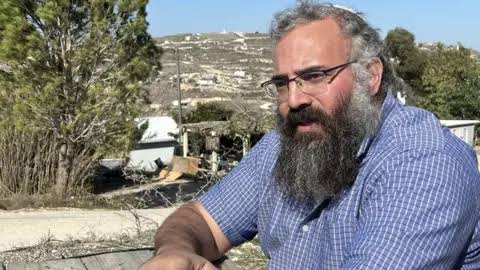
During the interview, Yehuda Shimon, a lawyer who represents Israelis accused of attacking Palestinians, defended the reprisals against nearby Palestinian villages.
“I think now, after they killed one Israeli, we need to kill all the people in Tal and Sarra, even Jit and Farata,” he said, referring to neighbouring Palestinian communities.
When questioned about equating the death of one Israeli with the lives of hundreds or thousands of Palestinians, Shimon replied: “No, millions. One Jewish life, it’s 10 million [Palestinians].”
Asked whether his comments were racist, he did not deny the accusation.
“Yes, I know,” he replied. “But this is the truth, because God chose us [and] because of this you are jealous.”
The BBC noted that such views are rejected by many Israelis. However, it said they help explain the growing tensions in the West Bank, where Israeli settlements and unauthorised outposts continue to expand amid rising violence against Palestinians.
Many settlers in outposts such as Havat Gilad believe the West Bank was divinely promised to the Jewish people. International law considers both authorised Israeli settlements and unauthorised outposts in the occupied territory illegal.
Shimon dismissed international legal objections. He argued that biblical claims supersede international law. He also criticised the Israeli government and military, claiming they have not done enough to support Jewish claims to the land.
“The Israeli government and the Israeli army, they like the United Nations – if Palestinians come and Jewish people come, [they] don’t kill the Palestinians, [they] just separate the people,” he said. “Afterwards, because they don’t kill Palestinians, the Palestinians kill us.”
However, figures from the United Nations Office for the Coordination of Humanitarian Affairs (OCHA) present a different picture. According to the agency, 64 Palestinians were killed in the West Bank between the beginning of the year and July 20. It said 18 of those deaths occurred during settler attacks. At least 12 victims were reportedly killed by settlers, while three died at the hands of Israeli forces. Responsibility for three other deaths remains under investigation. OCHA also recorded one Israeli death during the same period.
The UN agency further reported that injuries caused by settler attacks have increased sharply this year, with more than three Palestinians injured each day on average.
Shimon also alleged that international media had accepted what he called the Palestinian narrative. He claimed, without presenting evidence, that Palestinians in the area were heavily armed and intended to repeat the Hamas-led attacks of October 7, 2023.
“If we don’t wake up and drop them all from this area, from all areas of Israel, even Gaza too, they will come back, and come back [again],” he said.
The report noted that Israeli settlers in the West Bank are protected by the Israeli military and local armed security units. Palestinians, on the other hand, remain under Israeli military occupation and face movement restrictions through checkpoints and road closures. Some international human rights organisations have described the system as “apartheid,” a characterisation Israel has rejected as “absurd and distorted.”
When asked about the future of Palestinians in the West Bank, Shimon outlined three options.
He said they could remain under Israeli rule, relocate voluntarily to Arab or Muslim countries, or face deadly consequences if they continued to resist.
“if you don’t want to make peace with us, and you don’t want to get out, I don’t have a choice: I must kill you, and I kill you all,” he said.
The BBC also highlighted similarities between Shimon’s views and proposals previously advanced by Israeli Finance Minister Bezalel Smotrich. Before joining the government, Smotrich proposed that Palestinians either abandon demands for statehood and live under Israeli rule, leave the territory voluntarily, or face military action if they continued armed resistance.
Meanwhile, many Palestinians living near Havat Gilad told the BBC they feel abandoned and vulnerable. They accused Israeli forces of prioritising the protection of settlers while leaving Palestinian communities exposed to repeated attacks.
“It’s a very bad situation,” one resident said. “Europe is busy, America is occupied with Iran, China doesn’t care, Russia is fighting Ukraine, the UN are finished and the Arabs have internal problems. We don’t know what we can do.”
Israeli Settler Defends Killings in Gaza, Claims One Israeli Is Worth More Than 10 Million Palestinians

ByAdmin
1 August 2026