By Sabiu Abdullahi
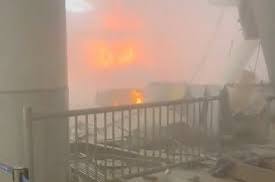
At least one person was killed and 63 others sustained injuries after an Iranian drone struck a passenger terminal at Kuwait International Airport on Wednesday, amid renewed hostilities involving Iran and US forces in the Gulf region.
Indian authorities confirmed that the victim was an Indian national, while several other citizens were among those injured in the attack.
Kuwait’s military strongly condemned the incident and described it as an act of “criminal Iranian aggression”. Iran’s Revolutionary Guards, however, blamed US actions for the escalation. The group alleged that American forces had targeted a tanker and a communications tower on Qeshm Island, prompting a response.
The latest violence has raised concerns about the stability of the April 8 ceasefire that halted more than a month of fighting triggered by US-Israeli airstrikes on Iran. Although the truce has largely remained in place, occasional exchanges of fire have continued.
Israeli Prime Minister Benjamin Netanyahu accused Tehran of “playing with fire”.
“Iran surely knows what the (US) president has said, that if necessary, there’ll be a full-scale return to military action,” Netanyahu warned in an interview with US channel CNBC, referring to threats made by Donald Trump.
Kuwaiti health ministry spokesman Abdullah al-Sanad said 63 people received medical treatment for injuries sustained in the attack. He noted that the casualties suffered “including head wounds, cerebral haemorrhages, amputations and injuries resulting from explosions”.
Following the strike, Kuwaiti authorities temporarily suspended air traffic and redirected incoming flights to alternative destinations. Flight operations later resumed through Kuwait Airways.
The airport has come under attack on several occasions during the conflict and had only returned to full operations earlier this week.
Kuwait said it detected 30 ballistic missiles and drones launched during what it described as “heinous Iranian aggression”. The country also rejected claims from Tehran that its territory and airspace had been used for attacks against Iran.
A resident living near the airport, Hassan Sheikh, recounted hearing multiple explosions overnight.
“For the first time, my children felt how serious the situation was,” he said.
Bahrain also reported overnight drone attacks, while the United Arab Emirates called for a “cohesive Gulf stance” among neighbouring states in response to Iran.
Although Iran’s Revolutionary Guards did not claim responsibility for the airport strike, they accused Kuwait and Bahrain of assisting US military operations. The group said it had targeted “the Ali Al Salem Air Base in Kuwait, which hosts helicopters”.
Iran’s chief negotiator in talks with the United States, Mohammad Bagher Ghalibaf, warned that any “aggression will be met with a decisive, regrettable, and proportionate response”.
Meanwhile, the US military said it had “successfully defeated” several Iranian missile and drone attacks directed at Kuwait and Bahrain. It also confirmed carrying out strikes on Iran’s Qeshm Island.
Bahraini authorities reported intercepting three Iranian missiles and several drones.
The escalation coincided with diplomatic efforts in Washington, where US, Israeli and Lebanese officials held discussions aimed at ending the parallel conflict between Israel and Hezbollah.
According to the Lebanese embassy in Washington, a proposed US-backed arrangement would initially cover Israeli attacks on Beirut and Hezbollah operations against Israeli territory.
Neither side has publicly endorsed the proposal. Senior Hezbollah official Mahmud Qomati said in a written statement that the group “will not accept a partial ceasefire”.
US Secretary of State Marco Rubio said Washington wanted the Lebanon talks to remain separate from negotiations involving Iran, although Tehran has repeatedly linked both conflicts.
Israeli forces have expanded ground operations in Lebanon, marking their deepest advance into the country in two decades.
Lebanese authorities said Israeli strikes on Wednesday killed at least nine people in southern Lebanon, including two paramedics. Another airstrike reportedly targeted a vehicle near Beirut.
Hezbollah claimed responsibility for a rocket attack against Israeli troops in northern Israel, stating that the action was a response to what it described as Israeli violations of an existing ceasefire.
A truce intended to halt fighting in Lebanon was scheduled to take effect on April 17, but both sides have continued military operations.
Israeli officials have maintained that attacks on northern Israeli communities by Hezbollah could trigger strikes on Beirut’s southern suburbs. They say the position is supported by Washington.
Netanyahu also said Trump shared his objective of disarming Hezbollah in order to “save Lebanon”.