
By Nasir Yusuf Jibril, Ibrahim Aliyu Gurin and Bilyaminu Gambo Abubakar
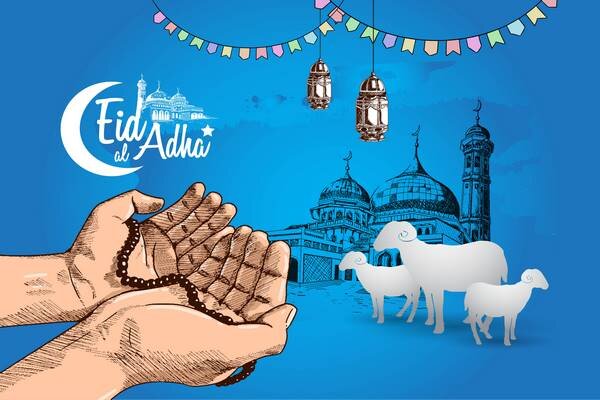
Eid al-Adha, also known as the Eid of Sacrifice, is the second festival celebrated each year by Muslims worldwide after Eid al-Fitr. The festival is being celebrated on the 10th of Zhul Hajj, the last month of the Islamic calendar. Muslims on this day are expected to sacrifice a sheep, a goat, a cow or a camel. The meat of the sacrificial animal is expected to be divided into three portions. The first portion is for the family, the second for friends and relatives, and the last for the needy.
The festival is celebrated to commemorate the spirit of obedience and the sincerity of Prophet Abraham (A.S). It was reported that Prophet Abraham (A.S) had repeatedly dreamt that Allah (SWT) ordered him to slaughter his only beloved son, named Ishmael, as a sacrifice. He informed his wife and, later, his son as well of the development, and they all agreed to obey the order from their Creator.
“And when he reached with him [the age of] exertion, he said, ‘O my son, indeed I have seen in a dream that I must sacrifice you, so see what you think.’ He said, ‘O my father, do as you are commanded. You will find me, if Allah wills, of the steadfast.’” (Qur’an 37:102).
While trying to slaughter his son, Iblis (The Devil) appeared and asked him, how dare he slaughter his son? Abraham (A.S) pelted the devil seven times and then moved to another place to slaughter the son. Here, too, Iblis followed him; he again pelted him with seven stones and moved to the third place. As he was about to put a knife to the neck of his beloved son, Allah (SWT) sent a sheep to replace Ishmael.
“And We ransomed him with a great sacrifice.” (Qur’an 37:107).
What transpired above was one of the numerous tests and challenges Prophet Abraham (A.S) underwent during his lifetime. Recall that Prophet Abraham (A.S) was the son of Aazar, the idol worshipper and seller. At about seven years old, little Abraham started questioning idol worship. He was once reported to have asked his father, “How could you worship what could not help or harm you?”
“O my father, why do you worship that which neither hears nor sees and will not benefit you at all?” (Qur’an 19:42).
He then advised Aazar, in a respectful way, to stop worshipping Iblis and to follow him, and that he would show him guidance.
“O my father, indeed there has come to me of knowledge that which has not come to you, so follow me; I will guide you to an even path.” (Qur’an 19:43).
The father, Aazar, got angry at one point and threatened to stone his little son, Abraham, if he continued asking silly questions.
“He said, ‘If you do not desist, I will surely stone you, so leave me for a long time.’” (Qur’an 19:46)
Furthermore, his community too decided to burn him to ashes as a punishment for destroying their deaf and dumb gods – idols. After setting one of the hottest fires on Earth, the idol-worshippers catapulted Prophet Abraham (A.S) from a far distance into the fire. His prayer was ” HasbunAllahu Wa Ni’imal Wakeel meaning “Allah is enough for me.”
“And whoever relies upon Allah – then He is sufficient for him.” (Qur’an 65:3)
Allah then asked the fire to become cold and peaceful to Abraham (A.S).
“We said, ‘O fire, be coolness and safety upon Abraham.’” (Qur’an 21:69)
The fire had answered the order from its Creator and untied him from the ropes and made him feel comfortable in it. Abraham (A.S) later walked out of the fire majestically without being hurt. The idol-worshippers were shocked and realised that the real Lord was with him, but unfortunately, none of them agreed to follow Abraham (A.S.), only his little nephew, Lot (A.S.). They (Abraham and Lot) decided to migrate (the first migration in the world for freedom of worship) from Iraq, where they were born, to another part of the Middle East.
“Indeed, I will go to my Lord; He will guide me.” (Qur’an 37:99).
When Prophet Abraham (A.S) married his beautiful wife, Sarah and left for Egypt, the King of Egypt, Nimrod, attempted to sleep with Prophet Abraham’s wife, but with supplication and absolute trust in Allah, Sarah was protected, and the arrogant King was paralysed. Allah then gave Prophet Abraham (A.S) Hagar, and then revealed the whole set of laws when Prophet Abraham (A.S) was 80. In the laws, he was ordered by Allah to circumcise himself, which he did without questioning. Prophet Abraham (A.S) prayed to his Lord to grant him a child, and his prayer was answered; he had his first son, Ishmael, through Hagar.
“My Lord, grant me [a child] from among the righteous. So We gave him good tidings of a forbearing boy.” (Qur’an 37:100–101)
They were happy and joyous, but his wife, Sarah, was jealous and wanted Hagar and her child to leave. Allah then ordered Prophet Abraham (A.S) to go and abandon the duo in a desert, the present-day Mecca, when Ishmael was barely a year old.
“Our Lord, indeed I have settled some of my descendants in an uncultivated valley near Your Sacred House, our Lord, that they may establish prayer.” (Qur’an 14:37)
Hagar asked Abraham (A.S) if he was commanded by Allah (SWT) to keep them there? Then Prophet Abraham answered Yes and had his way. Hagar and her son exhausted the bottle of water that Abraham (A.S) gave them. She, therefore, moved back and forth seven times between the mountains of Safa and Marwa to search for help. She later returned to her son, who was starving and dehydrated, to give him shelter. Allah SWT sent angel Gabriel to dig a well known as Zam-Zam at the exact place where little Ishmael was kicking his legs.
The aforementioned were some of the tests and challenges Prophet Abraham (A.S) went through, and he successfully passed them. What are the lessons to be learnt from this Man of Honour? Prophet Abraham (A.S) was a symbol of bravery, as he challenged his father, his community, and the most powerful King of his time – King Nimrod- to abandon their idols and worship Allah, the Creator. Prophet Abraham (A.S) also symbolised sacrifice, patience, perseverance, patriotism, respect, determination, commitment, dedication, trust, truth, justice, sincerity and obedience to Allah at the expense of his happiness.
“Indeed, Abraham was a nation [in himself], devoutly obedient to Allah, inclining toward truth, and he was not of those who associated others with Allah.” (Qur’an 16:120)
The question is: what, then, did he get in return for demonstrating these unique qualities? Allah has declared in the Holy Qur’an, the book in which Prophet Abraham’s name was mentioned 73 times in 25 different chapters, one of which was named after him, that “I shall make you the leader amongst men.”
“Indeed, I will make you a leader for the people.” (Qur’an 2:124)
Thereafter, all the prophets who came after him were from his two sons, Isaac and Ishmael. All the children of Israel, the Jews, Christians and Muslims look up to their father, Prophet Abraham (A.S). He was the only Prophet that Allah (SWT) asked Prophet Muhammad (SAW) to emulate his exemplary lifestyle.
“Then We revealed to you, [O Muhammad], to follow the religion of Abraham, inclining toward truth.” (Qur’an 16:123).
Moreover, the desert Abraham (A.S) abandoned his beloved wife, and his son became the city in which the last and final messenger, Muhammad (SAW), was born. The Masjid built by Abraham (A.S.) and his son, Ishmael, continues to be the direction that millions of Muslims face when performing their prayers. The well of Zam-Zam, dug for his abandoned family, still pumps water which is being drunk by millions of people. The seven-times movement between the mountains of Safa and Marwa, performed by Hagar, is part of the Hajj rites.
Additionally, the three different places he relocated while trying to slaughter his only son, then, Ismael became a place of Ibada known as Jamrats, where every Pilgrim goes and stones the devil seven times as Prophet Abraham (A.S) did thousands of years ago.
Indeed, Prophet Abraham (A.S) was a true leader who, despite the tests, challenges, and calamities that befell him, never turned away from his Lord but rather became more committed and dedicated to his religion, leading by example for us to follow.
The writers can be reached via Ibrahim Aliyu Gurin (ibrahimaliyu5023@gmail.com), Nasir Yusuf Jibril (nasirjibril2018@gmail.com), and Bilyaminu Gambo Abubakar bilyaminugambokonkol01@gmail.com).