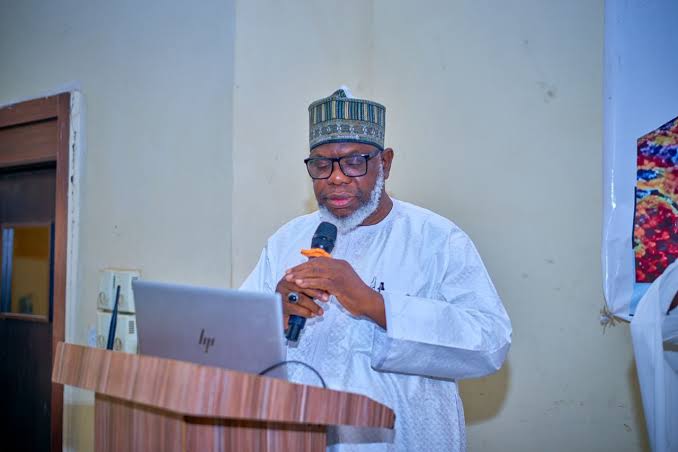
By Kabiru Haruna Isa
In any civilised society, intellectuals, scholars, and men of letters are accorded special recognition, respect, and appreciation because of their intellectual gifts, knowledge, and contributions to society.
The Greek philosopher Plato, in his famous work, The Republic, argued that philosophers should govern society. He maintained that society would only be properly governed when leaders become philosophers or philosophers become leaders. In his view, those who possess wisdom, knowledge, and a proper understanding of justice are best suited to govern society.
Institutions, agencies, and societies led by enlightened individuals are often better managed and function more efficiently. This, however, does not suggest that institutions cannot fail or even collapse under the leadership of those considered enlightened.
It is certainly in pursuit of efficiency and effective service delivery that the current administration appointed Prof. Salisu Shehu as Executive Secretary of the Nigerian Educational Research and Development Council (NERDC), with the responsibility of steering the affairs of the agency and guiding the development of curricula for schools in line with international best practices.
Since assuming office, he has made significant efforts to transform the agency by building on the achievements and legacies of his predecessors while introducing new innovations.
One of his most outstanding achievements is the development and implementation of the History curriculum in primary and secondary schools across the federation. History, as a subject, had been removed from the curriculum of Nigerian schools since the 1980s, a decision that contributed to producing generations of Nigerians with limited knowledge of their history, community identities, national values, and the importance of patriotism.
Alas, despite Prof. Salisu Shehu’s efforts to serve his country diligently and with distinction, some extremists, whose primary interest appears to be the promotion of ethnic and religious bigotry, have embarked on a baseless and unfounded campaign of calumny against his person.
They have questioned his appointment as Executive Secretary of NERDC on the grounds that he authored a book on the Islamisation of Knowledge. Interestingly, these critics have not questioned his competence, intellectual capacity, or integrity. This is perhaps because his credentials as a scholar and his qualifications to head not only NERDC but also similar agencies and institutions are difficult, if not impossible, to dispute.
These are the same elements who criticised Prof. Ishaq Oloyede when he was appointed Registrar of the Joint Admissions and Matriculation Board (JAMB) on 9 August 2016, solely on account of his religious identity and affiliation with the Nigerian Supreme Council for Islamic Affairs (NSCIA).
Prof. Oloyede, however, proved his detractors wrong and went on to become one of the most outstanding, transformative, and transparent registrars in the history of JAMB. He discharged his responsibilities with integrity, humility, transparency, and accountability.
The detractors of Prof. Salisu have succeeded only in exposing their lack of understanding of the curriculum development process. They create the misleading impression that the Executive Secretary personally sits in his office or mosque to determine the philosophy, content, and objectives of the school curriculum.
They should have demonstrated greater intellectual honesty by investigating the institutional processes of curriculum development at NERDC and identifying the individuals involved in it.
To set the record straight, curricula for different subjects are developed by experts drawn from various institutions across the federation. These experts are engaged as resource persons based on their professional expertise, academic qualifications, and knowledge of their respective subject areas, certainly not on the basis of their regional or religious affiliations.
A closer examination of the arguments put forward by Prof. Shehu’s traducers reveals that they inadvertently give him credit by drawing attention to his uncommon intellectual capacity and ability to produce knowledge, rather than discrediting him.
This is an important quality expected of any scholar, particularly one entrusted with the leadership of an educational and research institution such as NERDC.
In effect, the arguments of these detractors further reinforce the qualifications, intellectual competence, and suitability of Prof. Salisu Shehu to head and steer the affairs of NERDC.
[OPINION]: When Knowledge Production Becomes a Crime in Nigeria: A Response to the Discreditors of Prof. Salisu Shehu

ByAdmin
17 November 2026