
By Dr Umar Jibrilu Gwandu
It is common knowledge that the world is experiencing numerous challenges. The Global Peace Index Report of 2025 says that the world has become less peaceful for the 13th time in the last 17 years: more conflicts, more militarisation, and fewer resources for peacebuilding.
Similarly, the 2025 report by the Institute for Economic and Peace says global peace is at its lowest level and that there are now over 122 million people who have been forcibly displaced due to conflicts globally.
In Nigeria, insecurity and economic hardship dominate public discourse. Figures from the Nigerian National Bureau of Statistics (NBS) revealed that 614,937 Nigerians were killed and 2,235,954 others were kidnapped nationwide within a single year in 2024.
Analysts confirmed that the number of people killed in Nigeria in 2024 was higher than the death toll in Israel’s war on Gaza, where over 40,000 had died. The figure is far more than the killings from the long-running Russian war on Ukraine, where 57,500 had been massacred as of December 2024
According to the World Food Programme’s August 2026 Country Briefing, an estimated 36.2 million people in Nigeria are acutely food insecure, with 2.1 million facing emergency levels of food insecurity. The 2022 NBS reports claimed that 133 million people living in Nigeria are multidimensionally poor.
This situation calls for a national prayer to seek divine intervention to complement the efforts of Governments at the state and Federal levels, which have been launching noble initiatives, projects, and programmes to end lingering insecurity and improve the living conditions of Nigerians.
The Glorious Qur’an made it abundantly clear that many afflictions and tribulations are caused by the wrongdoings committed by men, as a test that, peradventure, men may turn to God, who promised them succour afterwards. “Chaos appears in the land and the sea because of the evil deeds which people’s hands have earned, in order to make them taste the flavour of some of their misdeeds – in order that they may come back” (Qur’an 30:41).
Muslims believe that prayer has the spiritual power to overcome compounding and complex situations. “Your Lord has said, ‘Pray to Me, for I shall answer your prayers'” (Qur’an 40:60). For instance, with a “single prayer”, Prophet Moses (A.S.) got comfort, food, accommodation, a job and thereafter a family (Qur’an 28:24 – 27).
Allah has always assured the believers that “when My servants ask you about Me, then surely I am near: I answer the prayer of the suppliant when he prays to Me. So, let them respond to My call, and believe and trust in Me, so that they may be guided.” (Qur’an 2:186).
To strengthen believers in the efficacy of prayer, the glorious Qur’an is replete with stories of Prophets like Zakariya, Ayyub, Yunus (A.S.), among others, who prayed for certain issues and had their prayers answered (Q21:83-90).
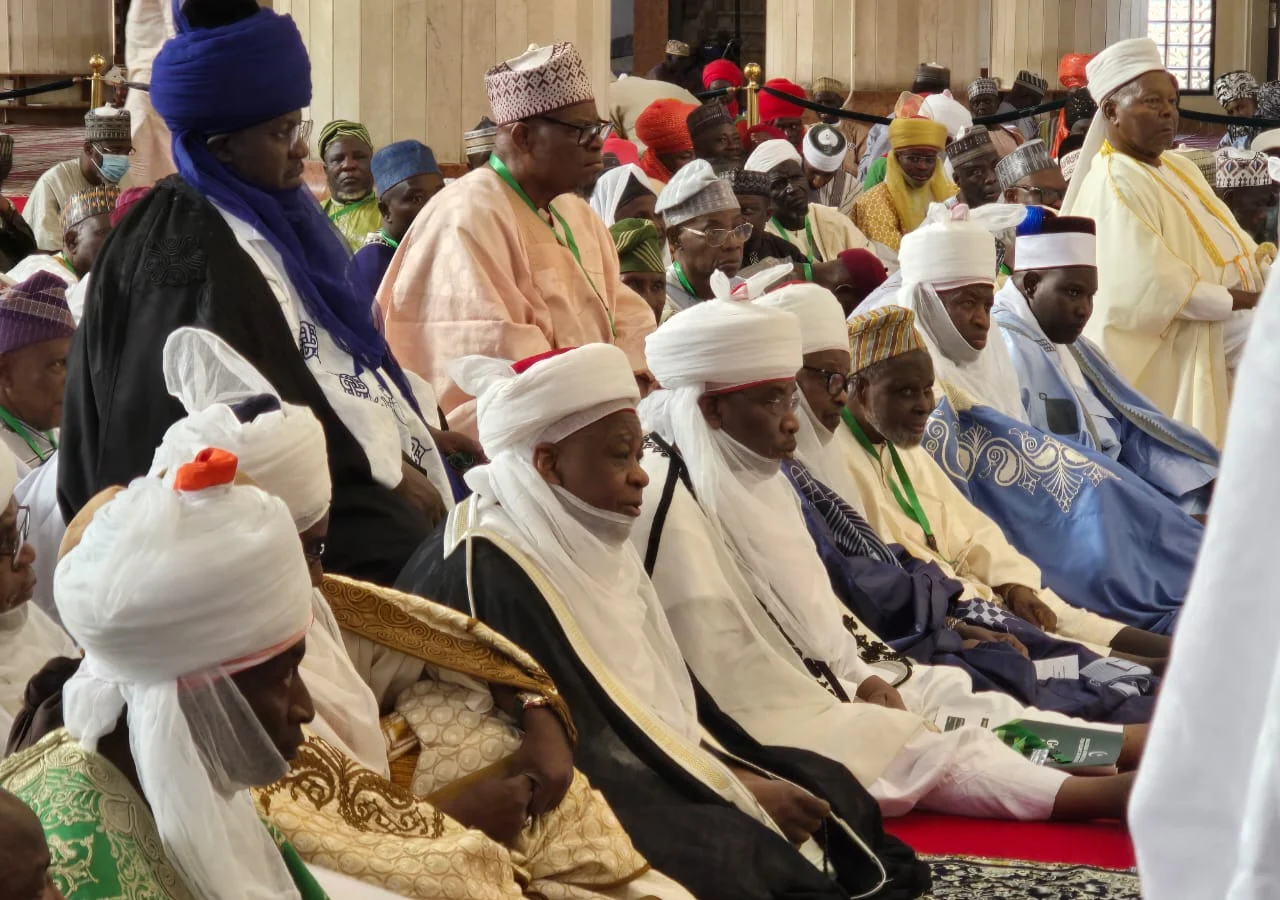
As a demonstration of patriotism embodied in spirituality and faithfulness, the Nigerian Supreme Council of Islamic Affairs (NSCIA), under the leadership of the President General and the Sultan of Sokoto, His Eminence Alhaji Muhammad Sa’ad Abubakar, organised a national prayer for peace, unity and prosperity of our dear country, Nigeria.
The prayer session, preceded by the recitation of the entire Glorious Qur’an, was attended by Chief Imams of the Central Mosques from 36 states of the Federation, representatives of Islamic Organisations in Nigeria, and Muslim leaders from various spheres of life.
The event saw patriotic believers eschewing differences, stripping off their ranks and status, converging on one of the sacred places in the land in awe of God with reverence, praying to God, the Creator of all creation, to grant “our one request: help us to build a nation where no man is oppressed, and so with peace and plenty”
One of the Qur’an’s most powerful lessons is that faith is not passive. Islam does not teach believers to sit and wait without effort. Rather, it teaches Muslims to pray sincerely and act decisively. The central message is that as one raises hands in prayer, one is equally expected to roll up their sleeves and act.
Consider the example of Maryam (Mary) in Qur’an 19:25. In her moment of pain and distress, Allah tells her to shake the trunk of a palm tree. A weak woman, exhausted, shaking a strong tree—this action alone could not bring down dates. Yet Allah wanted to teach believers: make the effort, even when it seems small, and He will bring the result.
Likewise, when Musa (Moses) stood before the sea with danger behind him, Allah commanded him in Qur’an 26:63 to strike the sea with his staff. The sea did not part until Musa acted. Again, the lesson is clear: divine help comes alongside human effort.
Allah reminds us in Qur’an 13:11: “Indeed, Allah will not change the condition of a people until they change what is in themselves.”
This is a call to responsibility. If we seek relief from hardship, we must turn to Allah with du‘a, while also striving to improve our condition.
The story of Nuh (Noah) reinforces the principle of pairing prayer with concrete and decisive action. In Qur’an 11:37, Prophet Nuh (A.S.) was commanded to build an ark long before any visible sign of the flood.
Despite ridicule from his people, he continued his work. His survival, and that of the believers with him, came not merely from prayer, but from obedient and sustained effort.
The Qur’an reassures believers in Qur’an 94:5-6 that “with hardship comes ease.” However, that ease is often reached through a combination of spiritual devotion, patience, and purposeful action.
Equally compelling was the account of Ayyub (Job), a symbol of patience in suffering. After enduring prolonged illness, he turned to Allah in supplication. Yet his healing was linked to action: in Qur’an 38:42, he was told to strike the ground with his foot, whereupon a spring emerged. The narrative highlights that even divine healing may come through human participation.
Beyond individual stories, the Qur’an lays down general principles. In Qur’an 13:11, it states: “Indeed, Allah will not change the condition of a people until they change what is in themselves.” This verse underscores personal and collective responsibility—change requires initiative.
Other prophetic examples expand this theme. Yusuf (Joseph) advised on long-term economic planning during a coming famine (Qur’an 12:47), while Dhul-Qarnayn organised the construction of a protective barrier with collective effort (Qur’an 18:95). Even military discipline is emphasised in the story of Talut (Saul), where restraint and obedience determine success (Qur’an 2:249). The command is to combine reliance with preparedness. Qur’an 8:60 teaches that even with trust in Allah, believers must prepare and act.
Yes, Muslims throughout the country responded positively to the call of His Eminence, the Sultan of Sokoto and offered the National prayer for our country. What is expected is that they would equally rally behind him to implement a carefully crafted action plan, guided by his sagacity and leadership acumen, in line with divine guidance and in conformity with extant laws of the land, for a peaceful and prosperous future that posterity would be proud of.
“Keep working: Allah will behold your works and so will His Messenger and the believers;” (Q9:105).
Dr Gwandu is the National Public Relations Officer of the Nigerian Supreme Council for Islamic Affairs.