By Salmanu Isah
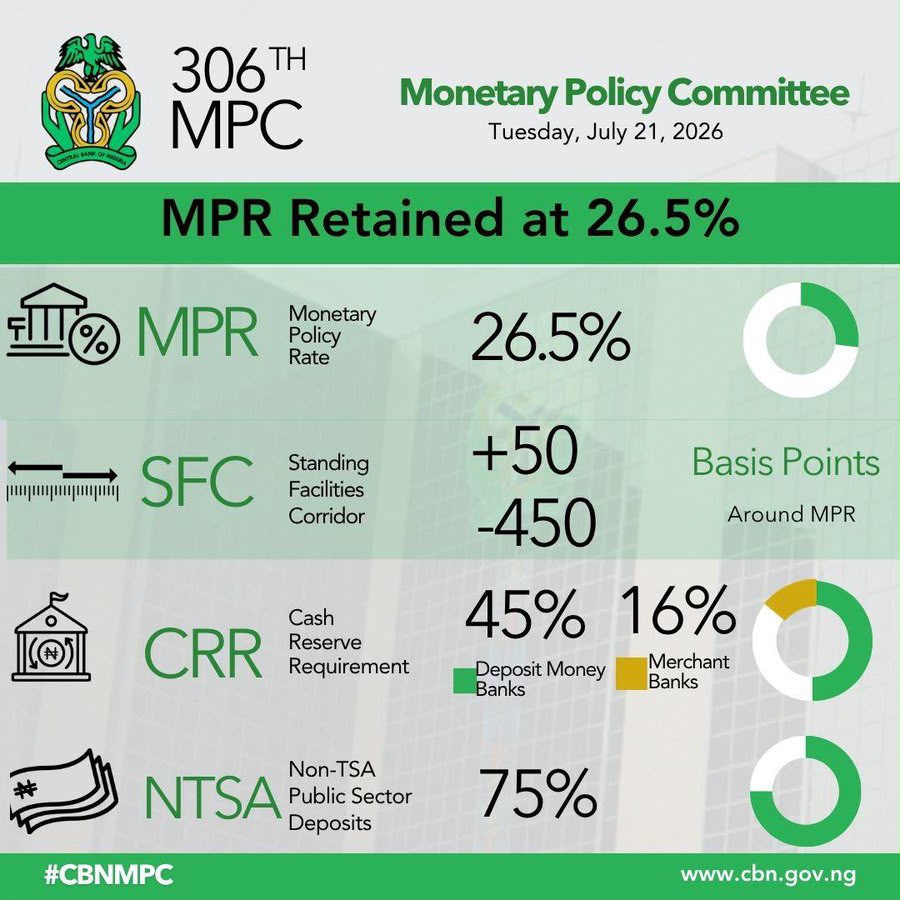
The Central Bank of Nigeria (CBN) has once again demonstrated its preference for caution and stability, opting to retain the Monetary Policy Rate (MPR) at 26.5 per cent despite a gradual easing of inflationary pressures across the country.
At the end of its 306th Monetary Policy Committee (MPC) meeting, the apex bank resisted calls for an immediate adjustment to interest rates, choosing instead to hold all major monetary policy parameters steady. The decision reflects the CBN’s determination to protect the progress made in stabilising the economy while remaining vigilant against fresh threats emerging from the global environment.
For the CBN, the modest decline in inflation is encouraging but not yet sufficient to justify a policy shift. Although headline inflation eased slightly in June and core inflation recorded a more noticeable drop, policymakers remain concerned that renewed tensions in the Middle East could trigger another wave of global price increases, particularly in energy and food markets. Such developments would inevitably have consequences for Nigeria, where imported inflation continues to influence domestic prices.
The Bank’s decision signals confidence in the effectiveness of its previous policy actions. Over the past two years, the CBN has maintained a firm anti-inflation stance, tightening monetary conditions and implementing reforms aimed at restoring confidence in the foreign exchange market. The latest economic indicators suggest that some of these measures are beginning to deliver results.
Exchange rate stability has improved considerably compared to previous periods, helping to reduce pressure on prices. External reserves have also strengthened, rising above $52 billion, providing a significant buffer against external shocks and reinforcing investor confidence in the economy. These developments have given the CBN greater room to maintain its current course while carefully monitoring future trends.
Beyond inflation, the MPC’s statement highlights the growing importance of collaboration between the CBN and the Federal Government. The Committee acknowledged that recent coordination between fiscal and monetary authorities has helped cushion the domestic economy from global disruptions. This recognition reflects a broader understanding that sustainable economic stability cannot be achieved through monetary policy alone.
While the CBN continues to focus on price and financial system stability, the government is expected to complement these efforts through reforms that boost productivity, improve infrastructure, increase oil production and diversify revenue sources. The Committee’s endorsement of ongoing reforms in the oil and solid minerals sectors underscores the need for broader economic transformation beyond monetary interventions.
The banking sector also emerged as a bright spot in the MPC’s assessment. The Committee expressed satisfaction with the progress of the banking recapitalisation exercise, describing it as a significant step towards strengthening the resilience of financial institutions. A stronger banking system not only enhances financial stability but also positions banks to support economic growth through increased lending and investment.
Despite a slight slowdown in economic growth during the first quarter of 2026, signs of resilience remain visible. The non-oil sector continues to drive economic activity, supported by telecommunications, financial services, transportation and trade. The return of the Purchasing Managers’ Index to expansion territory further suggests that business confidence may be gradually improving.
Looking ahead, the CBN appears cautiously optimistic. Inflation is expected to moderate further as the effects of previous monetary tightening continue to filter through the economy and food supplies improve during the harvest season. However, policymakers are clearly unwilling to declare victory too early. The possibility of a prolonged conflict in the Middle East remains a major concern, with the potential to disrupt global markets and reignite inflationary pressures.
Ultimately, the CBN’s latest decision reflects a central bank focused on protecting hard-earned gains rather than pursuing quick wins. By holding rates steady, the Bank is sending a message that economic stability remains its overriding objective. For businesses, investors and households alike, the decision provides a measure of predictability at a time when uncertainty continues to dominate the global economic landscape.
As Nigeria navigates both domestic challenges and external risks, the CBN’s cautious approach suggests that maintaining stability will remain more important than pursuing aggressive policy changes in the months ahead.
Salmanu Isah Darazo is a publisher and policy analyst. He can be reached via Salmanudrz@gmail.com