By Uzair Adam
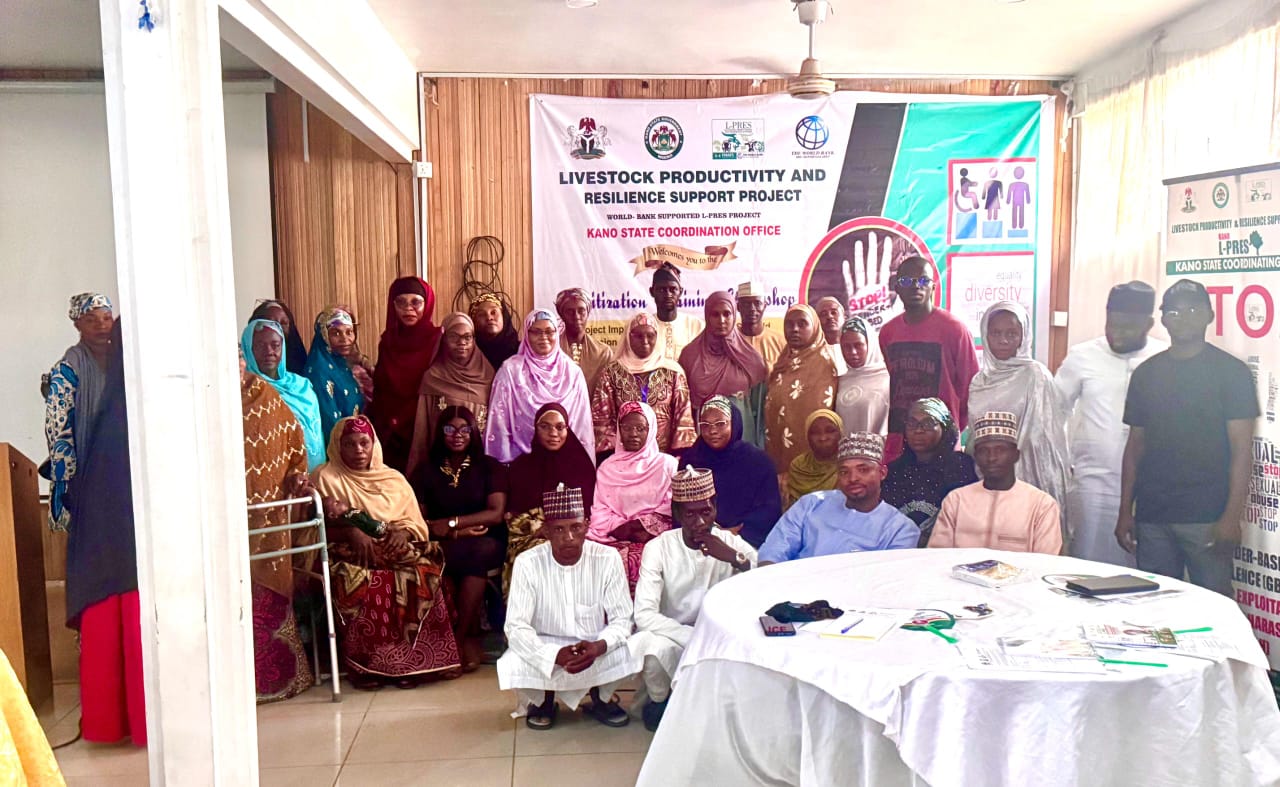
The Kano State Coordination Office of the Livestock Productivity and Resilience Support Project (L-PRES) has trained extension officers and other stakeholders on Gender Equity and Social Inclusion (GESI), Prevention of Sexual Exploitation, Abuse and Harassment (PSEAH), Gender-Based Violence (GBV) and referral pathways.
The workshop, organised under the World Bank-supported livestock development programme, was aimed at strengthening the capacity of project personnel, field extension officers and other stakeholders to promote inclusive and safe livestock development across the state.
Speaking at the event, the Kano State Project Coordinator of L-PRES, Dr. Salisu Inuwa, said the training was organised to equip extension officers with the knowledge required to address gender-related challenges among livestock farmers and pastoral communities.
Represented by the project’s Extension Officer, Gambo Isa Garko, Dr. Inuwa said the project considers gender equity and social inclusion critical to its success because it works directly with livestock farmers and Fulani pastoralists whose livelihoods are shaped by household and community dynamics.
He said the knowledge acquired during the training would be cascaded to farmers and pastoralists across the state to help reduce gender imbalance, encourage mutual respect and foster greater inclusion in livestock production.
“We are saying everybody is important. Let us include women in activities of men, include men in activities of women and respect each other’s opinions in the household,” he said.
Dr. Inuwa said about 96 participants attended the workshop, including 60 extension officers, who are expected to replicate the sensitisation in communities across Kano’s 44 local government areas.
He expressed optimism that the extension officers would reach thousands of farmers directly and indirectly through community-based sensitisation sessions during the lifespan of the project.
The Gender and Gender-Based Violence Officer of Kano L-PRES, Hajiya Ummi Sarki Abubakar, said the workshop formed part of the project’s continuous sensitisation programme to ensure staff and field extension officers understand the World Bank’s safeguards on gender inclusion and the prevention of sexual exploitation, abuse and harassment.
She said participants were also sensitised on referral pathways and the “Do No Harm” Code of Conduct to ensure cases of gender-based violence are handled professionally, without exposing survivors to stigma or discrimination.
“It is the responsibility of every member, directly or indirectly, to uphold these policies to ensure dignity, safety, protection and equal opportunities for all beneficiaries,” she said.
Delivering a presentation on Gender Equity and Social Inclusion, the Director of the Centre for Gender Studies and Livelihood Enhancement at Aliko Dangote University of Science and Technology, Wudil, Dr. Zahra’u Bamali Nouruddeen, said sustainable development can only be achieved when women, youths and other vulnerable groups are given equal access to opportunities and resources.
She said many women remain excluded not because they lack the ability to contribute, but because they are often denied access to information and training that would empower them economically.
“If you don’t call me, if you don’t show me the way, if you don’t train me, how will I know I am important?” she asked.
Also delivering a presentation, Zainab Baba, Social Livelihood Officer and Gender Desk Officer of the Agro-Climatic Resilience in Semi-Arid Landscapes (ACReSAL) Project in Jigawa State, highlighted the importance of referral pathways and codes of conduct in addressing gender-based violence.
She said project personnel must understand where survivors should be referred for appropriate services while ensuring that workplaces and project communities remain safe, inclusive and free from all forms of abuse.
One of the participants, Hajiya Bilkisu Ado Zango, Chief Executive Officer of Media Advocacy for Inclusion and Development, described the workshop as timely, saying it brought issues affecting persons with disabilities into discussions on gender, livestock development and gender-based violence.
She said the awareness created through the training would encourage more persons with disabilities to speak up against gender-based violence and participate actively in development programmes.