
By Sabiu Abdullahi
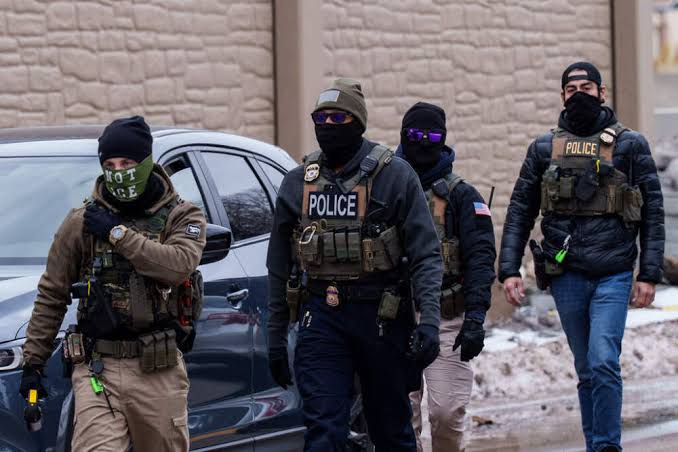
Anxiety has reportedly gripped Nigerian communities across the United States as Immigration and Customs Enforcement (ICE) ramps up its enforcement drive under President Donald Trump’s administration.
The aggressive campaign has pushed some Nigerians off the streets, caused many to lose jobs, and in some cases, prompted quiet, self-arranged returns to Nigeria. Others have gone into hiding to avoid arrest.
Heightened ICE raids, including door-to-door operations, have disrupted daily life for numerous immigrants. Reports indicate that many Nigerians are avoiding work, limiting their movement, and relying on informal or home-based businesses to make ends meet, according to PUNCH.
President Trump launched a renewed effort to arrest and deport undocumented immigrants shortly after his inauguration in January 2025. The policy, which he has consistently defended, has drawn strong criticism from civil rights groups and immigrant advocates. Critics accuse ICE of using excessive force and mistreating detainees.
The enforcement actions have led to deadly incidents. Official figures show that at least 32 people died in ICE custody in 2025, marking the deadliest year for immigration detention deaths in more than twenty years. In 2026 alone, The Guardian of the UK reported that at least eight people have died during encounters with ICE officers.
Recent shootings in Minneapolis, Minnesota, have further escalated fear. Public outrage followed the death of 37-year-old Renée Good, who was shot by an ICE agent on January 7 during an operation. A medical examiner later ruled her death a homicide caused by multiple gunshot wounds. Weeks later, 37-year-old Alex Pretti was also killed during a federal immigration operation in the same city.
Since the crackdown began, about 70,000 people have reportedly been detained by ICE, while roughly 540,000 immigrants have been deported. Sources across the U.S. indicate that the climate of fear has led some Nigerians to abandon regular jobs and make discreet plans to return home.
Social media has captured the human toll of the raids. A Nigerian woman described the panic and grief among immigrants, saying she was traumatised by Pretti’s death, an intensive care nurse at the Minneapolis VA Medical Center. She said ICE agents often ignored legal status during operations.
“It is very traumatising the way these (ICE) people are treating immigrants,” PUNCH quoted her as saying. “President Trump, if you want the immigrants to leave America, tell us. Just come out and say, ‘All immigrants, we want you out, whether you are criminal or not.’”
She added, “These (ICE) people don’t even care. There are a lot of immigrants who are treated like animals, and these people will be telling them, ‘we are citizens’, but they don’t care.”
The woman, who requested to be identified as senior Immigrant, said fear of arrest has driven many Nigerians into online trading and home-based work. She recounted a shop assistant who stopped coming to work in mid-December and a family who left factory jobs after ICE activity in their area.
“My girl, who was working with me in my shop, stopped coming in mid-December. The reason was that she was scared for her life because ICE came to my area,” she said. “The most unfortunate thing was that they came to her area in New Jersey. Since then, she has had anxiety and fear.”
She added, “People are staying indoors because of the fear of ICE. They get family support from those who work. Two weeks ago, someone called me to say that they were donating to support some families, and they requested that I contribute, which I did.”
She said some families now sell goods from home or prepare meals for online orders that customers pick up privately. “There are many people with other serious experiences,” she noted.
Mrs Chris Ademiluyi, President of the Nigerian community in Maryland, confirmed that many Nigerians have chosen to go into hiding rather than return home.
“They are in hiding instead. Nigeria is not any better,” Ademiluyi said. “Some people affected may want to talk anonymously, but they are not talking because of fear.” She added that Nigerian-Americans are largely shielded and that community organisations are providing support where possible.
The situation has also sparked online debate. The Lead Pastor of Lighthouse/Rejuvenation Church in Rosenberg, Texas, Shola Adeoye, cautioned Nigerians against fear-driven decisions in a Facebook post.
“Some Nigerians are moving back home due to fear of this administration. It’s not wise to bury yourself before death,” Adeoye wrote.
Ben Ijeh, a Facebook user, commented, “Whoever that leaves involuntarily by ICE is not psychologically likely to want to come back in the future. The trauma will be too much to bear. God will always make a way for His own.” Another user, Olukunle Durodolu, wrote, “The way ICE agents capture people could be scary; they may not have the opportunity to get themselves together. So, it is preferred to time their return home when they can control themselves.”
Policy changes have compounded the pressure. Mr Gbenga Ogunjimi, Executive Director of the Nigerian Center, a non-profit immigration and cultural organisation in Washington, DC, said the organisation has seen a surge in Nigerians seeking help.
“The problem we are facing is multi-layered. There is a visa ban,” Ogunjimi said. “Before the visa ban, Nigeria was designated as a Country of Particular Concern. That was last year.”
He explained that in December 2025, a partial ban suspended most visa categories, including non-immigrant visas. “What they did not tell those of us in America or Nigerians in America is that the ban will also stop their ability to file for citizenship, green cards, work authorisation, asylum, and things like that,” he said.
Ogunjimi said the Nigerian Center has focused on public education and guidance. “If you go to our website and social media, we put out a policy memo, educating people on the parameters of this ban. We’re just giving information to folks.”
An increasing number of immigrants are considering voluntary departure, Ogunjimi noted. “We’ve seen cases where a lot of people are self-deporting right now,” he said. “Some of them asked if they would be able to come back to the US if they leave.”
In some cases, his organisation advises immigrants not to leave hastily. “They probably came here on a visiting visa… maybe they have overstayed for a couple of days,” he said, adding that waivers may still be possible.
On exact figures, Ogunjimi said, “Do I have numbers of those who have actually gone back, and who have taken the advice? The answer is: I don’t know. I don’t have those numbers.”
As ICE enforcement continues, uncertainty remains the defining reality for many Nigerians in the U.S., caught between fear of arrest abroad and harsh economic and security conditions at home.