By Uzair Adam
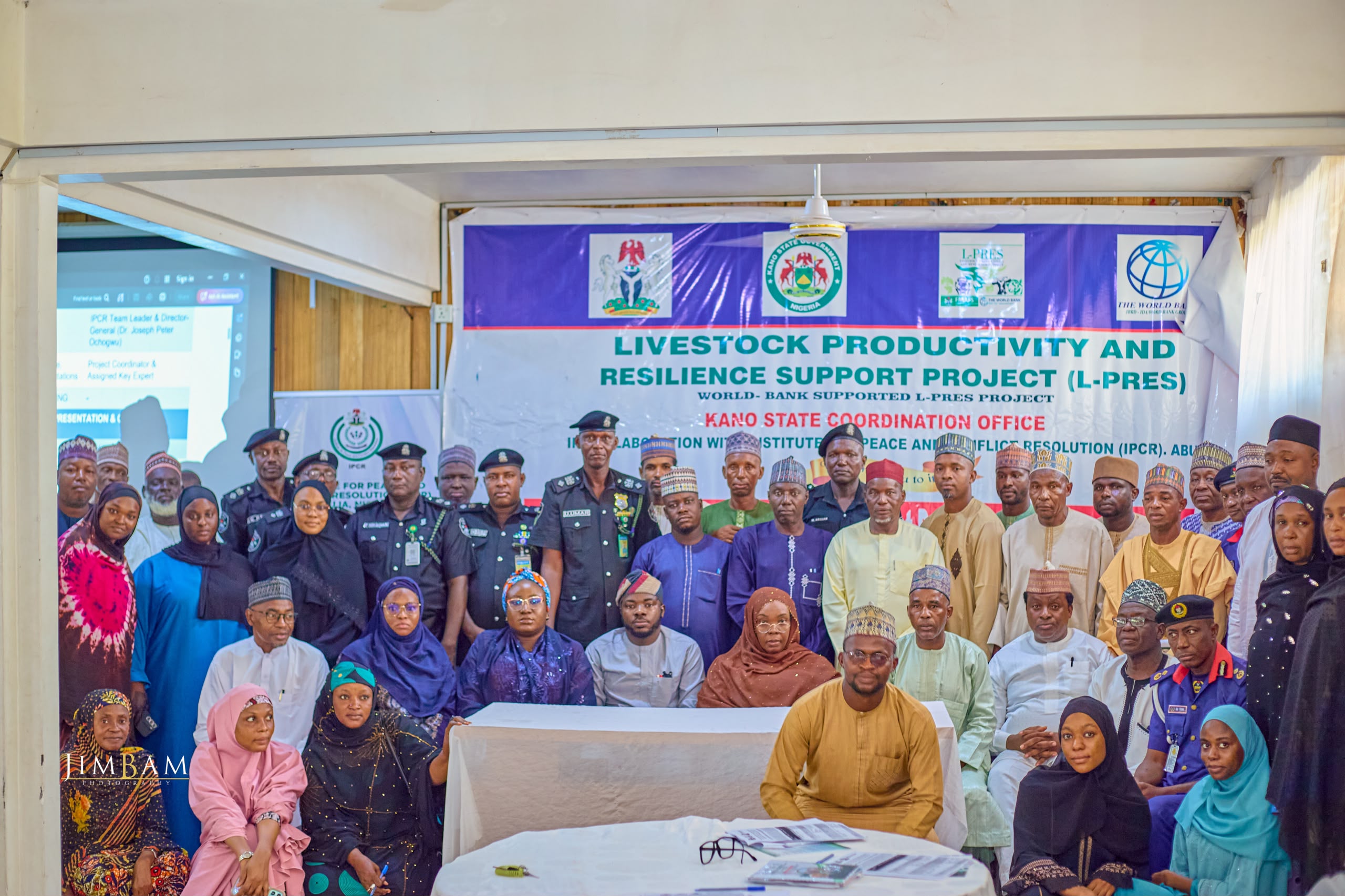
The Kano State Coordination Office of the Livestock Productivity and Resilience Support Project (L-PRES) has commenced a four-day training for key stakeholders on peacebuilding, conflict prevention, management and resolution.
The training, organised in collaboration with the Institute for Peace and Conflict Resolution (IPCR), Abuja, is aimed at strengthening stakeholders’ capacity to prevent conflicts, manage grievances and promote sustainable peace, particularly between farmers and pastoralists.
The Daily Reality reports that the training, which began on Monday, September 7, brought together farmers, pastoralist leaders, security personnel, traditional and religious leaders, government officials, women and youth representatives, among other stakeholders.
The programme focuses on the third component of L-PRES, which deals with crisis prevention and conflict mitigation, with particular attention to conflicts and grievances that could arise from interventions targeting farmers and pastoralists.
Speaking at the event, the Kano State Project Coordinator of L-PRES, Dr. Salisu Muhammad Inuwa, who was represented by the project’s Monitoring and Evaluation Officer, Sule Saleh, said the training was important because development interventions could sometimes create disagreements among beneficiaries and communities if not properly managed.
Saleh explained that L-PRES provides various forms of support to farmers and pastoralists, including interventions involving grazing areas, water and infrastructure, which could sometimes lead to disagreements between the two groups.
He said the third component was therefore designed to prevent or minimise such conflicts and grievances, particularly those arising from interactions between farmers and pastoralists.
According to him, farming and livestock rearing had traditionally coexisted, but the movement of pastoralists in search of grazing land and water could bring them into cultivated farmlands and trigger disputes.
“The programme looks at the reasons why pastoralists move from one location to another. Is it because of inadequate grazing land, lack of water or market-related issues?” he said.
Saleh said identifying the underlying causes of pastoral movement would enable stakeholders to develop appropriate solutions and reduce situations that could escalate into conflicts.
Also speaking, Paul Andrew Gwaza, an official of the Institute for Peace and Conflict Resolution, Abuja, said the institute was collaborating with L-PRES to implement the conflict prevention and mitigation component of the project in 20 states, including Kano.
Gwaza said the training was designed to equip participants with the knowledge and skills needed to facilitate dialogue, mediation and conflict resolution within their communities.
He stressed that the objectives of L-PRES could not be fully achieved in an environment where conflicts and crises continued to disrupt relationships between farmers and pastoralists.
“The essence is that you cannot achieve component one and component two when there are conflicts and crises, especially between farmers and herders, which is affecting livestock productivity,” he said.
He said the participants were also being trained on stakeholder mapping, conflict-sensitive investment, gender and social inclusion to ensure that development interventions promoted unity rather than create divisions within communities.
Gwaza explained that conflict-sensitive investment was particularly important because development projects must be implemented in ways that do not create new grievances or deepen existing divisions among communities.
He added that the programme also sought to ensure that minority groups were not marginalised in the implementation of L-PRES interventions.
On the collaboration between L-PRES and IPCR, Gwaza said the partnership was intended to strengthen peacebuilding efforts and ensure their sustainability beyond the lifespan of the project.
He said the institute was also working with relevant peacebuilding agencies at the state level, where available, to build local capacity and ensure continuity after L-PRES exits.
According to him, the direct beneficiaries of the training include pastoralist and farmer leaders, security agencies, traditional and religious institutions, women and youth leaders and civil servants.
He said the participants would subsequently take the knowledge and skills acquired to their respective communities, making the wider population of Kano State the ultimate beneficiaries.
The training, which is being held under the L-PRES conflict prevention and mitigation component, is expected to strengthen stakeholders’ ability to identify potential sources of conflict, promote dialogue and contribute to peaceful coexistence between farmers, pastoralists and other communities across Kano State.
Kano L-PRES Trains Stakeholders on Conflict Prevention, Peacebuilding

ByAdmin
8 September 2026