By Sabiu Abdullahi
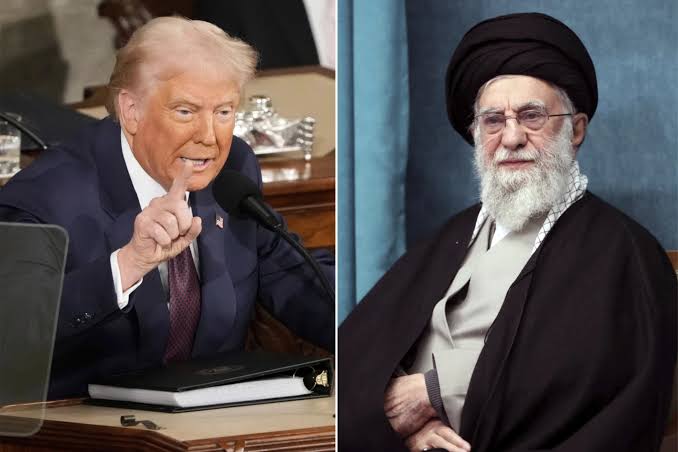
Tensions between the United States and Iran have escalated after US President Donald Trump warned that Washington could resort to military action if Tehran fails to comply with its demands on key security issues.
In remarks made to Israeli broadcaster Channel 12 and published on Tuesday, Trump suggested that the United States was prepared to act forcefully if ongoing efforts to reach an agreement with Iran collapse.
“Either we reach a deal, or we’ll have to do something very tough,” Trump told the news outlet.
His warning came at a time when Iran’s security chief, Ali Larijani, held talks with Oman’s Sultan, Haitham bin Tariq Al Said. Their meeting focused on the outcome of recent discussions between American and Iranian officials.
In the past few weeks, Trump has highlighted the expansion of US military deployments around the region. He disclosed that a “massive armada” had been dispatched to nearby waters. The deployment includes the aircraft carrier USS Abraham Lincoln. Reports by Channel 12 and Axios also indicated that Washington is weighing the option of sending a second aircraft carrier to the Middle East.
The growing military presence has raised fears of a possible US strike on Iran. Critics argue that such action could further destabilise an already fragile region. Earlier on Monday, the United States issued fresh guidance to commercial vessels flying its flag. The advisory urged them to remain “as far as possible” from Iranian territorial waters.
‘With Speed And Violence’
Since January, Trump has intensified pressure on Tehran. He warned that the US military is “locked and loaded and ready to go”.
He drew parallels between Iran and Venezuela, where a US military mission on January 3 led to the removal of former President Nicolas Maduro.
“Like with Venezuela, [the US military] is ready, willing, and able to rapidly fulfill its mission, with speed and violence, if necessary. Hopefully Iran will quickly ‘Come to the Table’ and negotiate a fair and equitable deal,” Trump wrote on social media on January 28.
Toward the end of last month, the Trump administration outlined three broad conditions for Iran. These include halting uranium enrichment, cutting ties with regional proxy groups, and restricting its ballistic missile arsenal. Israel has long pushed for such limits.
During his first presidency, Trump withdrew the United States from the 2015 nuclear agreement that imposed strict limits on Iran’s nuclear programme in exchange for sanctions relief.
After returning to office for a second term in January 2025, he reinstated his “maximum pressure” strategy against Tehran. The campaign features sweeping sanctions and demands to dismantle Iran’s nuclear programme, which Iranian authorities insist is strictly for civilian energy use.
Last June, Trump approved military strikes on three Iranian nuclear facilities during a 12-day conflict involving Iran and Israel.
Focus On Anti-Government Protests
Trump’s renewed threats have coincided with a fresh wave of anti-government protests inside Iran.
Authorities in Tehran responded with a violent crackdown that reportedly left thousands dead. The development drew condemnation from international human rights organisations.
Reports indicated that security forces fired live rounds at demonstrators during an internet blackout.
On January 2, one day before the Venezuela operation, Trump threatened to intervene in support of the protesters and “come to their rescue”, though no such action was eventually taken.
Some analysts believe that proposed US strikes on Iran would do little to assist protesters. They argue that military action would instead align with long-standing US and Israeli objectives of weakening Iran’s military strength.
Iranian officials maintain that armed groups infiltrated the protests and attacked security personnel, leading to the deaths of hundreds of officers. Tehran has also accused foreign powers, including the United States and Israel, of backing the unrest.
While many aspects of the protests remain difficult to independently verify, Iranian authorities have acknowledged that thousands were killed during the government response.
We’ll do ‘something very tough’ if US demands are mot met, Trump threatens Iran

ByAdmin
10 February 2026