By Sabiu Abdullahi
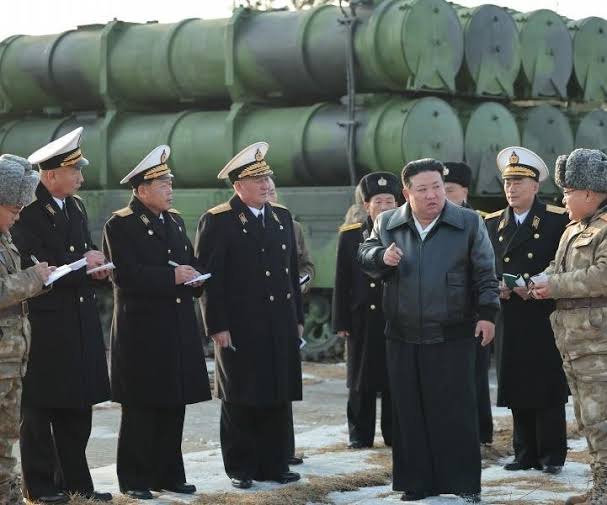
North Korea on Tuesday launched several ballistic missiles into the sea, moves that South Korea and Japan said appeared to involve short-range projectiles, as officials from Washington and Seoul continued discussions on reshaping their joint defence posture against Pyongyang.
According to Reuters, South Korea’s Joint Chiefs of Staff said the missiles were fired from an area near the North Korean capital, Pyongyang, at about 3:50 p.m. local time (0650 GMT). The missiles travelled roughly 350 kilometres (217 miles) before landing in waters off the country’s east coast.
Japan’s coast guard also reported detecting what it described as possible ballistic missiles from North Korea, which fell into the sea minutes after launch. Japanese Prime Minister Sanae Takaichi said the launches posed no impact on Japan.
Japanese authorities said the missiles reached a maximum altitude of 80 kilometres.
In response, South Korea’s Office of National Security called on North Korea to immediately stop ballistic missile launches. It described the action as provocative and a breach of United Nations Security Council resolutions.
Japan issued a similar condemnation, stating that “repeated launches of ballistic missiles…by North Korea threatens the peace and security of our country, the region and the international community”.
“Such ballistic missile launches also violate relevant U.N. Security Council resolutions and constitute a grave issue affecting the safety of the public. Japan has lodged a strong protest with North Korea and strongly condemned these actions,” the statement added.
North Korea has in recent months carried out tests of short-range missiles and multiple-launch rockets. Pyongyang has said these weapons form a central part of its tactical nuclear arsenal, which it claims is meant to counter threats from the United States and South Korea.
Attention to North Korea’s short-range ballistic missiles and artillery has increased after Pyongyang supplied such weapons to Russia for use in the war in Ukraine under a mutual defence pact signed with Moscow in 2024.
Tuesday’s launch came as a senior U.S. Defense Department official visited South Korea. During the trip, discussions focused on modernising the military alliance, at a time when Washington seeks a more limited role in joint defence efforts against North Korea.
North Korea launches ballistic missiles into sea as US, South Korea hold defence talks

ByAdmin
27 January 2026