
By Abubakar Idris
From the beginning of February 2024, there has hardly been a Nigerian daily without a headline about the country’s economic hardship. For example, on Tuesday, 6th February 2024, Premium Times Nigeria reported a ‘protest over economic hardship in Minna – the capital city of Niger State’. Tribute Online, among other news agencies, also reported similar cases with traders in Kogi State and elsewhere. In such a precarious economic climate, no doubt, any additional financial strain is nothing short of a burden.
The cost of living in Nigeria is just too high. It is increasing as the country battles double-digit inflation and multidimensional poverty among most citizens and ranks with the highest unemployment rate. Whether the talk is about the ultra-expensive medication and foodstuff we couldn’t do without buying, or the non-subsidized petroleum and electricity products and services we must patronise, or any other inflated resources of necessity [take out luxury], it is clear that the income from work of an average Nigerian is not close to been enough to scale them out of Maslow’s first stage of Need Hierarchy! From Adamawa to Kebbi, Borno to Lagos, Katsina to Bayelsa, and Sokoto to Akwa Ibom, the distinction in our sociocultural variables exerts little difference on the state of suffering. Everywhere, the story is just the same.
By the look of things, the next generation of Nigerians, one hopes not, will be left with two very difficult options: either ‘not schooling’ or ‘getting education only outside their own country’. This assumption is based on the premise that education in this part of the world is at high speed on its way to its grave. At the same time, relevant stakeholders, especially the government, seem to be walking on a turtle’s back in their effort to reverse the disaster.
As much as this line of thinking sounds pessimistic, it is the only reality one can grasp. In all honesty, any variation from this understanding is, or at least could be taken for, vague. This is because the conclusion is born out of an in-depth analysis of the current situation in which the country found itself.
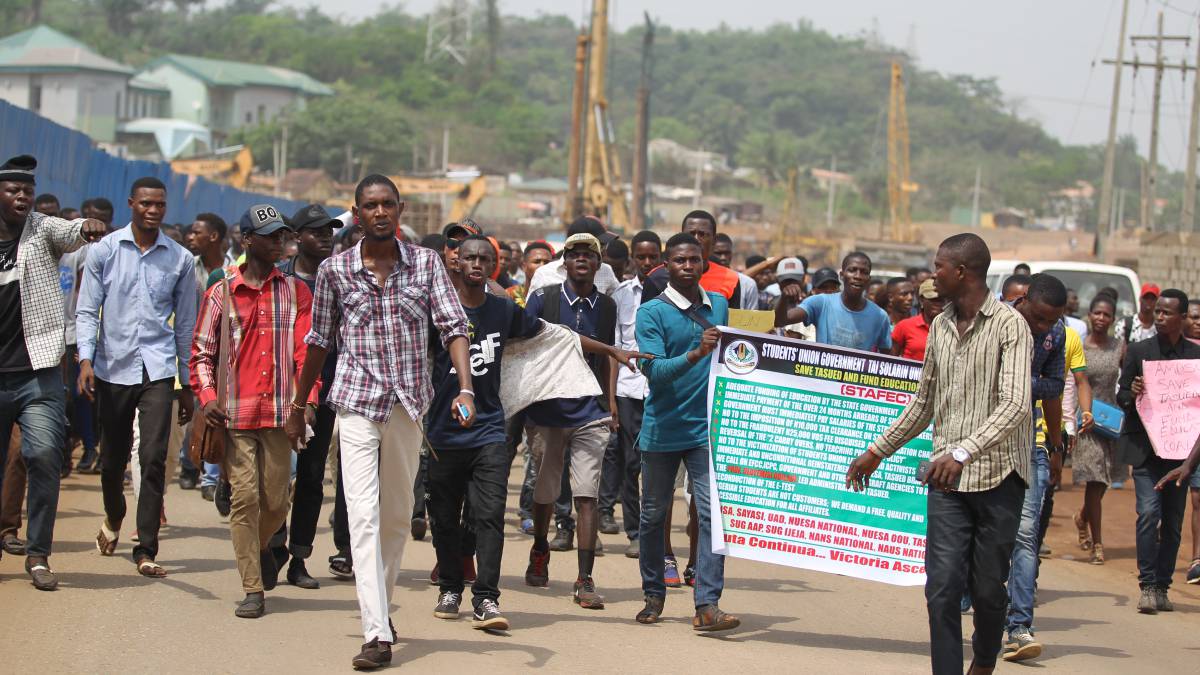
While the Senate summoned ‘economic team’ over the worsening economic situation, as was made known to the general public on Wednesday, 7th February 2024, Punch Newspaper quoted the National Association of Nigerian Students (NANS) as lamenting about “rising inflation and economic hardship” on the same day. It’s a talk about a for-long burning fire in the backyard. Namely, an increase in tuition fees in tertiary institutions. Calling it by its name, it’s a time bomb – one more wrong move and all the huts are burnt down!
After all, this is not the first time the said students’ union has been crying over the worsening Nigerian condition, engaging the nation’s leadership, holding it accountable, and insisting on doing the right thing – particularly regarding their education. The students are too familiar with the terrain to help others navigate it.
On different occasions since early last year, when universities started increasing their tuition fee by at least 200% in the University of Maiduguri and even up to 300% in Ambrose Alli University, Ekpoma, Edo State, NANS and other social activists such as Femi Falana (SAN) keep urging the federal government to reverse the hikes. All in vain! To date, only a few universities have not been affected by such increases. I have since saved my heart by refusing to learn about the number of students who dropped out because of the hikes.
Worth noting is that, for parents, education has always been a top priority. They sacrifice and scrimp to ensure their children receive the best possible education, often compromising and forgoing their own needs. However, the recent spike in school fees has turned this daunting task into an uphill battle. Education is supposed to be the great equaliser, offering every person a chance to succeed regardless of their background. However, this fundamental principle is being undermined by excessive school fees. Education is fast becoming a privilege reserved only for the affluent while the less fortunate struggle to keep up.
Four (4) months ago, nationwide research by the Leadership Newspaper showed a “concern that university education may soon be out of reach of the children of ordinary Nigerians [the concern of which] was prompted by the [hitherto] recent pronouncement by the minister of education, Professor Tahir Mamman, that the federal government will grant full financial autonomy to public universities.” Or, in simpler terms, the government will stop sponsoring the education entities.
Whatever the reasons the universities and government hold for the tuition fee increase, it needs no saying: the timing couldn’t be more inappropriate. At a time when parents are already stretched to their limits financially, the additional burden is pushing many families to the brink of financial ruin. Some parents are forced to make agonising decisions –between paying school fees or putting food on the table, between investing in their children’s future or simply making ends meet.
Moreover, experts believe that the impact of rising school fees extends far beyond the financial realm. It creates a sense of insecurity and uncertainty among students, affecting their ability to focus on their studies and excel academically. It also perpetuates inequality, widening the gap between the haves and the have-nots and depriving countless children of the opportunity to realise their full potential.
In light of these challenges, action must be taken to address the issue of rising school fees – with reversing the recent changes being the most important. Take the so-called ‘Students Loan Act’ out of the equation for a while; government interventions such as subsidies or financial assistance programs are urgently necessary to help alleviate the financial burden on parents and ensure that education remains accessible to all.
Educational institutions also have a role to play by implementing transparent fee structures and exploring alternative funding sources. In case they become autonomous, let there be partnerships between them and the private sector.
Finally, stakeholders at all levels ought to prioritise education and take decisive steps to mitigate the impact of rising school fees. The country’s future depends on it, and we cannot afford to let financial barriers hinder our dreams and aspirations. It’s time to ensure that education remains a beacon of hope and opportunity for every Nigerian, regardless of economic circumstances. Until something is done, the protests witnessed in many institutions from the southern part of the country could translate to a security challenge that promises to consume a great pool of the nation’s young talents. Allah Ya kiyaye!
Abubakar Idris “Misau” is a graduate Forestry and Wildlife from University of Maiduguri. He writes from Yola, Nigeria, and can be reached via mail at abubakaridrismisau@gmail.com.