
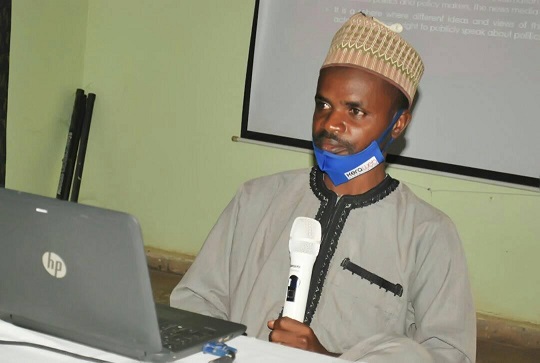
By Kabiru Danladi Lawanti, Ph.D.
Since 2018, when Nigeria’s public universities started announcing hikes in school charges or what is popularly known as service charges, the survival of indigent students in these universities has become threatened. Public universities are the last hope for children from poor backgrounds. According to Emmanuel Onwubiko, the National Coordinator of the Human Rights Writers Association of Nigeria, over 70% of youths from poor backgrounds attend these universities. Therefore, denying these institutions funding is a direct declaration of war on Nigerian youths.
While it becomes necessary for public universities to increase the shortfall in government funding, the increase in school fees means millions of youths will be denied the opportunity to acquire a university education. To say that Nigerian public universities are underfunded is an understatement. That our public universities are in serious crisis is a fact. That universities are unable to achieve the goals of contributing to national development is sadly true.
Two schools of thought exist on this issue. On one hand is the Academic Staff Union of Universities (ASUU), which opposed increasing school fees. Their argument is quite simple: increased school fees automatically mean denying the children of the poor the opportunity to acquire a university education. They argue that there is a need for more citizens to have a university education. The logic is simple: more people with university education in the population automatically translate to positive economic growth, social development, and political cohesion.
To show their seriousness in what they believe in, ASUU had to go on strike several times for several years, starving their members to push forward with this idea. However, there are people who believe education should be removed from social services. They argue that since students are the direct beneficiaries, then the funding of universities should be shifted “from society to the students who are the beneficiaries of the higher incomes their degrees will provide.” These are the advocates of “commodification of university education.”
There are broadly three sources of funding for public universities in Nigeria, as identified by Professor Olanrewaju Fagbohun, the former Vice Chancellor of Lagos State University. These are government grants or subsidies, student/parent contributions (charges fees or allied non-instructional fees) and the income derived by the institution from commercial or quasi-commercial ventures or services, investments, donations, and endowments.
With overpopulation, teeming unemployed graduates, falling standard of university education, corruption in the management of university education and the shift from a mixed economy to a neoliberal economic system since 1986, Nigerian universities are left struggling to survive. Also, the attitude of the people’s government towards education since democracy’s return in 1999 has combined to suffocate the system already in the ICU.
However, in 2017, the universities came to grapple with a very hostile regime under President Buhari. The regime not only cut funding to public universities but imposed an embargo on the recruitment of academic staff in the universities. For over six years now, universities have not employed any fresh staff. Where they are employed, they are imposed on Vice Chancellors from Abuja. Departments no longer have the power to recommend to the VC to retain the best-graduating students in the departments. IPPIS was the last straw that broke the camel’s back. Departments are short-staffed, and IPPIS stopped universities from engaging contract staff, visiting and adjunct lectures and sabbatical staff.
These are the issues that Nigerians need to look at holistically. As it is now, most people have realised the mistake of not supporting ASUU to force the government to investigate the crises of the public universities. The reality clearly shows that indigent students or children from poor backgrounds cannot afford university education. While many analysts gave ASUU strikes the Boko Haram Logic interpretation, no one sees the onslaught on public universities by government agents as “bokoharamisation” of the university education. It is a disservice to Nigeria to remain silent about the current crises confronting the Nigerian public universities and find our voices when ASUU declares strike. This is succumbing to Boko Haram’s wishes. Already, our public primary and secondary schools are in ruins, and it will take the grace of God to resuscitate them. We are now confronted with the collapse of the public university system.
What is the way forward?
Addressing the current crises requires all stakeholders in the Nigerian Educational System. This is a matter of saving Nigeria from collapse. Already, parents have taken 60% of the burden of educating their children in the university. Parents now pay from N50,000 to 250,000 a year for service charges for their children. They provide for their upkeep – accommodation, feeding, laundry, clothing and, of course, purchase of textbooks. Added to that, they take the burden of transporting their children to and from the schools every now and then when the need arises, which can be weekly, monthly, or quarterly. Already, they are involved in funding their children’s education at the university.
The government is supporting universities with infrastructure payments of staff salaries (both academic and non-academic). The government also pays a fraction of the running cost to the universities. TETFUND will not be counted as government funding because it comes from 2% education tax contributions. People in government are leveraging on this and using funding as a weapon of control, as we saw in 2022 when ASUU members were starved for eight months for declaring an industrial dispute with their employer.
Industrial disputes should not be seen as confrontations or a narrow material interest of “greedy lecturers” or “Boko haram logic” of denying Nigerians the opportunity to acquire a university education. It should be seen as a patriotic intervention to salvage a collapsed system.
The commodification of university education in developing nations like ours is never a solution to the lingering crises in the public university system. Commodification destroys “the value of intellectual challenge and exploration by reducing knowledge to quantifiable, job-oriented results”. In fact, commodification is what derives the idea of a “skills rather than degree” gang promoted by a former minister.
I deliberately ignored the push by the present regime of education banks that will serve as lending institutions for university students because it is deceptive, unrealistic, and impracticable in a country like ours. What we need is an acceptable cost-sharing formula that is realistic and acceptable to all stakeholders. And this can come only through negotiation and mutual agreements between university unions, parents, and the government. We need to start this conversation to save our public universities.