By Sabiu Abdullahi
Former President Olusegun Obasanjo has criticised President Bola Tinubu’s defence of government borrowing, describing excessive debt as more damaging than leprosy because its consequences can affect generations yet unborn.
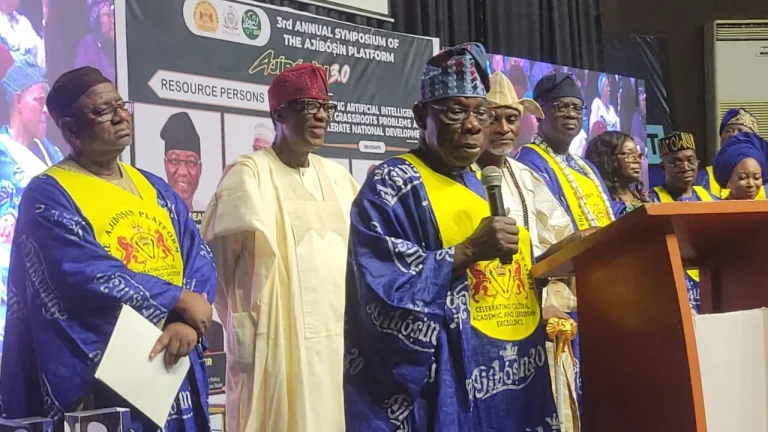
Obasanjo made the remarks on Friday at the third Ajibosin Annual Symposium, held at the amphitheatre of the Olusegun Obasanjo Presidential Library in Abeokuta, Ogun State.
The symposium was themed, “Leveraging Artificial Intelligence to Solve Grassroots Problems and Accelerate National Development.”
Tinubu had recently argued that borrowing was not leprosy, maintaining that his administration was prepared to work hard to repay whatever loans it obtained.
However, Obasanjo dismissed the argument, questioning the country’s growing debt burden and the ability of its leaders to manage the economy.
The former President, who secured a $30 billion Paris Club debt relief for Nigeria during his administration from 1999 to 2007, argued that while leprosy affects an individual, excessive borrowing places the future of entire generations at risk.
“For anybody to say debt is no leprosy is absolute nonsense. Debt is worse than leprosy, because leprosy destroys only one person. Debt destroys generations,” he said.
Obasanjo faults dependence on World Bank, IMF
The former President also criticised the policies of the World Bank and the International Monetary Fund (IMF), arguing that their recommendations were not necessarily designed to advance Nigeria’s development interests.
He questioned why African countries were discouraged from subsidising agriculture while developed countries continued to support their own agricultural sectors.
Obasanjo said Nigeria should develop policies based on its peculiar economic realities rather than blindly adopting recommendations from international financial institutions.
He also expressed concern over what he described as excessive reliance on foreign economic prescriptions, warning that such dependence could undermine the country’s ability to determine its development priorities.
Raises concern over naira depreciation
Obasanjo further lamented the depreciation of the naira, comparing its value against the US dollar when he started his farming business about 47 years ago with its current exchange rate.
He recalled that the naira was stronger than the dollar at the time, questioning how the country had reached a situation where the exchange rate was around ₦1,500 to the dollar.
“What has Nigeria done in 47 years that we now have N1,500 naira to the dollar? What have we done?” he asked.
He also challenged Nigerian leaders to demonstrate their understanding of the country’s economic problems through practical solutions.
Warns against foreign control of artificial intelligence
Obasanjo also cautioned Nigeria and other African countries against adopting artificial intelligence without understanding its implications and ensuring sufficient local control over the technology.
He argued that innovations developed by powerful foreign countries could be exploited against nations that lacked the capacity to regulate and control them.
“I don’t know too much technically about AI. But I know that anything that is not in your control can be abused against you,” he said.
The former President urged Nigeria to determine how artificial intelligence could serve its development priorities instead of allowing foreign interests to dictate the country’s technological direction.
Africa warned against another form of exploitation
Also speaking at the symposium, historian and political commentator, Dr Umar Ardo, warned that Africa could face another form of economic exploitation through artificial intelligence if it failed to control its data, technological infrastructure and intellectual property.
Ardo acknowledged the potential of AI to transform economies and support national development but cautioned that adopting the technology without local ownership and adequate safeguards could reinforce existing economic inequalities.
He traced Africa’s history of economic exploitation from the transatlantic slave trade and colonialism to the post-independence period, arguing that the continent had repeatedly supplied valuable resources while foreign interests controlled the technologies and captured much of the economic benefits.
According to him, the pattern continues today, with African countries exporting raw materials while importing finished products and depending heavily on foreign technology and expertise.
He cited Nigeria’s continued dependence on imported refined petroleum products despite being a major crude oil producer, as well as the reliance of cocoa-producing countries on foreign manufacturers for finished chocolate products.
Ardo warned that data generated from African citizens, businesses, hospitals, farms, languages and public institutions could become another valuable resource extracted and controlled by foreign companies.
He argued that although artificial intelligence presents significant opportunities, Africa must establish ownership of its data and technological infrastructure to benefit fully from the emerging digital economy.
The Daily Reality
Debt Worse Than Leprosy, Obasanjo Tells Tinubu, Warns of Burden on Future Generations

ByAdmin
31 October 2026