By Sabiu Abdullahi
Canada has announced plans to impose fresh tariffs on selected goods from the United States after Washington introduced a 50 per cent levy on about $20 billion worth of Canadian products.
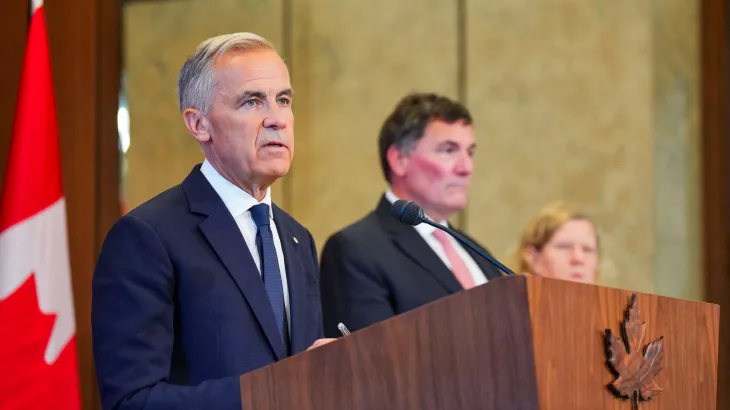
Canadian Prime Minister Mark Carney announced the decision in Ottawa on Saturday, saying the new measures would affect US steel, dairy products, appliances, agricultural equipment, pulp and paper, electronics and other goods.
The tariffs are expected to take effect on September 8.
“Canada will match Washington’s new tariffs dollar for dollar in order to protect Canadian workers, farmers, families, and businesses,” Carney told reporters.
The decision followed the collapse of trade negotiations between the two countries after several days of discussions. Carney said the United States had presented conditions that Canada could not accept.
“In recent days, the United States proposed new terms that were uneconomic, unfair and undermined the net benefits for Canada, and called into question the reliability of any deal,” Carney said, adding these demands included curtailing Canada’s ability to forge new trade deals.
“We cannot accept what they’ve offered, and we will not give what they’ve asked.”
Carney also accused US negotiators of making unacceptable “threats” concerning the French language and “Quebec culture”.
The latest US tariffs affect several Canadian exports, including wine, furniture, dairy products, cement, clothing, fishing rods and hockey equipment. The affected goods represent about 5.5 per cent of Canada’s exports to the US.
Reacting to Carney’s announcement, US President Donald Trump wrote on Truth Social, “Canada wants the benefits of being a State, without being one!!!”
Trump also claimed that Canada had imposed “massive amounts” of tariffs on US farmers for years and added, “No more!!!”
Carney said Canada would also introduce support measures for industries affected by the new US duties. He said the government would provide more details on the retaliatory measures in the coming days.
The trade dispute is expected to put additional pressure on the Canadian economy. Al Jazeera correspondent David Mercer said the tariffs could lead to higher costs, increased prices and rising unemployment.
“Costs are going to go up, prices are going to go up, unemployment is going to go up as well,” Mercer said. “And it’s been warned that business owners – small [and] medium-sized businesses – some of those will have to declare bankruptcy.”
Mercer said Carney was also using the dispute as an opportunity to expand Canada’s economic links with countries outside the United States.
“He’s been around the world, he’s been talking to countries in Asia, in Europe, shoring up new trade relationships, wanting to diversify Canada’s economy and Canada’s trade relationships with other countries around the world just to get away from that dependency that Canada has traditionally had on the United States,” he said.
Ontario Premier Doug Ford supported the Canadian government’s decision to retaliate against the US tariffs.
“I’m glad he didn’t sign that deal because it was a bad deal. It was a bad deal for Ontario. It was a bad deal for the auto sector, the steel sector, and manufacturing sector,” Ford told reporters on Saturday.
Some Canadians have expressed concern about the possible impact of the trade dispute on household expenses.
“I think probably the gas will go up even more, and all products, from food to, I don’t know, wood, everything else,” said Pamela Coulis, a resident of Fort Erie.
Another resident, Stuart Edwards of Port Colborne, said the trade dispute would “hurt everybody” and described the situation as “just sad”.
“We have a bully in Washington, and he’s just hitting us all with the big stick all the time,” he said. “And we’re not going to put up with it; Canada isn’t. We’ll fight back.”
Diamond Isinger, a former special adviser to ex-Canadian Prime Minister Justin Trudeau, said both countries would face economic difficulties as the dispute continues.
“It’s going to cause pain and challenge for Canadians and Americans alike – in terms of the actions that, unfortunately, the US has taken as well as Canada’s retaliation. But ultimately this was the way forward; this was the only realistic next step,” she said.
“Because the US administration responds best, of all the responses that they could have, to all the actions that a government like Canada could take, to strength,” Isinger added.
“So, we could not simply accept 50 percent tariffs going forward. We had to move forward with our own retaliatory package.”
US Trade Representative Jamieson Greer said no fresh negotiations had been scheduled with Canada.
“We’re moving forward with measures that respond to Canadian retaliation,” Greer said. “They’ve always had the best deal, and they still would have an even better deal, but they didn’t want that.”
The escalating dispute has also drawn criticism from some US Democratic lawmakers and governors, who accused Trump of increasing economic pressure on American businesses and families.
“Needlessly picking fights with our allies and raising prices here at home. That’s Trump’s economic policy in a nutshell,” New York Governor Kathy Hochul posted on X.
The Business Roundtable, which represents about 200 chief executives of major US companies, also warned that the new tariffs “risk raising costs for American businesses and families” and called on Canada and the United States to return to negotiations.
Canada to Impose Retaliatory Tariffs on US Goods From September 8

ByAdmin
23 August 2026