
By Sabiu Abdullahi
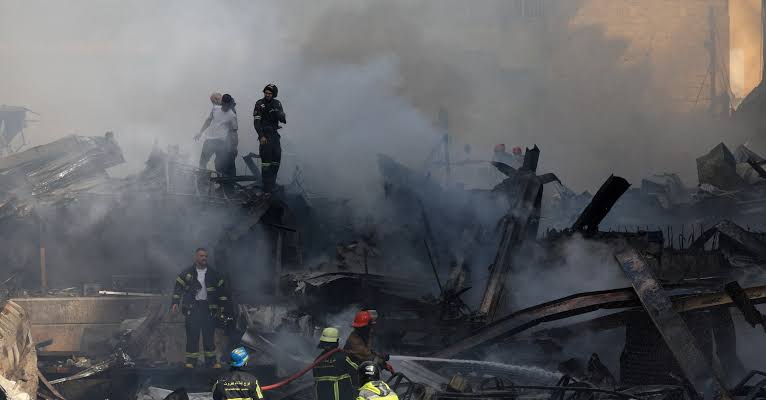
Hundreds of people have been killed and many others injured after Israeli forces carried out a fresh wave of airstrikes across Lebanon, Lebanese Health Minister Rakan Nassereddine has said.
The attacks followed an announcement by the Israel Defence Forces (IDF), which confirmed it had executed what it described as its most extensive coordinated military action in Lebanon since the launch of “Operation Roaring Lion.”
In a message shared on its official X account, the IDF stated, “In 10 minutes, the IDF completed the largest coordinated strike across Lebanon since the start of Operation Roaring Lion.”
According to the Israeli military, more than 100 locations linked to Hezbollah were targeted during the operation. These included “headquarters, military arrays, & command-and-control centers in Beirut, Beqaa and southern Lebanon.”
The IDF added that the strikes also focused on “intelligence command centers and central headquarters used planning terror attacks,” alongside “infrastructure of firepower and naval arrays, responsible for launching missiles.”
It further disclosed that the operation hit “assets of the Radwan Force, & the Aerial unit—Hezbollah’s elite units.”
The bombardment affected several parts of the country, including Beirut, the Beqaa Valley, and southern Lebanon. The scale of the assault marks a sharp escalation in the ongoing hostilities between Israeli forces and Hezbollah fighters.
Lebanese authorities confirmed a high number of casualties. However, they have not provided a precise breakdown of those killed or injured. Emergency teams are still working at multiple sites to rescue victims and assess the damage.
Israel indicated that its military campaign will continue. The IDF said it intends to maintain pressure on Hezbollah due to security concerns in northern Israel.
“We will continue striking the Hezbollah terror organization and will utilize every operational opportunity. We will not compromise the security of the residents of northern Israel. We will continue to strike with determination,” said IDF Chief of the General Staff, Lieutenant General Eyal Zamir, who supervised the operation.
The situation has heightened tensions across the region, with fears growing that the conflict could widen. Cross-border exchanges between Israel and Hezbollah have intensified in recent days.
Israel had earlier stated that it would sustain its strikes on Lebanon despite a two-week ceasefire agreement between Iran and the United States in the broader Middle East conflict.
Several countries have previously urged Israel to halt military actions in Lebanon. Israel, however, maintains that Hezbollah, an ally of Iran, remains a significant threat due to its presence in the country.
Amid the ongoing crisis, Lebanon’s Foreign Affairs Minister, Youssef Raggi, announced a diplomatic move against Iran. He revealed that Lebanon had withdrawn its approval for Iran’s designated ambassador, Mohammad Reza Shibani, and ordered him to leave the country.
In a statement, Raggi said, “I instructed today the Secretary-General of the Ministry of Foreign Affairs and Emigrants to summon the Iranian Chargé d’Affaires in Lebanon to inform him of the decision to withdraw the agrément for the designated Iranian Ambassador, Mohammad Reza Shibani, declare him persona non grata, and request that he leave Lebanese territory no later than 29 March 2026.”