By Uzair Adam
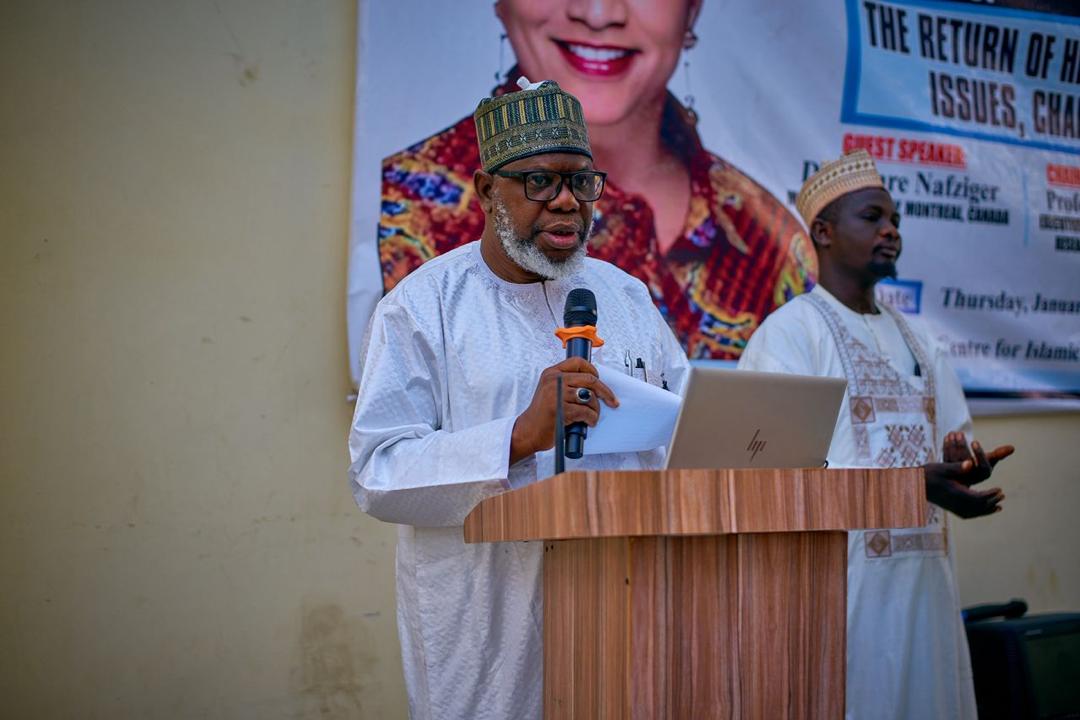
Bayero University, Kano (BUK), on Thursday hosted a public lecture on the reintroduction of History into Nigerian schools, highlighting the issues, challenges and prospects associated with the subject’s return to the national curriculum.
The Daily Reality reports that the Executive Secretary of the Nigerian Educational Research and Development Council (NERDC), Professor Salisu Shehu, served as Chairman of the Occasion.
The lecture, titled “The Return of History in Nigerian Schools: Issues, Challenges and Prospects,” was organised by the Department of History under the Faculty of History and Development Studies.
Dr. Nanre Nafziger, an Assistant Professor of Black and African Studies at McGill University, Canada, delivered the lecture, offering a conceptual explanation of History and its relevance to human and societal development.
In her presentation, Nafziger said History extends beyond common assumptions that limit it to the narration of events, wars or prominent individuals, stressing that it examines how the past shapes the present and how the present influences the future.
She explained that historical knowledge is grounded in patterns and processes that emerge from human and societal evolution, adding that History addresses causation, time, space, consequences and the impact of both human and natural phenomena.
According to her, the discipline also encompasses peoples, communities, societies, geopolitical territories, empires, states and nationhood, as well as norms, values, cultures, traditions and civilizations.
Nafziger noted that History is closely connected to institutions such as politics, the economy, education and technological development, arguing that this interconnectedness makes it a fundamental component of educational content at designated levels.
She said the renewed emphasis on History in Nigerian schools was informed by these considerations, alongside the need to transform and update educational curricula.
Under the revised curriculum, Nafziger explained, History will be taught as a stand-alone subject at the primary level from Primary One to Six, as well as at Junior Secondary School levels One to Three.
At the senior secondary level, she added, History will be infused into compulsory subjects, including Citizenship and Heritage Studies.
She further stated that the new History curricula were developed using new approaches and feature elements that are development-focused, context-sensitive, competency- and outcome-based, thematic and spiral in structure, as well as aligned with 21st-century educational standards.
The public lecture attracted academics, students and other stakeholders, and formed part of ongoing discussions within the academic community on the role of History in national education and development.
BUK hosts NERDC executive secretary, scholars on curriculum, prospects of history’s return to schools

ByAdmin
3 February 2026