By Uzair Adam
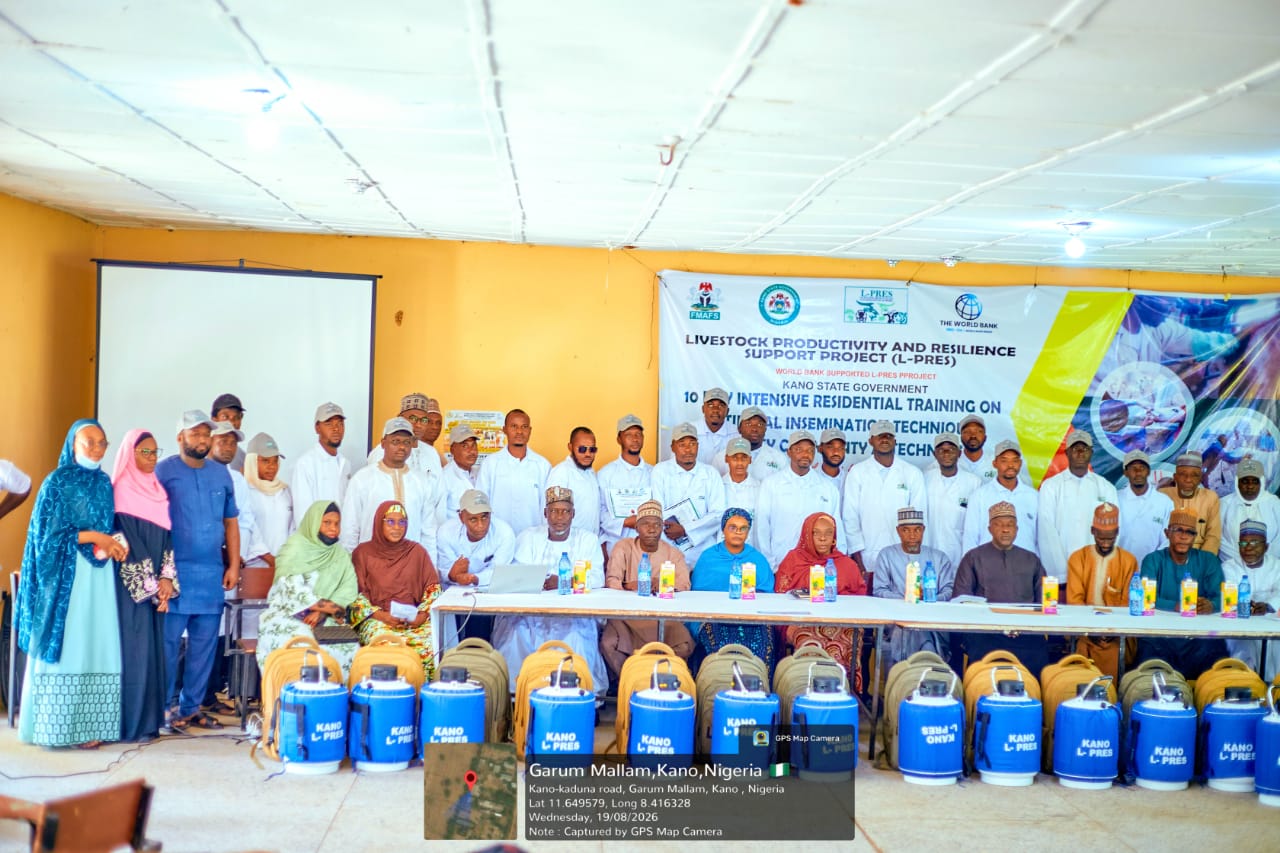
The Kano State Coordination Office of the Livestock Productivity and Resilience Support Project (L-PRES) has concluded a 10-day intensive training for 23 community-based artificial insemination (AI) technicians, with the beneficiaries set to take the skills acquired to livestock-producing communities across the state.
The training, which commenced on August 10, 2026, was held at the Artificial Insemination Centre and Farmer Field School, Kadawa, Kano State, where participants received theoretical and practical training in AI and livestock reproductive management, including semen handling, heat detection, animal selection and insemination of live cattle.
At the end of the programme, the technicians received post-training support packages to enable them to commence and sustain AI services among pastoralist farmers and individual livestock farms across the state.
The Daily Reality reports that twenty-two of the beneficiaries will each cover two local government areas, while Abubakar Muhammad Kabiru, Animal Husbandry Officer with the Kano L-PRES Project, will supervise their activities as the 23rd member of the team.
The deployment forms part of L-PRES’s planned 5,000 artificial insemination exercises across Kano’s 44 local government areas, with the intervention expected to improve livestock breeding, increase milk and meat production, create employment opportunities for youths and strengthen the livestock value chain.
Speaking at the closing ceremony, Dr. Salisu Muhammad Inuwa, State Project Coordinator of Kano L-PRES, said the completion of the programme marked the beginning of the beneficiaries’ responsibility to apply the knowledge and practical skills they acquired in the field.
Inuwa told the trainees that the success of the programme would ultimately depend on how effectively they translate their training into services for livestock farmers and pastoralist communities.
“The real success of this programme, however, will be measured by how effectively you apply these skills in the field,” he said.
He said the post-training support packages were intended to empower the technicians to commence and sustain AI services among pastoralist farmers and individual livestock farms across Kano State and beyond.
The project coordinator urged the beneficiaries to use the resources responsibly, maintain proper records and uphold professional standards in the discharge of their duties.
He further appreciated the technical partners and facilitators for their contributions to the success of the programme, particularly the Aliko Dangote University of Science and Technology (ADUSTECH), Bayero University Kano (BUK) and the National Animal Production Research Institute (NAPRI), as well as the Kano State Government for its continued support.
Inuwa assured the trainees that Kano L-PRES would continue to monitor the utilisation of the support packages and assess the impact of the services provided.
He congratulated the beneficiaries on completing the intensive programme and encouraged them to become worthy ambassadors of improved livestock breeding technology in Kano State.
Speaking on what would be expected of the beneficiaries after the training, Abubakar Muhammad Kabiru, Animal Husbandry Officer with the Kano L-PRES Project, urged the technicians to strictly adhere to the procedures and technical guidelines they were taught.
“We advise these youths, both the females and males, that when they go out to carry out these activities, they should do so diligently as they were taught, adopt the technical guidelines and appropriate techniques, and try to convey the message that was taught to them to farmers across Kano State,” Kabiru said.
He said the technicians would help take AI services closer to livestock-producing communities, particularly farmers and pastoralists who may have limited access to specialised reproductive services.
Kabiru explained that 22 of the technicians would each be assigned to two local government areas, collectively covering the state’s 44 LGAs, while he would supervise their activities.
“Twenty-two of them will go around the 44 local governments. Each of them is assigned to two local governments, and I, as their supervisor, am the 23rd person,” he said.
According to him, the programme is expected to improve livestock genetics, increase productivity and reduce the spread of venereal diseases among animals.
He added that the intervention would create direct and indirect employment opportunities for youths across the state and contribute to internally generated revenue.
Kabiru said L-PRES would engage the technicians in implementing its planned 5,000 artificial insemination exercises, while their continued fieldwork would further sharpen the skills acquired during the programme.
He expressed optimism that the programme could eventually surpass the initial target as the technicians gain experience and expand access to AI services across the state.
Also speaking, Hajiya Rabi Ibrahim Waya, Permanent Secretary, Kano State Ministry of Livestock Development, described the initiative as part of the government’s efforts to strengthen the livestock value chain while creating economic opportunities for young people.
Waya said artificial insemination would contribute to economic diversification by improving livestock production and opening up employment opportunities for youths.
“This will increase the value chain of the livestock, at the same time provide employment opportunities for our teaming youth, as well as the economic growth of the state. That is the essence of it,” she said.
She commended L-PRES and other stakeholders for supporting the programme and assured the beneficiaries of continued government assistance as they begin their assignments.
Waya described the 23 technicians as the first set of beneficiaries and said more young people would benefit from similar programmes.
“This is just the beginning. They are the first set and, Insha Allah, soon many more will follow them,” she said.
She added that the state government had several training and development programmes aimed at engaging youths and ensuring that its interventions produced tangible results across Kano.
One of the beneficiaries, Rukayya Usman Umar, said the programme had significantly improved her knowledge despite having received AI training previously.
“I can say I have achieved a lot, both on the theoretical part and the practical aspect. In fact, I was trained before, but this training is one of the best. I have learned a lot,” Umar said.
She pledged to apply the knowledge acquired and contribute to the success of the L-PRES programme.
“I am very ready and I promise L-PRES that I will never let them down. I will try all my possible best to do my work,” she said.
However, Umar identified transportation and the need for assistance as challenges that could affect female technicians when visiting farms and rural communities.
She appealed for motorcycles to enable the technicians to reach their destinations and provide AI services more effectively.
“For us as females, we will have to have an assistant that will be assisting us when we are going to the farm. We also have the challenge of transportation. We really need a motorcycle so that it can help us to go to our destination to do our work,” she said.
The completion of the programme marks the transition from training to field implementation, with the beneficiaries expected to provide community-based AI services across Kano’s 44 local government areas.
The intervention is expected to support livestock genetic improvement, boost milk and meat production, create employment opportunities for youths and strengthen the livestock value chain as L-PRES works towards its target of 5,000 artificial insemination exercises across the state.
Kano L-PRES Completes 10-day AI Training For 23 Technicians, Targets 5,000 Inseminations

ByAdmin
24 August 2026