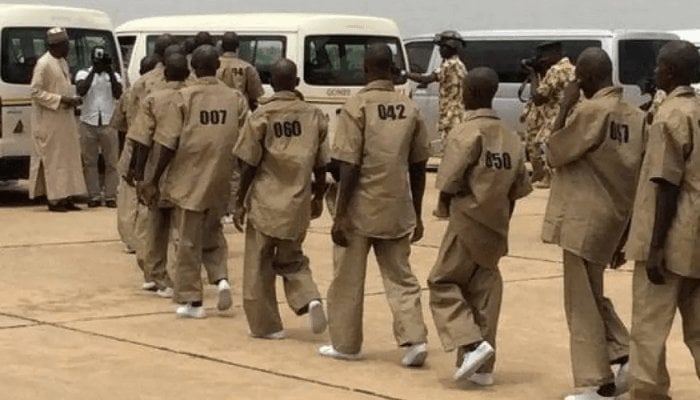
No fewer than 117 former insurgents have concluded the Federal Government’s de-radicalisation, rehabilitation and reintegration programme under Operation Safe Corridor in Borno State.
The development was announced during a high-level stakeholders’ meeting organised by the Defence Headquarters in collaboration with the leadership of Operation Safe Corridor at the Nigerian Army Resource Centre in Abuja.
In a statement issued on Thursday, Samaila Uba, Director of Defence Information, said the coordinator of Operation Safe Corridor, Y. Ali, disclosed that the ex-combatants completed the Disarmament, Demobilisation and Reintegration (DRR) process at the Mallam Sidi Camp.
According to Ali, the meeting focused on finalising arrangements for the transfer of the rehabilitated individuals to their respective national and state authorities for reintegration into society. He noted that the latest development reflects improved cooperation between federal and state governments in the areas of reception, monitoring and community reintegration.
Ali commended the Chief of Defence Staff, Olufemi Oloyede, for what he described as strong leadership and institutional backing. He stated that the progress recorded by Operation Safe Corridor aligns with the CDS philosophy, which promotes enhanced jointness, improved welfare and effective administration within a whole-of-government structure.
He explained that the initiative operates as a multi-agency humanitarian stabilisation programme supported by the 1999 Constitution and relevant international humanitarian and human rights frameworks. The programme draws personnel from 17 services, ministries, departments and agencies.
Since its establishment, he said the initiative has strengthened its screening procedures, reviewed its ideological disengagement modules, enhanced psychosocial recovery systems and expanded coordination among participating agencies. He added that the structure of the programme prioritises accountability, behavioural reform and sustainable reintegration.
Ali also disclosed that the programme has extended to the North-West region. A DRR camp established there in February last year marked what he described as an important stabilisation step. He revealed ongoing discussions with the Zamfara State Government to reposition the facility towards a broader framework that will focus on victim healing, rehabilitation and reintegration, alongside psychosocial recovery, community reconciliation, livelihood assistance and structured monitoring.
He further stated that Benue State has formally requested the establishment of a DRR camp. He said the Defence Headquarters has inspected proposed locations and advised that any approval must align with national standards on infrastructure, security and sustainability.
Ali outlined the objectives of the stakeholders’ meeting. He said participants were expected to define the responsibilities of state authorities and relevant ministries, departments and agencies, develop structured resettlement support systems, determine approaches for community sensitisation and camp visitation, and approve graduation timelines for rehabilitated clients.
The Chief of Defence Staff, represented by Jamal Abdusalam, Chief of Defence Operations, reaffirmed Nigeria’s commitment to a comprehensive government and societal approach to peacebuilding and national recovery. He described Operation Safe Corridor as a vital component of the country’s security framework.
“Since its inception in 2016, operation safe corridor has processed thousands of clients through a controlled and integrity-driven disarmament, rehabilitation and reintegration framework,” he said.
“When properly screened and coordinated, surrender pathways degrade insurgent cohesion, generate actionable intelligence and support long-term stability.”
The meeting attracted representatives from federal ministries, the Office of the National Security Adviser, state governments and neighbouring countries including Burkina Faso, Chad, Niger and Cameroon. International partners such as Norway, the United Kingdom, the European Union, the Foreign, Commonwealth and Development Office, the International Committee of the Red Cross and the International Organisation for Migration were also represented.
117 repentant terrorists complete rehabilitation programme in Borno

ByAdmin
20 February 2026