By Sabiu Abdullahi
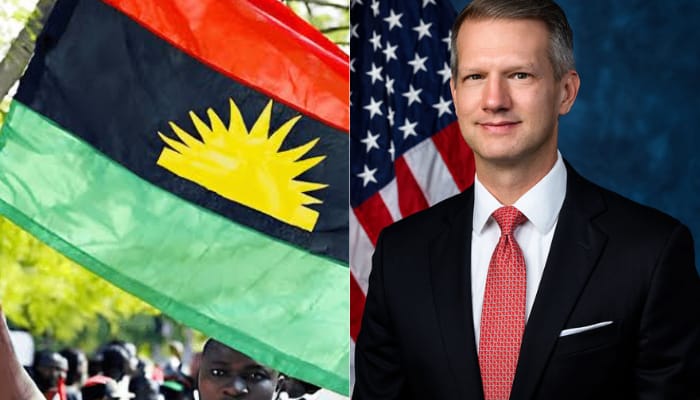
The Indigenous People of Biafra (IPOB) has criticised comments attributed to U.S. Representative Riley Moore concerning Nigeria’s unity, religious persecution, and the movement for Biafran self-determination.
In a statement released on Sunday, Comrade Emma Powerful, IPOB’s Spokesperson and Media/Publicity Secretary, challenged Moore’s view that maintaining Nigeria’s territorial integrity guarantees the protection of Christians.
Moore, who recently concluded a fact-finding visit across Nigeria, warned against the country’s potential balkanisation, arguing that supporting separatist movements could endanger Christians, particularly in the North and Middle Belt regions. According to Moore, his visit included meetings with government officials, church leaders, aid organisations, and Internally Displaced Persons (IDPs) to examine what he described as the “rampant persecution of Christians” in the country.
IPOB, however, described Moore’s position as flawed. “With utmost respect, the position attributed to Rep. Riley Moore reflects a familiar but deeply flawed assumption: that preserving the territorial integrity of Nigeria is synonymous with protecting Christians. History proves the opposite,” the statement said. Powerful highlighted that, over the past six decades, Christians in Northern Nigeria, the Middle Belt, and parts of Yorubaland have faced “cyclical massacres, mass displacement, church burnings, and a culture of impunity enabled by the state itself.”
The group also dismissed Moore’s claim that self-determination “emboldens terrorists,” calling it “a line of reasoning born out of 9 million dollars lobbying enterprise in Washington not reason.” Powerful argued, “terror movements are not triggered by oppressed peoples seeking safety; they flourish where centralized states suppress identity, deny autonomy, and reward violence with appeasement.” He cited Afghanistan as an example where decades of military cooperation and aid collapsed while radical ideology resurged.
Referring to history, IPOB’s statement noted that persecuted religious minorities often survived because independent states provided refuge. “The religiously persecuted Huguenots did not survive Catholic France because France became tolerant. They survived because an independent Protestant England already existed — a sovereign refuge with the political will, military capacity, and moral clarity to protect them. Without Protestant England, there would have been no sanctuary for European Protestants fleeing annihilation,” it read.
Powerful linked this historical context to the current Biafran movement led by Mazi Nnamdi Kanu, describing it as “not a call to violence, nor a scheme to destabilize West Africa as British/Nigerian lobbyists in Europe and USA would have us believe. It is a demand for a democratic referendum, the most peaceful conflict-resolution mechanism recognized in international law.”
The statement added that a restored Biafra “would function as a safe civilizational anchor — a homeland where Christians and people of other faiths from across Nigeria can live without fear, and from which persecuted Christians elsewhere could find refuge and protection.” IPOB also claimed that its emergence has helped reduce attacks on Igbos in Northern Nigeria, stating, “Since the emergence of the IPOB, the once-routine mass killings of Igbos in Northern Nigeria abruptly ceased. That outcome was not accidental. Collective self-assertion created deterrence where decades of appeasement failed.”
While acknowledging the value of security cooperation with the United States, IPOB argued that it addresses symptoms rather than the root causes. “Security cooperation between the United States and Nigeria may manage symptoms, but it has never cured the disease. Repeating a strategy that has failed for generations — while dismissing self-determination as dangerous — is not realism; it is historical amnesia,” the statement said.
Powerful concluded that advocacy for self-determination does not conflict with peace or countering violent extremism. “No serious advocate of peace opposes cooperation against violent extremism. But refusing to acknowledge peaceful constitutional exits, while insisting on the permanence of a demonstrably broken state, guarantees the continuation of persecution rather than its end,” he said.
The spokesperson further argued that an independent Biafra would enhance, not threaten, regional stability. “An independent Biafra, like an independent Protestant England or the State of Israel, would not threaten regional stability. It would create it — by giving persecuted peoples something they have never had within Nigeria: a sovereign place of safety.”
“True concern for Christians — and for all Nigerians — begins with intellectual honesty: forced unity has failed. Safety, dignity, and peace have always followed self-rule, not its denial,” Powerful concluded.
IPOB rejects U.S. lawmaker’s claim that Nigeria’s unity ensures Christians’ safety

ByAdmin
8 February 2026