
By Sabiu Abdullahi
United States President Donald Trump has said Washington has deployed what he described as “a big armada next to Iran” amid rising tensions, while insisting that Tehran’s leadership is still interested in reaching an agreement with the US.
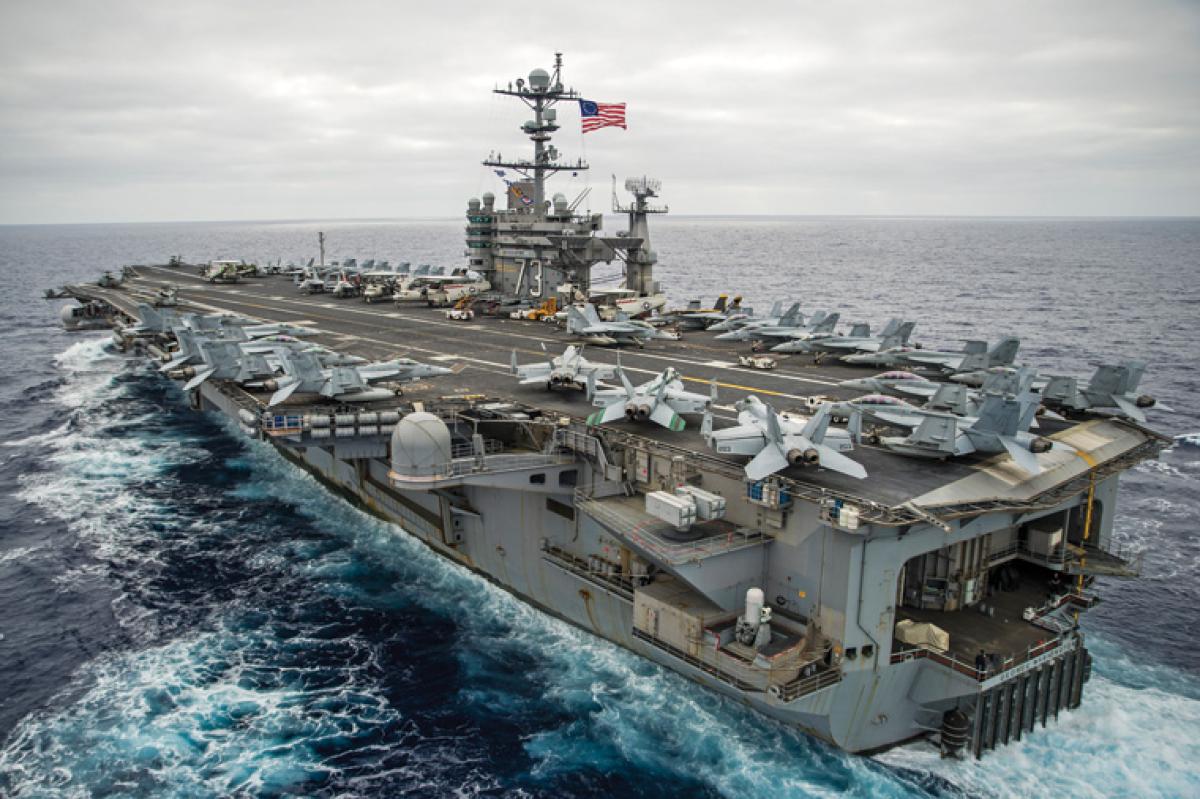
Trump made the remarks during an interview with Axios late on Monday, shortly after the aircraft carrier USS Abraham Lincoln entered the US Central Command’s area of responsibility in the Middle East. The move marked a major escalation in the US military posture close to Iran.
Speaking on the deployment, Trump said: “We have a big armada next to Iran. Bigger than Venezuela.”
He also emphasised that diplomacy remained possible. “They want to make a deal. I know so. They called on numerous occasions. They want to talk.”
According to White House officials quoted by Axios, a military strike against Iran remains an option, although Trump has not taken a final decision. The officials added that the president is expected to hold further consultations this week and assess additional military choices.
Iranian authorities, on their part, have continued to warn of serious consequences if the US launches any attack. The warnings come amid ongoing arrests linked to deadly nationwide protests and a prolonged internet blackout across parts of the country, Aaljazeera reports.
The Islamic Revolutionary Guard Corps (IRGC) has also issued strong signals. In a report carried by Press TV, an unnamed IRGC official said the force is “closely monitoring” US and Israeli actions in the region. The official added that any belief that a strike on Iran would be quick and clean is based on an “incomplete understanding” of Iran’s capabilities. Last week, IRGC commander General Mohammad Pakpour said his forces were “more ready than ever, finger on the trigger,” and urged the US and Israel to “avoid any miscalculation.”
Meanwhile, Lebanon’s Hezbollah has declared it would not remain neutral if Iran is attacked. Hezbollah leader Naim Qassem made the position clear during a televised address delivered via video link at a solidarity event.
Qassem said Hezbollah fully supports Iran and its leadership. He added that any threat against Iran’s Supreme Leader, Ayatollah Ali Khamenei, would be treated as a threat against Hezbollah itself, according to Hezbollah-affiliated Al-Manar TV. Qassem also accused Washington of long-standing hostility towards Iran, saying the US had plotted against the country since the 1979 Islamic Revolution and later pursued conflict through Iraq in the 1980s.
Regional reactions have also emerged. The United Arab Emirates announced that it would not allow its land, airspace or territorial waters to be used for any military operation against Iran. In a statement, the UAE Foreign Ministry said it would also refuse to provide logistical support for such an attack. The Gulf state maintains strong trade ties with Iran, despite regional rivalries and its 2020 normalisation agreement with Israel, which was brokered by the US.
In Tehran, tensions have spilled into public symbolism. Authorities unveiled a massive mural in Enghelab Square that shows a damaged US aircraft carrier with destroyed fighter jets and streams of blood. The caption on the artwork, written in both Farsi and English, reads: “If you sow the wind, you will reap the whirlwind.” Enghelab Square often hosts state-organised gatherings, and officials regularly change its murals to reflect national events.
The developments underline the growing strain between Washington and Tehran, as diplomatic signals continue alongside military deployments and stark warnings from Iran and its allies.