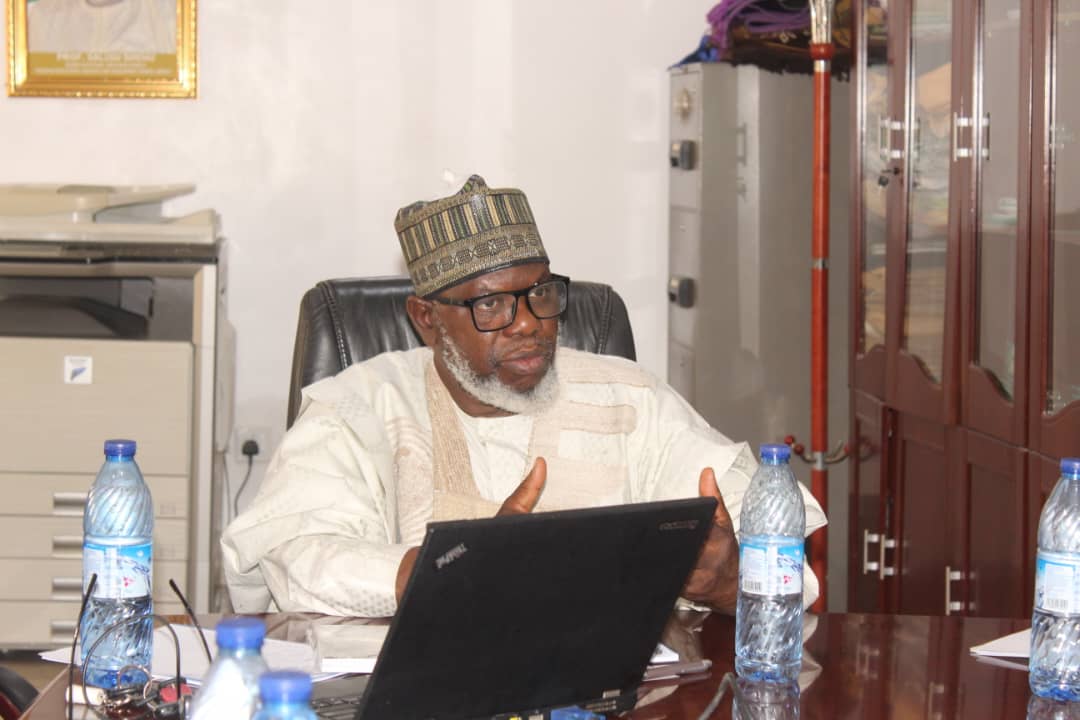
By Murtala Uba Mohammed, PhD
I am writing this piece not merely as a rejoinder to the baseless assertion made by a detracting critic, who claimed that Professor Salisu Shehu, having authored a text on the Islamization of knowledge some three decades ago, has nothing to contribute to Nigeria’s apex curriculum design institution. Such a claim, born out of sheer ignorance and prejudice, ordinarily warrants no reply, as no well-informed observer would take it seriously. Rather, I write to set the record straight and highlight the sterling academic pedigree and exemplary character of a distinguished scholar: Professor Salisu Shehu.
Professor Salisu Shehu stands out among contemporary academics for his gift of eloquence, prolific writing, and mastery of his discipline (Educational Psychology) alongside broad general and religious scholarship. He communicates effortlessly, both in speech and in writing, across three major languages: English, Arabic, and Hausa. This rare combination of rigorous academic training in education and deep familiarity with classical texts makes him an invaluable asset wherever he serves. While his terminal degree and professorship in Educational Psychology directly equip him to steer an institution like the Nigerian Educational Research and Development Council (NERDC), his strong moral grounding shapes his character, earning him widespread respect for the humility and fairness with which he treats everyone, regardless of age, gender, religion, or social background.
Having known him since my undergraduate days in the early 2000s, and later having had the privilege of working alongside him as a university colleague, I have never encountered a single complaint regarding his interpersonal relations, whether from students, academic peers, or non-teaching staff. Moreover, having grown up in the multicultural and multi-religious environment of southern Bauchi State, Professor Shehu possesses an accommodating, tolerant, and cosmopolitan outlook that sets him apart from many of his contemporaries.
As noted earlier, the smear campaign against him collapses under the weight of its own absurdity; it is laughable to suggest that a seasoned Professor of Educational Psychology has nothing to offer a national curriculum development agency. Blinded by bias, his detractors conveniently overlooked Professor Shehu’s core academic credentials, focusing narrowly on his authorship of a book on the Islamization of knowledge, his role as National Coordinator of the International Institute of Islamic Thought (IIIT), and his service as Deputy Secretary-General of the Nigerian Supreme Council for Islamic Affairs (NSCIA).
While these roles are themselves testaments to his intellectual depth and leadership capacity, it is worth reminding the public that Professor Shehu holds all three of his university degrees, Bachelor’s, Master’s, and PhD, in Education. Beyond the classroom, he has served with distinction as a Dean, a Director of Continuing Education at one of Nigeria’s foremost universities (Bayero University, Kano), and the pioneer Vice-Chancellor of Al-Istiqama University, Sumaila.
Before concluding, I wish to clarify what the “Islamization of knowledge” actually represents. Far from dismissing modern scholarship or scientific inquiry, it is simply an intellectual framework aimed at harmonizing Islamic ethical principles with teaching and learning. It guides how Muslims engage with contemporary knowledge through the methodologies and epistemological traditions of Islamic scholarship. In essence, it is no different from the indigenization or decolonization of knowledge, concepts every student of history and education readily recognizes, accepts, and even takes pride in. Yet, when a similar intellectual effort is approached from an Islamic perspective, these detractors suddenly grow uncomfortable. One is left to wonder: is their hostility driven by Islamophobia, sheer ignorance, desperation, or a combination of all three?
Professor Salisu Shehu is a fine scholar, an avid reader, and a deep thinker well-qualified for any position where intellect and experience matter. Endowed with remarkable energy and the capacity to thrive in demanding, multitasking environments, he is precisely the kind of leader an institution like NERDC stands to benefit from; a seasoned academic, capable administrator, public servant, and respected religious scholar rolled into one. Who could be better suited to help shape and guide the development of a curriculum meant to educate and prepare our children and youth? Indeed, at no time has Nigeria needed a leader of such calibre more than now, amid pervasive distractions and national challenges.
My advice to his detractors is simple: sheathe your swords. Professor Shehu is at NERDC to contribute his expertise, not to “Islamize” Nigeria’s curriculum, a feat no single individual, not even the President, could unilaterally accomplish. Rather, his mandate is to guide and coordinate the collaborative work of experts and professors drawn from across both sides of the Niger. Instead of peddling baseless fears, let us channel our collective energy toward more constructive goals: producing quality educational materials, mentoring our younger generation, and praying for a stronger nation that secures a brighter future for our children and youth. That is what Professor Salisu Shehu stands for. And for which he has dedicated nearly three and a half decades of his life to achieving.
With such an enviable blend of expertise in curriculum-relevant psychology, administrative leadership, and unimpeachable integrity, Professor Salisu Shehu is not just qualified for his role at NERDC, he is truly a gift to Nigeria’s education sector.
Murtala is a lecturer in the Department of Geography, Bayero University, Kano.
[OPINION]: Professor Salisu Shehu: A Gift to the Nigerian Educational Research and Development Council

ByAdmin
17 November 2026