By Uzair Adam
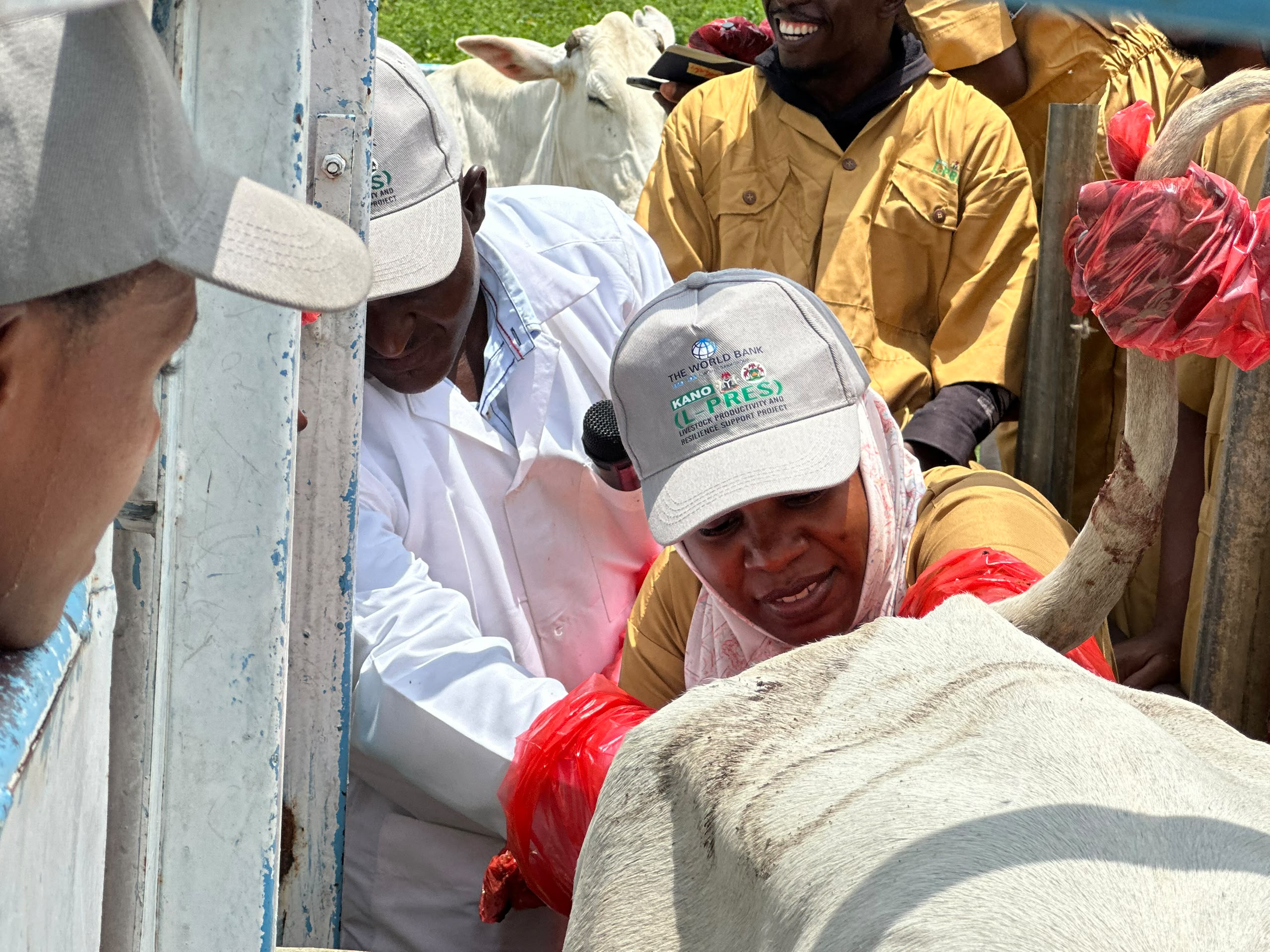
The Kano State Coordination Office of the Livestock Productivity and Resilience Support Project (L-PRES) has commenced the practical phase of a 10-day intensive training for 23 community artificial insemination (AI) technicians, with participants now applying their skills on live cattle.
The Daily Reality reports that the practical sessions, taking place at the Artificial Insemination Centre and Farmer Field School in Kadawa, are designed to equip the trainees with the skills required to provide artificial insemination services to livestock farmers across Kano State.
The training is part of L-PRES’s plan to conduct 5,000 artificial insemination exercises across the state’s 44 local government areas and wards.
The participants are being trained in semen collection, evaluation and preservation, heat detection, selection of suitable animals and the proper insemination of female cattle.
Speaking on the practical sessions, Abubakar Muhammad Kabiru, an Animal Husbandry Officer with the Kano L-PRES Project and supervisor of the training, said the trainees had progressed from classroom lessons to hands-on exercises involving live animals.
Kabiru said the training had reached its seventh day on Sunday, with the participants being assessed on their ability to apply the knowledge acquired during the earlier theoretical sessions.
“From yesterday, which was the sixth day of this training, the participants have been going through a series of trainings. That includes collection of semen, semen evaluation and examination for quality, and inseminating the female animal. Now they are into live animal practicals,” he said.
According to him, the trainees had earlier been taught how to examine the reproductive organs of cattle and correctly pass the artificial insemination gun through the vagina and cervix until it reaches the appropriate part of the uterus where the semen is deposited.
He said experts from the National Animal Production Research Institute (NAPRI), Ahmadu Bello University, Zaria, were leading the practical sessions using the facilities and laboratory at the Kadawa centre.
Kabiru explained that the participants had also been trained to assess semen quality using parameters such as colour, consistency, volume, sperm motility, live-to-dead sperm ratio, sperm morphology and pH.
He added that they had been exposed to techniques for preserving semen in both chilled and frozen forms.
“AI entails three major aspects: collection, evaluation or examination for quality, and artificial insemination of the female cows. They have been taken through these processes and today we are on the live animals,” Kabiru said.
The training supervisor expressed confidence in the participants’ performance, saying their results in the theoretical assessment and practical exercises indicated that they were capable of becoming effective AI technicians.
He disclosed that none of the participants scored below 21 out of 30 in the theoretical assessment, while some scored the maximum 30 marks.
Kabiru added that the resource persons had confirmed that all the trainees were able to successfully pass the AI gun through the reproductive tract during practical exercises, although only some had so far performed the procedure on live cattle.
He said the practical sessions would continue until the training ends on Wednesday.
Also speaking, Isa Muhammad, a trainer from NAPRI, described the participants as committed and enthusiastic, saying they had demonstrated an impressive ability to master the techniques taught during the programme.
Muhammad said the trainees’ ability to quickly learn how to pass the AI gun was evidence of their commitment to the training.
“These students are serious. They are even more than serious. During my service, I could not introduce the AI gun in two minutes, but these trainees can pass the AI gun in five, six, eight or ten seconds,” he said.
He explained that properly trained AI technicians could contribute significantly to improving the genetic quality of livestock and increasing productivity in Nigeria.
According to him, the training also exposes the participants to the use of semen from improved exotic breeds to crossbreed local cattle and enhance their productive capacity.
“This is one of the advantages of livestock production. We want to exchange the local breeds with exotic breeds. Here, we have exotic semen such as Jersey, Brahman and others,” Muhammad said.
He added that the trainees were being taught how to examine sperm cells under a microscope to determine their viability, movement and suitability for artificial insemination.
Muhammad commended L-PRES for providing the equipment and materials required for the training, saying the support would enable the participants to extend AI services to livestock-producing communities across Kano State.
He disclosed that the trainees would be provided with equipment including liquid nitrogen containers, semen straws and hormones used to induce heat in animals, among other materials needed to provide artificial insemination services.
The NAPRI trainer, however, urged the participants to safeguard the equipment and use them for the purpose for which they were provided.
“My message to them is that they should be careful and should not sell the materials and equipment. They should keep them and use them for the work,” he said.
Meanwhile, participants said the practical component of the training had improved their understanding and confidence in artificial insemination.
Faiza Umar Abdulkadir, an AI technician from Kumbotso Local Government Area, described the programme as a refresher course that had expanded her previous knowledge and skills.
She said the training had exposed her to improved techniques in heat detection, animal selection, semen handling and insemination.
“We can say this is like a refresher to us because before now we were AI technicians. But with this training, I got more knowledge about how to inseminate at the first stage and how to detect whether a cattle is in heat,” she said.
Abdulkadir said the practical sessions were particularly useful because participants were taken through semen collection and preservation before moving to heat detection and the actual insemination process.
She stressed that accurate heat detection was essential to successful artificial insemination, noting that a cow must first be confirmed to be in the appropriate reproductive stage before the procedure is carried out.
“For an AI technician, you have to be very conscious about how to select the animal. First, you have to detect whether her uterus is okay for AI because this is something we have to introduce to the farmers,” she said.
She added that the participants had also practised rectal palpation and learnt how to identify the cervix and correctly deposit semen.
Another participant, Anas Abubakar Abdullahi, said the training had equipped him with practical knowledge on selecting suitable animals and choosing appropriate breeds depending on whether the production objective was beef or dairy.
He said the trainees had also learnt how to select suitable bulls, collect semen, process it and preserve it for subsequent use.
“We have learned a lot in that aspect. We are very much grateful to the L-PRES project team for their support and effort in ensuring that we gain knowledge in this area of training,” Abdullahi said.
He said the project had informed the participants that they would receive equipment to enable them to provide AI services in communities across Kano State.
According to Abdullahi, the community-based approach would make artificial insemination services more accessible to livestock farmers and pastoralists while contributing to improved dairy and beef production.
He expressed appreciation to L-PRES for the training and support, saying the participants were prepared to apply the knowledge acquired to improve livestock production in their respective communities.
The ongoing training is expected to expand the pool of community-based artificial insemination technicians in Kano State and support the implementation of L-PRES’s broader livestock productivity programme, particularly its target of carrying out 5,000 artificial insemination exercises across the state.
Kano L-PRES Training Enters Practical Phase as Trainees Inseminate Live Cattle

ByAdmin
17 August 2026