
By Sabiu Abdullahi
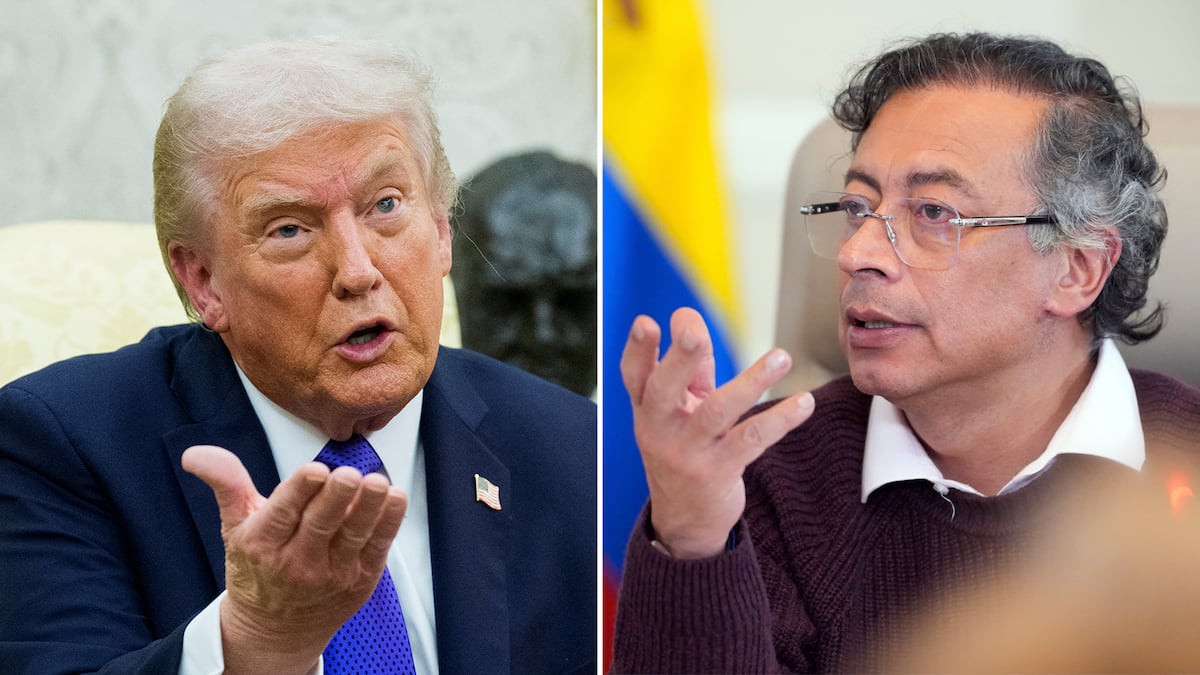
After months of sharp exchanges marked by insults, threats, tariffs and sanctions, United States President Donald Trump and Colombian President Gustavo Petro are set to meet in Washington on Tuesday in what appears to be an effort to ease a strained relationship.
Petro confirmed his attendance after accepting an invitation from Trump last month. The decision followed what both sides described as a cordial phone call that brought an abrupt end to a prolonged public feud.
The talks come at a critical time for the Colombian leader. His administration is seeking to convince Washington that it remains committed to fighting drug trafficking. This follows a recent US military operation in neighbouring Venezuela that led to the arrest of President Nicolás Maduro, whom Washington accused of links to drug cartels. Petro is also pushing for the lifting of US sanctions imposed on him.
Trump said on Monday that he was looking forward to a “good meeting” with his Colombian counterpart.
Petro arrived in Washington on Monday on a special visa. His previous visa had been revoked in September after a speech delivered to a pro-Palestinian audience, during which he urged American soldiers to disobey Trump.
The deterioration in relations began early in Trump’s second term in January 2025, despite Colombia’s reputation as one of Washington’s most reliable partners in the region, especially on security and defence matters.
Tensions flared after the Trump administration launched a mass deportation campaign that involved the use of military aircraft. Some deportees arrived in restraints, a move that angered Petro. He initially blocked two deportation flights and said he would “never allow Colombians to be brought back in handcuffs on flights.”
Later the same day, Petro reversed his decision after Washington threatened tariffs and sanctions. Colombian authorities announced that the country would accept “all” of Trump’s conditions, including the “unrestricted acceptance of undocumented immigrants” who entered the US.
The dispute deepened in March 2025 after US Homeland Security Secretary Kristi Noem claimed that Petro had described members of the Venezuelan criminal gang Tren de Aragua as “his friends” who only needed “more love and more understanding.” Petro denied the claim and blamed a possible misunderstanding on his limited English.
The Trump administration escalated matters in September by decertifying Colombia as a counternarcotics partner. US officials accused Bogotá of failing to meet its obligations, though they said funding would continue. Petro rejected the claim and argued that Colombia was doing its part, while drug consumption remained a US social problem.
“The US decertified us after dozens of deaths among police officers, soldiers, and civilians who were trying to disrupt cocaine trafficking,” Petro said.
Relations worsened further after Petro publicly called on American soldiers to disobey Trump during a visit to New York for the UN General Assembly. He also described Trump as an “accomplice to genocide” in Gaza. In response, the US revoked his visa, citing “reckless and incendiary actions.”
In October, Trump stepped up his criticism and described Petro as a “thug,” while blaming him for drugs reaching the United States. Soon after, the US Treasury imposed sanctions on Petro and several members of his family and cabinet.
“Since President Gustavo Petro came to power, cocaine production in Colombia has exploded to the highest rate in decades, flooding the United States and poisoning Americans,” Treasury Secretary Scott Bessent said.
Petro denied the allegations and vowed to challenge the sanctions. “On the contrary, my government has seized more cocaine than in the entire history of the world,” he said. In November, he made his bank accounts public to demonstrate, according to him, that he had no links to drug trafficking.
The standoff intensified again in December after Trump warned that countries involved in drug trafficking could be “subject to attack.” Petro responded by cautioning Trump against threatening Colombia’s sovereignty and invited him to visit the country.
A turning point came on January 3, 2026, when US forces carried out an operation in Venezuela that resulted in Maduro’s capture. Trump renewed his attacks on Petro soon after.
“He’s making cocaine and they’re sending it into the United States,” Trump said. “So, he does have to watch his ass.”
Trump later added that Petro was “a sick man who likes making cocaine and selling it to the United States, and he’s not going to be doing it very long.”
Petro rejected the remarks and spoke of “taking up arms” if necessary to defend Colombia’s sovereignty. Days later, Colombia’s foreign minister signalled readiness for dialogue with US officials.
On January 7, the two leaders held an unexpected phone call that eased tensions. Petro said the conversation helped calm relations, though he maintained that the US operation in Venezuela was “illegal.” Trump welcomed the exchange and invited Petro to the White House.
Ahead of the meeting, Trump said Petro’s attitude had changed in recent weeks. “He was certainly critical before that. But somehow after the Venezuelan raid he became very nice. He changed his attitude very much,” Trump told reporters.
Colombia’s presidency said the meeting would “define strategic priorities and strengthen lines of cooperation,” while describing Petro’s visit as a “milestone in bilateral relations.”
In addition to the White House talks, Petro’s schedule includes meetings with political, academic and business figures, as well as engagements with members of the Colombian diaspora in the United States.